 такое кино

Between Ash and Chalk: The Anatomy of Suspended Guilt
The Limbo Zone is not a novel in the conventional sense, nor is it merely a collection of short stories. It is a complex, polyphonic statement: a novella in fifteen parts, orbited by eight companion stories, and concluded by a “Song” with a brief postscript. Together, they form a structure resembling a wheel with spokes — or, to use the text’s own metaphor, a seam. It is that very seam by which, in the words of the tailor Noah Goldstein, “the past is sewn to the present, life to death, a name to a body.”
The Premise
Plot-wise, Yuri Melnikov’s new cycle describes the trajectory of one man—SS Untersturmführer Fritz Lang (a clear nod to the figure of Rudolf Höss), adjutant to the commandant of Sachsenhausen and one of the architects of the Nazi camp system. The action begins in September 1939, but in an alternative version of history: World War II does not last six years; it collapses in a matter of weeks. Soviet paratroopers take Rastenburg, Hitler is dead, the Reich is crumbling, and Lang flees from Lviv to the north — toward his wife Helga and their two sons. His path lies through fields of burnt machinery and dead horses, through the farm of an old Ukrainian man, through Auschwitz (in this world, still just a small town with Austrian barracks), through ambush, injury, delirium, a hospital in a sacristy, and finally, through the acquisition of false documents in the name of Hans Weber. His journey leads him further into the grey zone — to Hanover, where time stands still and where Weber is destined to meet the tailor whose workshop he will eventually set ablaze.
This is the narrative arc of the novella. But the novella is merely the centre de gravité around which the stories revolve. Each story grants a voice to another character: the signalman Bremme, the driver Zimmer, the mute farmhand Kasimir (revealed to be a participant in the Gleiwitz provocation), the euthanasia officer Klein, Pastor Schäfer, Lang’s wife Helga, the tailor Goldstein, and finally, the dress — that same blue dress with a white collar that traverses the entire cycle as a symbol of beauty that does not save, but merely covers. Everything concludes with the “Postscript” — an almost anonymous scene on a camp assembly ground, where a woman in a robe dances before a doctor in a white coat, then breaks a piece of bread to share with her friends (Edith Eva Eger, a 16-year-old Hungarian ballerina, did indeed dance for Dr. Mengele in Auschwitz).
Architecture
The first thing to note is the constructive complexity of the whole. The author builds a multi-level system of rhymes, repetitions, and echoes that only reaches its full power upon close reading. Smoke, as a recurring symbol, passes through several stages: the black smoke of burning military equipment, the white ash of crematoria, the transparent smoke of a British officer’s pipe in the Epilogue, and the internal smoke inhaled by Helga in the story “Mother.” The image of the stitch, first appearing in the Prologue (“every stitch is a small decision, a small choice”), unfolds into an entire philosophy of craft in the story “The Tailor,” where it is revealed that the world of this story is not the fabric itself, but specifically the seam. Four shots of vodka on Yarema’s farm, one of which stands before an empty chair, echo in the stories “The Farmhand,” “The Officer,” and “The Pastor,” each time with a new meaning: emptiness as absence, as presence, as a vessel for all the murdered and all the betrayed.
This rhythmic structure is not an ornament but a load-bearing construction. The cycle operates like a musical composition: themes are stated, retreat into the shadows, return in a different key, and intertwine in counterpoint. The nursery rhyme “Wake up, come free, and look around…”, heard in Lang’s delirium, in the Parish of St. Anne, on the platform in Breslau, and in the finale of “The Pastor,” is a kind of cantus firmus — a Greek tragic chorus commenting on the events from a position that cannot be localized: it is either the voices of dead children, the voice of guilt itself, or simply the wind in the radio frequencies.
The Philosophy of Guilt
The central theme of The Limbo Zone is guilt and the impossibility of atonement. But guilt here is understood neither legally nor moralistically, but rather existentially. Each of the eight stories explores its own mode of guilt:
-
Bremme (“The Radioman”): The guilt of the communicator, the man who “only transmitted,” ensuring the communication of the machine; he did not kill personally but was the nervous system of the system. His final “End of Transmission” is both a technical term and an existential sentence.
-
Zimmer (“The Driver”): Guilt through private life, through the inability to see beyond the vibration of the motor where that motor is heading. His dried aster is a symbol of the beauty that the machine ground into mincemeat without noticing.
-
Kasimir (“The Farmhand”): Guilt through the betrayal of the self. The voice that spoke the lie into the microphone at the Gleiwitz radio station—a lie that became the pretext for war—goes mute forever. He is also the only one who could have killed and did not.
-
Klein (“The Officer”): The guilt of the ideologue, the aesthete of evil, the pedagogue who believed that “liberation from suffering is the highest form of discipline.” His final entry, “Lesson Over,” is not repentance, but a statement of fact.
-
Schäfer (“The Pastor”): Guilt through mercy that became lubrication for the machine. The pastor, saving escaped SS men via the Vatican’s “ratlines,” discovers that his faith was not a tool of salvation, but a transfer station.
-
Helga (“The Mother”): Guilt through silence, through the transmission of darkness to children. A woman possessing an ancestral, witch-like gift to “see,” she protects her sons by “pouring” her darkness into them—rendering them invisible to the world, but heirs to her muteness.
-
Goldstein (“The Tailor”): Guilt through witnessing. He who sees the underside of the world and does not tear the seam, but sews it; who gives skin to the executioner just as he does to the victim. His almost biblical position — beyond morality — is precisely what causes the greatest discomfort.
-
The Dress (“The Dress”): The voice of an object that “embraces equally tenderly — the executioner and the victim” and which “remembers everyone — and did nothing.” Indifference as the ultimate form of mercy — or as the final crime.
Critically, Yuri Melnikov never passes judgment. He presents. His method is not a trial, but a dissection of conscience. This is why The Limbo Zone avoids the danger of becoming a moralizing treatise on the tragedy of the Holocaust.
The Image of Limbo
The title of the cycle refers to the Catholic theological concept — a place for souls that have entered neither heaven nor hell. In the author’s mythology, Limbo is the “grey zone,” the space between, the seam between two worlds. In the novella, it is localized geographically (the neutral territory between the occupation zones of Germany), but as the cycle develops, it becomes clear that Limbo is not a place, but a condition. Everyone is in it: Lang, wandering along Bahnhofstrasse to the voice of a ghost-radio reading lists of the living dead; the tailor, sewing the fabric of reality in a basement; Helga, whose lungs are filled with the ash of bodies not yet burned; and the pastor, whose God “locked the door from the other side and gave the keys to those who know how to run through the sewers.”
Limbo is not a punishment. It is a condition of existence in the world after the catastrophe. Or, more precisely, in a world where the catastrophe never stops occurring.
The Boundaries of the Permissible
Despite its high merits, the cycle is not without controversial choices. The direct reference to David Lynch’s film Mulholland Drive (the phrase “No hay banda,” the mention of Club Silencio in the glossary) is a risky technique. It may work as an homage for the initiated reader, but it may also weaken the independence of the artistic world, relegating it to a secondary status relative to another’s masterpiece. However, since the theme of the illusoriness of reality and “a recording instead of a live performance” is organic to The Limbo Zone, the citation does not feel foreign.
Certain plot developments (the letter from H-Sonderkommando in the story “Mother,” the scene in the Vatican basement in “The Pastor”) balance on the edge of the grotesque, but are prevented from falling by the precision of the stylization. Documents from the SS “witch” department are written with the same icy bureaucratic intonation as genuine historical sources.
The cycle demands high concentration from the reader: the non-linear structure, time shifts, and metaphysical layers may seem overloaded upon first reading. Yet this density is justified by the intent: Limbo should not be an easy read.
In certain parts, the intonational constructions (“not because… but because,” “not so much… as…”) approach a mantra, which occasionally slows the dynamics but overall works toward a hypnotic effect, mimicking the functioning of a traumatized consciousness. Real historical details are woven in organically, not disrupting the metaphysical order but reinforcing it. For the unprepared reader, a glossary or an author’s afterword may be required; however, in its current form, the former is already built into the structure and does not overburden the narrative.
Stylistics and Linguistic System
The prose of the cycle relies on dense, tactile metaphors. Leitmotifs (thread/seam/stitch, smoke/ash/chalk, radio/frequencies/silence, blue dress with a white collar, briefcase/documents, clean hands) function not as ornaments, but as load-bearing structures. The language is rhythmized: incantatory repetitions, syntactic parallelisms, and shifts in registers (from bureaucratic reports to the fabric-as-narrator) create a polyphonic effect.
The author masterfully employs intertextuality (Lynch, as well as Kafka and Chamberlain, historical documents, biblical allusions), but rather than quoting, he weaves them into the flesh of the text, forcing the reader to engage with associative layers. The grammatical experiment in “The Dress” (using the neuter gender for the first person: I remembered, I felt, I lived — which in Russian conveys an “it-ness”) brilliantly communicates the ontology of the witness-object, deprived of will but endowed with memory. This is a rare case where a syntactic shift becomes a philosophical statement.
Conclusion
The Limbo Zone is a rare instance where experimental form and deep ethical problems do not contradict but rather reinforce one another. Yuri Melnikov has written a book that simultaneously speaks harshly about the most terrifying aspects of the 20th century and raises questions that extend far beyond the historical context: What is responsibility? Where does the line between mercy and complicity lie? Can one remain clean if they were simply “doing their job”?
This is not “another book about the Holocaust.” It is a book about the mechanics of human indifference, which proves more terrifying than any ideology. It is prose that does not leave one indifferent because it speaks not of the past, but of how the past continues to breathe in the present.
Historical Preface: The Rastenburg Divergence and the Birth of the Grey Zone
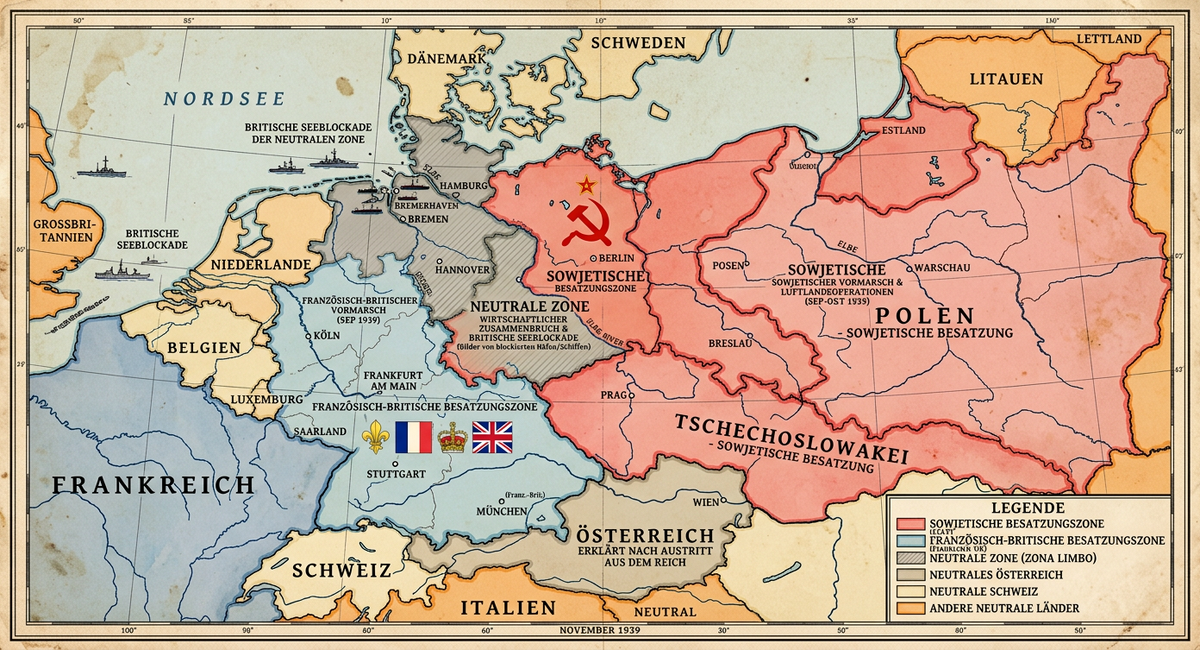
The Rastenburg Incident (September 1939)
The point of divergence occurred in mid-September 1939. A precision Soviet airborne operation targeted the Wolfsschanze (the Wolf’s Lair) near Rastenburg. The successful elimination of the Nazi high command, including the death of Adolf Hitler, triggered an immediate and chaotic structural failure of the Third Reich. The “Thousand-Year Reich” did not burn out in a prolonged siege; it imploded from within as internal power struggles and a sudden lack of central authority paralyzed the German military machine.
The Six-Week War
Hostilities across the European theatre ceased by early October 1939. The resulting power vacuum led to a frantic, uncoordinated race for territory between the advancing Soviet paratroopers from the East and the Anglo-French forces from the West. In this chaos, the front lines did not solidify into clear national borders but into a jagged “Seam” of occupation zones.
The Emergence of the Grey Zone
The “Limbo Zone” (also known as the Grey Zone or the Interzone) emerged as a geopolitical anomaly. It is a stretch of neutral, disputed, or simply forgotten territory — primarily centered around regions like Hanover—where the authority of the victors is nominal at best.
-
Atmospheric Stasis: Time in the Grey Zone feels suspended. It is a place inhabited by those who were “too late” to die and “too early” to be reborn — deserters, refugees with false identities (like Hans Weber), and civilians caught in a permanent state of waiting.
-
The Architecture of the Past: Locations such as Oświęcim (Auschwitz) exist in a state of eerie innocence. In this timeline, the town remains a collection of old Austrian barracks used for transit, yet the metaphysical “smoke” of a genocide that could have been seems to permeate the very soil.
The Metaphysics of the Seam
To the inhabitants of this world, the war was not a victory or a defeat, but a “Rupture.” The survivors are bound together by a collective “suspended guilt” — the feeling of being part of a machine that was stopped just as it began its most horrific work. This is the world where the tailor Noah Goldstein sews the past to the present, and where the dead walk alongside the living through the frequencies of a phantom radio.
Wolf Eisenstadt, specially for Das Schwarze Korps