 такое кино
The Radioman
From the cycle “The Limbo Zone”, Story One
Walter Bremme stepped out of St. Anne’s Cathedral at the exact second the sun began probing the lower edge of a cloud — cautiously, like a finger cautiously probing the edge of a fresh wound. The cathedral loomed behind him, red and ponderous, thrusting its Gothic spire into the gray sky like a syringe into the vein of a dying world. Inside, in the sacristy, Fritz Lang lay in delirium. Pastor Schaefer sat nearby; everything in that scene was crafted from old, desiccated wood: the chair, and the pastor himself. Only the blood remained alive, trickling down the Untersturmführer’s cheek — a thin, scarlet, pulsing thread, the only honest thing left in this world.
Bremme stood on the steps. The radio weighed on his shoulder. Twelve kilograms. He knew this weight to the gram, a memory etched by the greased scales of Oranienburg. For forty-one days, he had carried this altar of communication. Forty-one days at twelve kilograms apiece — four hundred and ninety-two kilograms of cumulative weight pressed into his right collarbone. Counting was his religion. Counting was order, and order was the only thing separating an Aryan signaller from an animal hauling a piece of iron on its back.
He descended. His right boot pinched — the sole was coming loose, and with every step, the wet October mud oozed inside. He felt it: a cold, viscous slush between his sock and his sole, as loathsome as someone else’s spit on his skin.
…
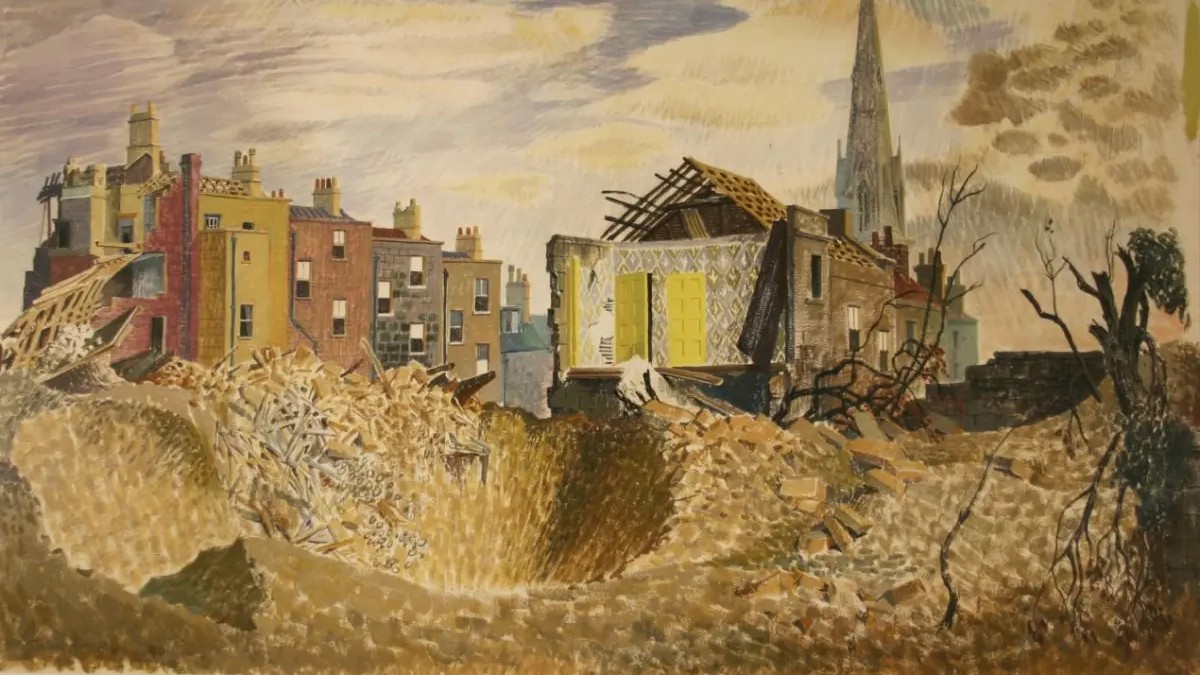
Breslau did not lie before him — it hung, crucified upon the steel skeletons of ruined buildings, like meat on slaughterhouse hooks. Reddish brick dust clogged his pores, turning every breath into a slow suicide. Bremme walked without choosing a path. To stop was to begin waiting, and to wait was to believe that the sky might still answer. But the ether was dead.
He found the coat in a house on a nameless street. A bomb had sheared off the building’s front wall, clean and neat as a knife taking the lid off a tin can. The lives of strangers — wallpaper, paintings, stopped clocks — were frozen in this display case of catastrophe. The coat hung in the hallway, retaining the shape of an absent body.
Bremme undressed.
He removed his uniform slowly, as if performing a rite of unmaking. Each button embossed with runes was a scale of his pride. He folded the tunic neatly, as one folds a flag before surrender. The SS — two silver lightning bolts on the collar tabs, two frozen discharges of pure order — now looked like faded scars on the body of history itself. They no longer granted power; they only chilled his fingers with dead metal.
The radio remained on the floor. The copper antenna wire coiled like a golden umbilical cord. He could not take it with him — the radio was a voice, and he needed to become mute. Donning the stranger’s coat, he caught the smell of someone else’s sweat and stale kerosene. Now, he was no one.
…
The road west was white — not with snow, but with lime dust. Every step kicked up a small cloud that settled on his hem, turning Bremme into a shadow. He walked along the shoulder, behind a line of thistles, hiding from the columns of refugees.
The fear within him had changed. It was no longer the fear of a Russian shell, but a fear of the world. He was afraid of being recognized, not by his enemies, but by his own. Those Germans walking beside him toward the west — women with bundles, old men with hollow eyes. They carried within them the knowledge of cellars, of things one cannot see and remain the same. Bremme, however, had only transmitted. He caught frequencies while others caught bullets. This was the radioman’s guilt — the guilt of a man who stood by the apparatus while the world gorged on blood — and it burned him more fiercely than any wound.
…
The village appeared on the morning of the fourth day, when fever began turning his brain into a white-hot stone. This wasn’t Poland. And yet, it was Poland. He knew it by the icons in the windows and the skeletons of the shadoof wells.
“Woda? Chleb…” he forced out of a dry throat.
The old man who came to the threshold had a face weathered by time into the texture of tree bark. He brought out a mug and some bread. Bremme ate ravenously, like a beast, tasting nothing. Water ran down his neck and under his collar, but he did not wipe it away. The old man stood and watched. In his faded eyes was a certain knowledge. An animal instinct for the scent of gunpowder and the System — a scent that no road dust could ever wash away.
Bremme wanted to say “thank you,” but his tongue was a dead rag. Shame for this silence became his new companion. He stood up. Nodded. Did not offer thanks. Turned. Walked.
Three steps. Five. Ten. He did not look back. He couldn’t. Not because he was afraid — but because shame was stronger than fear. A shame that had no name, for it was not shame for the uniform, for the camp, or for the war. It was shame for the silence. For the inability to utter a single word. He walked away, and in his head, like a broken record, a foreign, unpronounceable word spun: Dziękuję… Dziękuję…
…
The shed at the edge of the field smelled of mice and rot. Bremme burrowed into the hay. The cold entered him in layers, like water into the hold of a sinking ship. He dreamed of a white field where he pulled an endless copper cable — warm as a living vein — into absolute void.
He did not hear the footsteps behind him. Exhaustion had muffled his instinct. Or perhaps he had simply stopped hiding.
The blow of the rifle butt to the back of his head was not pain, but information. The world became material once more.
“Get up! Documents!”
The Russian voice was sharp, like a dog’s bark.
Bremme stood. Hay in his hair, boots of different sizes, the little toe on his right foot numb with pain. He had no documents. He had nothing but this exhausted body. They led him through the damp morning as one leads cattle to slaughter — without anger, with the pure automatism of labor.
…
The camp met him with familiar geometry: watchtowers, wire, barracks. The same architecture of order he had seen in Oranienburg, only now he was on the inside, not the out. In the booth, a young officer in glasses was entering data into a ledger. The same ledger, the same columns.
“Name?”
“Bremme. Walter.”
“Rank?”
“Rottenführer.”
“Unit?”
“Don’t remember. Communications. Headquarters.”
“Documents?”
“None.”
Bremme, Walter. Communications. W/D. “W/D” — without documents. Those two letters erased his biography, turning him into a gap where a tooth used to be — a gap the System feels only by its pulsing emptiness.
…
Barrack number fourteen was overflowing with bodies and the smell of greasy despair. Bremme crowded onto a top bunk.
He memorized the routine.
Not because he wanted to. Because he couldn’t do otherwise. His brain worked on its own, automatically, like a receiver scanning frequencies: static, static, static — signal. Seven AM — wake up. Seven-thirty — roll call on the parade ground. Eight — soup. Your own mug. Or not yours. Doesn’t matter. The main thing is to get it before it’s gone. Twelve — roll call. Five — roll call. Nine — lights out.
His brain scanned reality like a receiver scans the ether. In the corner sat an old Jewish man. He didn’t look at Bremme; he looked through him. Intently. Because he knew. Not specifically. Not by the documents. He just knew. That this old man had been there. In one of those places where Bremme caught signals and wrote reports and stood by the apparatus. And the old man had seen. Not him specifically. The uniform. Which Bremme had taken off. Но the scent remained. The scent of the soap used to wash the uniform. The scent of the oil used to grease the boots. The scent of the System.
Bremme turned away, closed his eyes. And slept.
…
On the third day, Bremme noticed someone on the bottom bunk cleaning a boot. One boot. The left one. And he cleaned it with the pedantry of a madman.
Józef was Polish. A former officer. Bremme knew it by his bearing — by the way he held his back, the way he held the boot — like one holds a weapon: with respect, with focus.
“German?” Józef asked in German.
His voice was low, calm, without an accent — or nearly so.
“Yes,” Bremme said.
“Wehrmacht?”
“…Yes.”
Józef looked at him. For a long time. In that gaze was the thing Bremme feared most: not a question, not suspicion, but understanding. Józef saw. Not the uniform — there was no uniform. Not the tattoo — there was no tattoo. He saw what the old man in the village had seen: the scent. The handwriting. The way of standing. The way of being silent.
“Sit,” Józef said.
He pointed to the spot beside him.
“There is porridge.”
Bremme sat. There was no porridge. Józef had simply told Bremme to sit. So that Bremme would know: there was a place. For now.
The Pole pulled a scrap of fabric from his pocket — gray, dirty — and laid it on the bunk next to Bremme. Wrapped in the fabric was a button. A large, copper one with an anchor. Naval. A button from a Polish Navy greatcoat. Józef didn’t explain. He didn’t have to.
They sat. In silence. Occasionally he spoke — not to Bremme, but generally, into the air, at the wall, into the creaking of the bunks:
“The Russians think I’m for Piłsudski. Because I’m an officer. Because I’m Polish. But I am for no one. I am for whoever gives me a boot. A right one. I have the left.”
He looked at his boot. The left one. Cleaned. With a polished toe.
“And you — who are you for?” he asked.
“I am for whoever gives me a boot that isn’t torn,” Bremme said.
Józef laughed. Briefly. Soundlessly. With his mouth, not his throat.
“Smart,” he said. “But your fear is the wrong kind.”
Bremme remained silent.
“You’re afraid that I know,” Józef continued.
“And you’re right to be. Because I do know. But I won’t say. Not out of kindness. But because I have one boot. And they have rifles. And if I speak, they’ll ask: how do you know? I don’t need that. I need a second boot.”
He paused.
“So you keep quiet. And I’ll keep quiet. And the old man in the corner will keep quiet. Everyone will be silent.”
They sat side by side: a man with one boot and a man with two left souls. Józef waited for a right boot; Bremme waited for the silence to stop ringing in his ears.
…
Surrender arrived with the smell of gray soup.
“Signed. Keitel in Berlin,” they whispered in the line.
For Bremme, nothing changed. The Reich was dead, but the watchtowers remained. His tin mug was the only thing that confirmed his existence.
“The transport is soon,” Józef said.
“Where to?”
“East. To Siberia. Or who knows. The Urals. Kazakhstan. The Russians are taking us where we would have taken them. Like a mirror.”
Bremme said nothing. Józef looked at him.
“There’s nothing to fear,” he said.
“There is porridge there, too. And roll call. And barracks. And wire. Everything just like here. Everything as it always is.”
He paused.
“You’ll get used to it,” he added.
“You’re a radioman, after all. A radioman always gets used to it. To any frequency. To any noise. To any silence.”
…
The freight car was packed with human scrap. Sixty souls, mixed together like sweepings in a corner. The train began to move.
Tu-dum, tu-dum.
The clatter of wheels over rail joints — measured, steady, like a metronome, like a pulse, like the count he had kept — always, all his life, since the day he assembled his first receiver in the kitchen in Stettin from flea-market parts and heard the first signal, the first voice, the first music, and understood that between the frequencies, there is space, and in that space, there is life.
Tu-dum. Tu-dum.
That rhythm became Bremme’s pulse. He slept, and he dreamed again of the white field. The cable in his hands was warm. He pulled it into nowhere, fulfilling his only function — to be a conductor between void and void. He was no longer afraid. Fear had exhausted itself like a battery, leaving behind only the steady, gray glow of peace.
…
The train stopped in the heart of a black forest. Snow fell in flakes, huge and heavy, like apple blossoms from another world. Bremme stepped out onto a platform that didn’t exist. The forest stood like the colonnade of a temple; the sky was blindingly white.
The cold entered his boots, and his ailing little toe finally went silent — frozen, turning into a brittle wire. Bremme raised his head. He didn’t know the language the guards were shouting, but he understood the rhythm. He stepped into the line. Without rushing. Because there was no reason to rush. Because ahead lay the Routine. And the Routine is always the same: exit, formation, roll call, soup, barracks, lights out. And the count. And the silence. And between the frequencies—the space in which there is life, or there is no life, or — what? — unknown.
The train was pulling away, back to the west, carrying off the remains of his memory. The steam dissipated. Bremme walked deep into the forest, and in that place where the ether is silent, he suddenly heard a signal. A thin, pure sound, with no addressee. It was his own voice, finally finding a clear wave. He did not look back. He walked in the formation.
The snow fell.
The forest stood.
End of transmission.