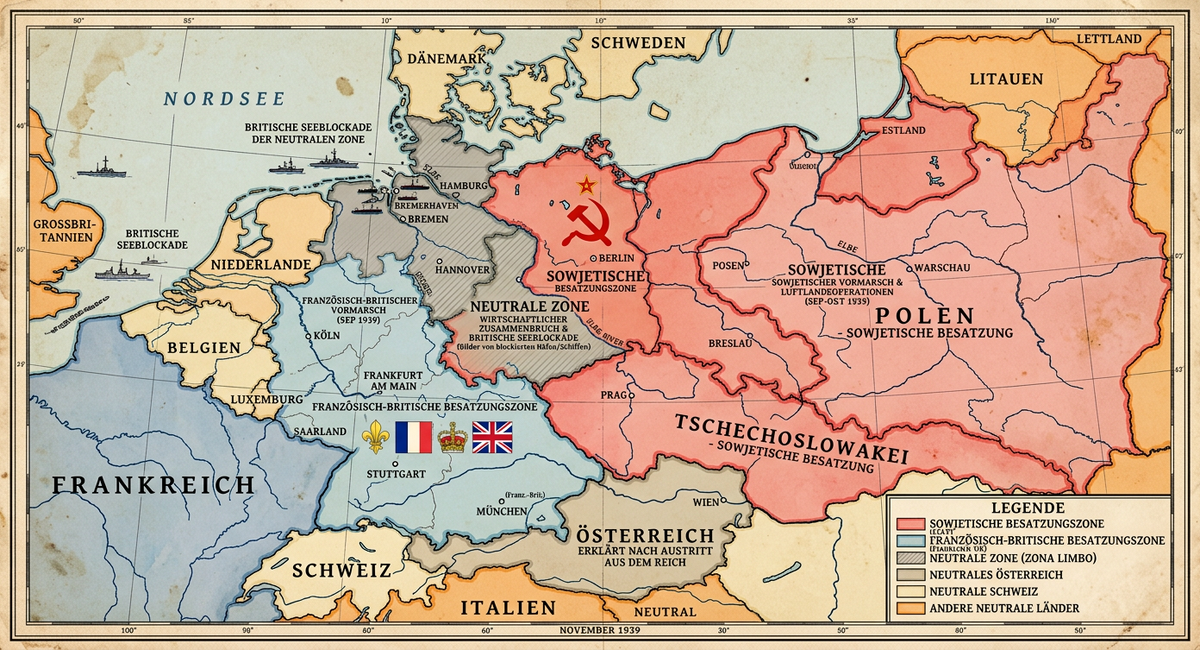
November oozed through the brick rubble, through the slate-blue pumice of the fog, settling on the shoulders of an alien coat — taken from an alien shoulder, too vast and loose. Hans Weber — that was the name given to the void inside this broadcloth, a name written in a calligraphic, accounting hand on a certificate issued by an office that no longer existed. He strode down Bahnhofstrasse.
He walked, listening to how the city receded before him: not out of respect, no, but out of a cindered, frozen indifference. Hannover was waking up with eyes wide open, like smashed storefronts. The sun, a tarnished brass button on the tunic of a dead sky, barely glimmered through the dust. Hans Weber, non-combatant, commercial representative, Protestant, was looking for his wife. He was looking for two boys, Klaus and Dieter, whose voices still splashed in his left ear like seawater trapped in a mother-of-pearl shell — water that was slowly but inevitably becoming salty blood.
From the disemboweled bellies of half-ruined houses, from behind curtains stitched from burlap, the radio seeped out. The airwaves in the Gray Zone suffered from an incurable arrhythmia; they were sick with frequencies that didn't exist on any tuning scale. No one knew whose hand turned the switch, but from the speakers, through the crackle of static, glassy electricity, flowed a melody as thick as molasses — “Lili Marleen” — slowed down, as if a pale finger were dragging the phonograph needle along the grooves.
Vor der Kaserne, vor dem großen Tor...
The music bogged down in the air, then severed, and the time of the Voice began.
The Voice was reading names.
A dry, barking, fractured Berlin tenor with a faint Rhenish accent — the voice of the — dead? — Doctor from Alexanderplatz, who now, from the cellars of a Moscovite non-existence, read the lists. He read them with that peculiar, pitiless, hypnotic intonation used for reading inventory ledgers.
Esther Rosenblum, nineteen-twelve. Moritz Klein, nineteen-hundred and three. Ruth Klein...
The names fell like measured drops from a rusted tap. These were the lists of people currently trading ersatz bread on the next street, people who were alive, breathing, but in the voice of the radio-wraith they had already turned into numbers, into ash, into a thick, sweetish smoke trailing over their houses.
Noah Goldstein, born eighteen-ninety-two. Place of death: Treblinka. Date of death: August fourteenth, nineteen-hundred and forty-two.
Weber pressed his palms to his ears — palms that were clean, with neatly trimmed nails — but the voice didn't come from without; it came from within, from that place where bone joins memory, and there was no plugging it.
In this world, this incorrect, defective world, there was no Treblinka. In this world, the war had ended in October. Goldstein is alive. He sits in his workshop. He sews a suit. He threads the needle on the first try. He smiles. There is no date. There is no place. The very word does not exist.
No, Weber was not listening to the names. No, Weber was walking to the tailor, moving his legs like a blind, swaddled pupa — a pupa waiting for a transformation, but having forgotten which specific butterfly it was destined to become.
The cellar of the workshop smelled of chalk, heated wool, and dust — the scent of halted time. Goldstein, an old Jew with eyes the color of wet asphalt, sat by a kerosene lamp. He was sewing. The needle entered the fabric and exited the fabric, in-out, in-out, and every stitch was a tiny decision, a minuscule attempt to sew back together a time torn to shreds.
“Your suit, Herr Weber. It is almost ready,” the tailor said without raising his head, and his voice rustled like dry leaves over cobblestones. “Good fabric. Pre-war. Everything is easier in a good suit. Even not being yourself — that too is easier.”
Weber sat on a chair, and the chair immediately became what every object in this zone was: a void with legs. The cellar swayed. The space of the room shivered like heated air over a brazier, and through the soot-stained walls, an endless, squelching mud seeped through.
Noah was not sitting by the lamp. Noah was standing.
He stood in a cold wind, and he wore no vest, only a thin, soaked-through striped Häftling uniform, and behind his back stretched rows of wooden, geometrically perfect barracks, receding into a gray eternity the color of a Wehrmacht uniform.
“You wanted to burn me, didn't you, Herr Lang?” the tailor said, and his lips did not move, but the words resonated, echoing in Weber’s temples with the hum of an electric furnace. “But the matches were damp... yes? You didn't sleep well tonight, Herr Lang?”
The humming ceased. The pendulum ticked again. The lamp smoked.
“You are quite pale, Herr Weber,” Goldstein looked over his slipped glasses, and in his gaze was unbearable, calm precision with which the dead look upon those who have forgotten to die. “Go to the station. A train arrived from Stettin today. Perhaps your family is there? If a man searches, it means he is still alive. When a man stops searching, it means he is already...”
“No,” Weber said quickly. Too quickly. Like a lie. “They stayed in Berlin. Helga would not have left Berlin.”
“Helga?” The tailor tilted his head. “A beautiful name. I had a client — Helga. A different Helga, of course. Before the war. In Berlin. She loved the color blue. She said: blue is the color of loyalty. I sewed her a dress — blue, with a white collar. A dress like that...” He traced his fingers through the air, drawing the contour of something that existed only in his memory. “The kind of dress in which one could survive the end of the world, and after the end of the world someone would look at you and say: what a beautiful dress.”
Weber was no longer listening. He burst out into the street, greedily gulping the frost-nipped air, pushing away the old man’s words, but the street was no longer a street.
There was a crunch. On the corner, hissing with its wide tires, stood a British patrol Willys. Two men in olive drab were lazily smoking. They were searching. They were looking at faces.
And then Weber smelled it.
A thick, animal, sickeningly sour smell of panic, of split adrenaline, of metallic sweat. The smell of fear. He knew it thoroughly. Back in August, in the SS training camps, he had inhaled this steam rising from those who were brought to him, the smell of those who realized they had become meat. He had been the conductor of this smell. He had been its creator.
But now there was no one else near. The smell was coming from his own armpits. From his skin. From his pores. He had stepped into the line. He had become the prey.
Beside himself, Fritz Lang — alias Hans Weber — bolted into a narrow alleyway. He ran, gasping, stumbling over bricks, and the alleyway folded like an accordion, narrowing, the walls rising upward, covered in dirty spring snow. Somewhere far away, or perhaps very close, inside his own cranium, a shepherd dog burst into a bark. One. Then another. The barking meant the scent had been caught.
The sound of his own footsteps began to change. The ragged breath, the thud of boots on stone — all of it smoothly, terrifyingly transitioned into the rhythmic, sated purr of an engine.
Fritz blinked. He was no longer running.
He was sitting on the soft, creaking leather seat of an army Kübelwagen. His hands, encased in the perfect black leather of officer’s gloves, rested calmly on his knees. The car rolled slowly through the March mud of the Warsaw Ghetto. And ahead of the car, gasping in animal terror, bleeding his feet to pulp, stumbling, ran a man in a coat that was too vast, taken from someone else’s shoulder.
And this running man, this hunted beast looking back at the dogs, was himself.
And the one sitting in the car, lazily watching the pursuit through the clean glass of the windshield, the one who felt the absolute, geometric correctness of what was happening — that was also himself. Cause and effect had traded places. The executioner was hunting his own mercy.
The alleyway ended. Weber pressed his palms against the damp wall near the railway station. His heart was hammering. There were no dogs. There never had been. He — was Hans Weber. From Bremen. Commercial representative.
The train from Stettin stood on the second track. Long, filthy, with smashed windows. People flowed out of the carriages slowly, the way people emerge from dark water — heavily, reluctantly. Women with bundles. Old men. All with the same expression on their faces, the faces of those who have arrived, but have not come home.
He stood on the platform and watched as space began to betray him again.
Every woman in a gray coat for a second became Helga. Every boy clinging to a hem — Dieter. But the longer he looked at the train, the more the smashed windows of the carriages were boarded up with planks. The doors grew heavy external bolts.
It was a different train. And the platform was different.
People did not exit slowly. They were unloaded. Fast, fast, schnell, spotlights struck the eyes, barking tore the eardrums. He stood on this platform, and before him wound an endless, submissive line, and his own hand, in its black glove, rose and fell. To the right. To the left. To live. To the oven. To the right. To the left. Every movement — a stitch of the needle, a tiny decision, a tiny choice. Meticulous. Like a column of figures.
And then he saw them.
In the crowd of refugees descending onto the Hannover platform of thirty-nine, came Helga, Klaus, and little Dieter. Alive. Real. Dieter was crying, clutching a wooden toy to his chest. They had escaped. They had arrived. He only had to take a step, call out to them, embrace them. To start a new, nameless, quiet life in this zone of Limbo.
He took a half-step. Klaus looked back, and froze.
No. He would find them. He would embrace Helga. Klaus would say “Papa.” Dieter would cry — he always cried when he was afraid, and then, when he stopped being afraid, he cried too. They would live — here, in this zone, in this Limbo, and he would be Hans Weber, commercial representative from Bremen, and no one — no one — would ever know.
And everything would be — fine. But he had already said this — he had already told himself this before, and even earlier, and even earlier than earlier. And it all repeats, like a skipping record.
And he would lie beside her at night, and the ceiling would be white, and in the darkness — gray, and then black, and then the ceiling would vanish, and in place of the ceiling — smoke. And he would know where that smoke came from. And in that world, in that magnificent world where the Reich stands for a thousand years, Helga would have been washing his uniform. And Klaus would have been marching, straight and true, as they taught him in school. And Dieter would have stopped crying, because men do not cry, because crying is weakness, and weakness is a “no.” And in the mornings, smoke would rise from the chimney behind the hill, and they would not ask — whose? And he would know, and this knowledge would be familiar, as rain is familiar, as wind is familiar, as everything to which one becomes accustomed is familiar.
And Noah Goldstein would not be sewing suits. And Noah Goldstein — would not exist. And that other Helga, who loved blue — would not exist. And the blue dress with the white collar — would not exist. And the boy on the platform — would not exist. And the boy would not have looked back.
And if this perfect world had won, if it had arrived right this moment...
Space clanged. Again. The trap snapped shut. He looked at his wife’s blonde hair — and saw her in a baggy, filthy Häftling robe. He saw Klaus, clutching a pale Dieter to himself. He saw how his own, perfect hand, encased in black leather... pointed them to the left. Into the oven. Because order demands purity. Because the machine knows no mercy.
Weber stood on the platform, not daring to approach them, not daring to touch them. He watched as someone’s family passed by, dissolving into the crowd of strangers, saved people whom he had not killed.
The train left. And the station left with it. Evening found him on Bahnhofstrasse.
The sun had gone — swiftly, thievishly, like a man who does not wish to be a witness. Hannover lay in the twilight, and the twilight suited it, the way a coat fits when tailored to a precise measure — the twilight hid what could not be seen in the light and exposed what the light hid.
From the barbershop on the corner, the voice of the dead propagandist could be heard again, monotonously reading the names of the dead-who-never-were. He did not stop — neither by day nor by night, neither in this world nor in that — he read as a river reads, as rain reads, as fire reads: without beginning, without end, without a comma, without mercy.
Weber stopped. He listened.
He listened to the names of people who in this world were alive, but in that other one — the one he had drafted, designed, calculated, the one where everything was correct, and pure, and according to the law — in that world, they did not exist. Not a single one. They were — figures. They were — smoke. They were — the ash that fertilized the lawn by their house, on which the grass later grew, and that grass was green, because ash is a good fertilizer; there were calculations about that too, and the calculations added up, and the columns were straight, and the handwriting — meticulous.
Rachel Kowalski, nineteen-hundred and ten...
He listened, and the names entered him as a needle enters fabric — rhythmically, precisely, stitch by stitch — and every stitch sewed him to this place, to this pavement, to this world where they are all — alive, where the tailor sews, where the boy looks back on the platform, where the woman in the gray coat leads a child by the hand — to this world where he — is nobody.
A commercial representative from Bremen. Protestant. Did not serve. Looking for his family.
He stood there, and in the window of the barbershop — in that cracked window that doubled everyone — was his reflection. Vague. Faceless. Beside it — another, small, stooped, with glasses and a goatee.
Goldstein? Again? — No. A flare. A crack. A shadow from a lamp. No one.
And the voice read:
Fritz Lang…
He recoiled.
— nineteen hundred…
But the voice continued with a different date, a different name, a different fate.
Not his. For now — not his.
The man without a name stood on Bahnhofstrasse, in a city pretending to be a city, in a zone that was neither a zone, nor a world, nor a purgatory, but a seam. A line along which one world is sewn to another, stitch by stitch, and if you pull the thread — both will unravel.
He stood and listened to the voice reading the names of the people he had not killed. In this world, he had not killed them.
And this “not” — thinner than a thread, thinner than a spiderweb, thinner than a blade drawn between two worlds — was the only thing standing between him and who he was.
Between him — and who he wanted to be.
And on the second track stood the empty train from Stettin, and in the empty carriages, the wind played, and the wind smelled of nothing.
Of absolutely nothing.
But above the station, above this dreary city, above this entire gray, torn-apart zone, on the very edge of one’s senses, where smell ceases to be physiology and becomes a state of the soul, there trailed a thick, sweetish, unbearably familiar scent of crematorium smoke that did not exist.
A blue dress with a white collar.
The distance from Oranienburg to Lemberg is one thousand and eighty kilometers along the Reichsautobahn — if the Reichsautobahn still existed, if the bridges haven’t been blown up, if the gasoline hasn’t run dry somewhere between Breslau and Krakow, if the convoy hasn’t been strafed from the air, if headquarters still stands where it stood yesterday, if yesterday was still yesterday, and not some geological era separated from this morning by an impenetrable layer of burnt paper, ash, and human numbness.
The distance from Lemberg to Berlin is seven hundred and ninety.
The distance from husband to wife is immeasurable.
Fritz Lang, SS-Untersturmführer, adjutant to the commandant of the special detention camp KL Sachsenhausen — so it was stated in his documents, and “special detention” meant a form of detention where the contents had a tendency to diminish, and Fritz had filled out these documents himself, with his own hand, in a neat accounting script, because meticulousness was not a trait to him, but a spine — stood in the corridor of the requisitioned voivodeship administration building, pressing a black Bakelite telephone receiver to his ear. It was heavy as a knuckleduster, cold as a stone — and he listened.
He was listening to his wife's voice.
The wire — gray, coiled — stretched to the apparatus on the wall. The apparatus was screwed into the plaster with Polish screws, the plaster applied by Polish hands, which now, most likely, were digging Polish earth or were already lying in it.
But the voice came through. The voice was coming from Berlin — along a copper wire strung on wooden poles from Lemberg through Krakow, through Breslau, across fields where bomb craters hadn't yet cooled — and this in itself was a miracle, a fragile, impossible miracle: the wall, the wire, the apparatus, the receiver, the ear, the voice. This entire chain hung by a thread, on its final tension, and every sound along the way lost a piece of itself, just as water flowing through pipes in winter loses its heat. And Helga’s voice, by the time it reached his ear, was no longer entirely her voice, but its shadow, its cast, its imprint in the wax of static.
“…Dieter didn’t sleep all night,” Helga was saying, and her voice trembled but didn't break, and there was something in it that made Fritz want to smash the receiver against the wall and simultaneously press it so deeply into his ear that the voice would penetrate bone and marrow, reaching that part of the mind where things are kept before they become memories. “He heard it, we all heard it — they bombed Spandau, we were in the Schmidts' basement because ours is flooded — and Klaus was silent all night, Fritz, silent, he didn’t cry, didn’t call for me — he just sat there with his eyes open. And I don’t know what’s worse: when a child screams — or when a child is silent.”
“Helga. Helga, calm down.”
“I’ve packed two suitcases. One for the children’s things. The other for documents and winter clothes. Mother called from Stettin, it’s quiet there, the British are only bombing the factories, and there are no factories in Stettin, there's a port, but a port isn’t a factory, Fritz — the trains are still running…”
“Helga, listen to me.”
“No,” and in that “no” of hers lay that specific feminine firmness, harder than any order, because an order can be disobeyed, but a wife’s “no” cannot. It is not subject to appeal, it has no higher authority, it is not logged in the incoming register. “No, Fritz, you listen…”
“I am listening,” Fritz said, and his voice became the one he used not with his wife, but with his subordinates: even, measured, the voice of a man in control of the situation. “And I am telling you: stay in Berlin. The roads are the worst place to be right now. You will stay home. Stettin is a port, but a port is a target, Helga. A port means ships, supplies, it’s what they bomb second, right after the factories. Berlin is a fortress. The Führer is in Berlin. As long as the Führer…”
“The Führer is not in Berlin,” Helga said. “The Führer is in Prussia. Everyone knows.”
Fritz gripped the receiver. His palm began to sweat. How did she know? The location of Headquarters — Wolfsschanze, Rastenburg, East Prussia — was a secret, but secrets in Berlin lasted no longer than butter on a hot skillet: they hissed and evaporated. Frau Schmidt knew what the General Staff knew, and she knew it earlier, because the General Staff received their briefings through communication channels, while Frau Schmidt received hers from Frau Müller, from Grossman the grocer, from the dentist who treated the Chief of Staff's adjutant's wife — through that human wiring that functions without poles, without current, without screws, and which no paratrooper drop could ever sever.
“Helga. Listen to me. Please… Turn on the radio. The Führer knows what he is doing. Yes, the Russians stabbed us in the back,” Fritz said. “Yes, Stalin broke the pact. But you have to understand, Helga,” and here his voice took on that didactic, almost paternal intonation that so irritated Helga and which he himself mistook for persuasiveness. “You have to understand politics, at least a little: Churchill hates the communists. The Entente won't make a deal with Stalin. The British, the French, they will stop the moment they see red flags at the Vistula. That is a law, Helga. It is a law of history… We have reserves…”
“Fritz!” Helga’s scream struck his ear so sharply he flinched. There was no SS officer's wife in that scream anymore. There was only a mother beast saving her young. “The bombs don't care about Churchill! They don't care about Stalin! They don't have eyes, Fritz! They fall from above! They don’t care what they fall on — a tank factory or Dieter’s crib! I am leaving. I am hanging up and taking the children.”
“Helga, I forbid…”
The line severed — not gradually, not fading out, but instantly, the way scissors cut, the way an umbilical cord is cut — and on the other side of the incision remained everything: the apartment, the coat rack, the smell of coffee, Dieter’s voice from the bathroom, Klaus with his open eyes, the two suitcases by the door. And on this side — silence. The hollow, final silence of a dead wire, the silence of a snapped thread, a silence without even a dial tone, because a dial tone is still a system, it is still order, still a connection, and here there was nothing. A severed edge. A crater. Emptiness.
“Helga?”
He pressed the cradle down. Released it. Pressed it again. Cranked the handle. Cranked it once more. The copper wire, seven hundred and ninety kilometers of stretched copper — was silent. Somewhere between Krakow and Breslau, or between Breslau and Liegnitz, or in an open field where a pole stood amidst an autumn furrow — somewhere out there, the thread had snapped: an artillery shell, sappers, a soldier's boot, the wind, or simply the weight of the world bearing down on a thin vein — and the conversation was over.
Two suitcases. One for the children's things. The other for documents and winter clothes.
The door at the end of the corridor flew open — it didn't just open, it flew wide, slamming against the wall — and Walter Bremme, SS-Rottenführer of the signals corps, rushed toward him. The usually polished, pedantic signalman now looked as if he had been dragged by a rope over gravel. His tunic was unbuttoned, his eyes widened into two saucers brimming with pure, unadulterated terror.
“Herr Untersturmführer!”
“Bremme.”
“The Russians, Herr Untersturmführer,” and the words tumbled out of him out of order, like belongings tumbling from a suitcase opened on the run, “paratroopers — airborne drop — near Lublin — and near Radom — and, they say, near Krakow — at night — massive — no connection…”
“No connection with whom?”
“With anyone.”
That “with anyone” dropped into the corridor and lay there — it didn't bounce, didn't roll, it simply settled, filling the space between the walls, between the stucco molding and the floor, between the painted-over eagle and the portrait of the Führer on the opposite wall. It settled and became the very air they now had to breathe.
“Not with Army Group Headquarters,” Bremme continued, his voice acquiring the flat drone of a man who has crossed over from panic into mere recitation. “Not with Berlin. Not with the Krakow commandature. The lines are cut. They’re cutting the wires, Herr Untersturmführer. They are — everywhere... General Guderian's tanks are stalled without fuel — the supply trains are burning... The Poles have struck our rear — the remnants hiding in the forests have joined up with the Soviets... And in the west…”
Bremme swallowed hard.
“The French have crossed the Rhine, Herr Untersturmführer. They aren’t even shooting. They are just driving trucks down our autobahns. The British are already in Belgium... We have no troops there. The Reich is squeezed from three sides.”
“What about the Führer?” Fritz asked. “Rastenburg?”
Bremme looked at him. And in that look — fleeting, sliding — was something Fritz had not seen on his subordinate's face even once in all their months of service: not fear; fear was the norm, fear was their working environment, fear was what they manufactured. This was something else. Bewilderment. That specific, infantile bewilderment that descends when a man discovers that the floor he was walking on has suddenly vanished.
“Rastenburg has been silent since four in the morning, Herr Untersturmführer. They say — airborne drop. They say — paratroopers approaching the perimeter. But these might be rumors.”
“Rumors,” Fritz repeated mechanically.
He hung up the receiver. Slowly, meticulously — precisely onto the cradle — because meticulousness cannot end, meticulousness is the last thing left when everything else has crumbled to dust. The receiver rested on the cradle, and Fritz's hands fell to his sides, and he stood in the corridor, straight-backed, buttoned to the collar, clean-shaven, flawless. He stood like a pole stands when the wire has already been cut, but the pole doesn’t know it yet.
He adjusted his tunic. Ran a palm over his hair — an automatic, morning, peaceful gesture, a gesture from a world where there is a mirror, a razor, a shaving brush, hot water, the scent of Kölnisch Wasser, a schedule on the wall — a gesture belonging to order. He existed for the sake of order. For the sake of every object being in its place, every man in his formation, every number in its column. So that contents would arrive and diminish, but always — always be accounted for.
And now, the numbers didn't add up. Nothing added up. The world had turned out to be a meat grinder with stripped threads.
Fritz, without looking at the signalman, moved toward the exit. He stepped out onto the porch.
Lemberg lay before him — alien, made of stone, indifferent — a city that didn't care who its master was: Poles, Germans, Russians, Austrians, Turks — it had outlived them all and would outlive these. The chestnut trees on the boulevard stood in their rust-red, copper foliage, and the September morning was clear and warm, and there was something obscene about this beauty — because the world had no right to be beautiful when everything was collapsing.
A column was moving down the street — westward. A retreat was not yet called a retreat: it was called a “regrouping,” an “alignment,” a “strategic withdrawal to pre-prepared positions.” But words have a breaking point, just like wire, and when a soldier is running, no word can turn a rout into a march.
Fritz looked at the column and thought about two suitcases.
Helga was probably already at the station. Or already on a train. Or the trains weren't running — the lines cut, the wires, the paratroopers. No: to the west, towards Stettin, the lines were still intact. They had to be intact. Stettin was a port. It was the north. It was the Baltic. The Russians were in the east. They were bombing Spandau, not Stettin. Stettin was out of the way. Stettin was on the outside. Stettin was...
The distance from Lemberg to Stettin is eight hundred and sixty kilometers.
The distance from husband to wife is infinity.
He walked back into the building.
“Bremme!”
“Herr Untersturmführer?”
“A car. Fuel. Rations for three days. A map. We are leaving in an hour. The business trip is over.”
“To where, Herr Untersturmführer?”
Fritz didn't answer. Not east — the Russians were there. Not west — the French were there. North?... To Helga. To the two suitcases by the apartment door on Schillerstrasse, if the suitcases weren't already buried under plaster, if the door was still there, if the apartment was still standing.
He was left alone. He stood by the window, wearing a uniform that just yesterday had signified absolute power, and today signified an absolute target. He picked up the heavy Bakelite receiver again, pressed it to his ear. He listened to the silence — long and intently, the way a doctor listens to a stopped heart.
And in that silence — for the first time, barely audible, on the very fringes of his consciousness — something stirred for which he had no name. Not fear — he knew fear, fear was a tool, a working material, fear he knew how to dose and tabulate.
This was different. Something that made the world, already derailed, begin to slowly, unstoppably turn. Like a massive centrifuge. Spinning, spinning, until up became down, until the soldier became a refugee, until the man who compiled the lists was himself transformed into a hunted animal on someone else’s list.
But that would come later.
For now — there are the clouds. For now — the chestnut trees. For now — the sentry at the gates, finishing his cigarette with that greedy, doomed concentration of a man who suspects this cigarette is his last. For now — two suitcases, one for children's things, the second for documents and winter clothes. For now — seven hundred and ninety kilometers of silent copper.
For now — there is the distance.
The road north from Lemberg begins with the fact that there is no road.
That is to say, it exists on the map: a thin red line, drawn by an imperial cartographer with the same meticulousness with which Fritz Lang traced the columns in his ledgers — a line connecting dot to dot, Lemberg to Lublin, Lublin to Warsaw, Warsaw to Danzig, Danzig to Stettin — on and on, along the red arteries of a Reich that only yesterday stretched from the Rhine to the Bug, but today was contracting like a fist from which water is leaking. The red lines on the map were becoming what they had always been: ink on paper.
On paper, a road. On the ground, a quagmire.
The Kübelwagen crawled along the highway like a beetle across a sodden page of newsprint. At the wheel sat Kurt Zimmer, a corporal from the Oranienburg motor pool, assigned to Fritz for the assignment along with the car — small, wiry, with a face carved from a root. He was one of those drivers who lead a car not with their hands, but with their spine, feeling every pothole as a personal insult. He was silent. He was silent because everything that could be said was being said by the road.
The road spoke of — retreat.
Passing them — heading toward Lemberg, from where they had just fled — was that which three weeks ago had been called the Wehrmacht: trucks with dropped tailboards where soldiers with faces the color of road mud jolted; motorcycles loaded so heavily their sidecars scraped the stones; horse-drawn wagons — horse-drawn wagons! — in an army that prided itself on tanks; and the infantry, gray-green, endless, marching out of step, without formation, without song — a mass that had lost the only thing distinguishing an army from a mob: direction.
“Where are you headed?” Fritz shouted, leaning out of the car as the Kübelwagen stalled once again in a bottleneck.
A lieutenant — young, with an ashen face and eyes where the spark textbooks call “fighting spirit” had already gone out — was walking beside his men, on foot. He had likely abandoned his vehicle, or lost it, or it simply no longer existed.
“To Lemberg,” the lieutenant said. “Orders are to hold Lemberg.”
“Whose orders?”
The lieutenant looked at Fritz — at the black uniform, the runes on the tabs, the Totenkopf on the cap — and in that gaze was the expression with which field officers looked at the SS: the way one looks at a rat that has found the cheese.
“Orders,” he repeated and walked on.
Whose orders — he didn’t know. No one knew. Orders were born of the void — of rumors, of fragments of the last radiograms, of words spoken by someone to someone else an hour or a day ago. Every order contradicted the next, and together they contradicted reality, while reality contradicted itself.
And along the shoulders flowed something else.
On the right, pushing carts piled with featherbeds and pots, were those fleeing the Germans to the east. On the left, wrapped in shawls, trudged those now fleeing the Russians to the west. Counter-flows of panic, rubbing against one another.
Jews and Gypsies walked in the same dust as Poles, shoulder to shoulder, and this was wrong — not because they walked, but because they walked together. In that calligraphically perfect world Fritz had built, these streams could never intersect. But the ruled world was over. There remained only the unruled world, where everyone saved themselves along the same ditch.
“In October, everything was different, Herr Untersturmführer,” Zimmer said suddenly, his eyes never leaving the grimy windshield. “Almost a year ago…”
He jerked the wheel, swerving around a dead horse with a belly bloated like a drum.
“When we entered the Sudetenland, there was no dust. In Carlsbad, they stood along the roads. Girls threw asters onto our armor. The autumn was warm, and those flowers... they smelled of perfume, of wet asphalt, of a holiday. We drove through Europe like gods, Herr Lang. A girl threw one to me — a white one — right into the cab. I dried it. I wanted to bring it home to my wife.”
He fell silent.
“Did you?” Bremme asked from the back.
“Lost it. Somewhere between Prague and Breslau. It fell out of my pocket. Or I threw it away. I don't remember.”
Zimmer spat out the cracked window.
“And now we’re driving through a cesspool. And no one knows which way to climb out.”
Fritz remained silent. The driver’s words bounced off him without causing harm, because inside Fritz, a different mechanics was at work. On his knees lay a brown leather briefcase with the monogram KL. And within this forest-like, primal panic, the briefcase remained the last island of supreme, crystalline reason. Inside was a folder marked “Geheime Reichssache.”
His assignment to Lemberg, to this melting pot of nationalities, had not been an inspection. Oranienburg was facing a crisis that Fritz, as a good manager, was supposed to resolve. Arrests of “asocial elements” were on schedule, but the system was failing at the output: the elderly, the sick, the exhausted could not work. They took up space. They consumed rutabaga gruel. They were a loss without a profit, a line in the budget that didn't balance.
Shooting them was not cost-effective. A bullet is brass, it is gunpowder, it is logistics and the human factor. The economics of death demanded elegance.
That was precisely why Berlin had sent him to the East. Here, in Galicia, where the local population was gleefully ready to take on part of the dirty work, where antisemitism was absorbed with mother’s milk, Fritz Lang sought a new solution. He held meetings. He drew diagrams. What to do with those who cannot work?
He had been one step away from a clean, almost mathematical revelation. He could already see the outlines of large, bright rooms with showerheads in the ceiling, where the problem would be solved hygienically and without the expenditure of non-ferrous metals.
But Russian paratroopers and French tanks had turned his blueprints of the future into scrap paper. His perfect Reich, where he would be the Architect of Purity, had collapsed, leaving him in the dust, fleeing north toward his wife.
“Zimmer,” Fritz ordered curtly. “Turn off. A backroad. Any of them.”
“But Herr Untersturmführer, it’s not on the map…”
“Turn off. We need to clear the filters and try to catch a signal. We won't make twenty kilometers before nightfall in this mess.”
The Kübelwagen veered, bounced over a ditch, and, crushing dry thistles, left the imperial highway. The thick, roaring noise of the refugees began to fade, muffled by yellow foliage, until it turned into the dull, distant hum of an ocean.
They stopped two kilometers later, by an old stone wall. The engine coughed and died. Silence fell — that deafening silence of September nineteen-thirty-nine, in which one could still hear an acorn fall, even though high-explosive bombs were already falling twenty miles away. The silence of a pause. The silence between an exhale and an inhale.
Bremme, the signals man, immediately hopped out of the car, carried the radio onto the hood as tenderly as an infant, and tossed a thin antenna wire over an oak branch. Zimmer opened the trunk, taking out tin cans of stewed meat and bread. Fritz stepped out of the car, stretching his stiff legs. He took out a cigarette. He wiped his hands with a handkerchief — carefully, finger by finger. A gesture from that world where, after every document, one had to wash one's hands.
He lit up. The smoke mingled with the scent of damp leaves.
And then, a dog appeared from the undergrowth.
It didn't run out — it appeared, the way things appear in this loosened world: without warning, without reason. A minute ago, an empty field. And now — her. A large mongrel, dirty white with tan patches, so thin that every rib could be read under the skin like a string.
She stood at the boundary of light and shadow. She didn't bark. She didn't growl.
But it wasn't her emaciation that was terrifying. It was her teats — swollen, dark, weighed down toward the earth. She was a nursing mother. A mother who had plenty of milk, but those who were supposed to drink it had vanished in the craters of this mad day.
She stood and looked at them. And in her brown, transparent eyes, there was neither hunger nor supplication. There was only one question, older than human speech: Where? Where are mine?
Zimmer froze with the open tin.
“Come here, mutt,” he called softly, breaking off a piece of fatty meat and tossing it into the grass. “Here…”
The dog didn't even twitch an ear. She didn't need meat. She was looking for what these men in gray and black uniforms had taken from the world by the very fact of their existence.
Fritz looked into the animal's yellow eyes. And in this wordless contact, something made his throat seize. Because he knew that look. He had seen it on the Appellplatz in Sachsenhausen when women were being led out of the barracks, those being transferred — where? To another barracks? To another facility? To another column? — and they would turn, and their eyes would dart along the line — and the question was the same, the same, always the same: Where? Where are mine?
But back then, that look had been mere material to Fritz. An incoming flow. But now, on this empty field, reality buckled, slid, and in the yellow canine eyes Fritz suddenly saw Helga. He saw his wife standing in a flooded Berlin basement. Helga, clutching a numbed Klaus to her, while from above, from an indifferent sky, a bomb falls with a howl, absolutely indifferent to whose flesh it tears.
A strike of alien, unbearable pain pierced him beneath the shoulder blade. A simple human weakness, from which he had so carefully cured himself over the years — with drill practice, regulations, columns of figures — something for which he knew no name and wanted to know none — poured into him like water into a ship’s hold.
“Get out!” Fritz shouted hoarsely.
He stepped forward, drawing the heavy Luger from his holster. The hand of the camp architect, always so steady, gave a small, unaccustomed tremor. He aimed the barrel at the animal, defending himself from her eyes, from her loss, from his own collapsed world.
“Get out, you beast!”
The dog wasn't frightened. She looked at the pistol, blinked slowly, and, turning just as noiselessly, dissolved into the autumn woods, taking her heavy, unrequited love with her.
Fritz stood there, breathing heavily, gripping the pistol.
And at that second, behind his back, the radio crackled loudly, strained.
“Herr Untersturmführer…” Bremme’s voice from beneath the headphones sounded dry, like breaking kindling. The signals man wasn't looking at the apparatus, but somewhere through the hood of the car. “On frequency forty-two point three. Clear text. No cipher.”
Fritz slowly lowered the Luger, without taking his finger off the trigger.
“Report.”
“Königsberg is transmitting. Rastenburg has fallen. Soviet paratroopers have captured the headquarters train.”
Bremme swallowed.
“The Führer is dead, Herr Lang. He shot himself.”
The forest around them stood yellow, silent, and absolutely indifferent. Fritz looked at the piece of fatty meat in the grass, at the copper wire slung over the oak branch, at his brown briefcase with the monogram. It was over. The world ruled into columns was dead.
He holstered the pistol.
“Roll up the antenna, Bremme. Zimmer, start it up. We’re moving.”
“Where to, Herr Untersturmführer?”
“North. To the sea.”
He had to keep moving. North. Toward Helga. Toward the two packed suitcases.
He was awakened by a touch — fingers on his shoulder, short, hard fingers smelling of gasoline and bread — and Fritz opened his eyes.
He opened his eyes — and saw himself.
He was hanging.
He hung in the aperture of the sky, within a frame composed of two blackened posts and a crossbeam — hanging, and his head was positioned incorrectly, tilted, like the head of a person listening to something very quiet, something rising from beneath the earth. But he wasn't listening; he couldn't listen, because his neck was broken, and from beneath the rope — coarse, hempen, the kind used to tie bales in the camp workshops — a tongue protruded. A blue, swollen, obscene tongue that would never again issue an order, a recommendation, or a single word.
And the face, his face, was his own: the same jawline, the same forehead, the same eyes. But the eyes were open and looking down at him, sitting in the car — looking not with reproach, or with pity, but with patience, with the infinite, mineral patience of a stone that knows that everything, sooner or later, must fall.
The hanged man swayed. The rope creaked. The creaking was measured, rhythmic, like a pendulum, like a metronome, like the clatter of train wheels going in one direction: creak-creak, creak-creak, in-out, debit-credit. And every creak was a word, and the word was one, and the word was his name — not the one written on the certificate, not “Weber,” no, but the other one, the real one, the one the rope knew.
Behind the hanged man’s back was not the sky. A fence. A brick fence, long and institutional, and near the fence — something he couldn't quite make out, and from this “something” came a scent — no, not that one yet, that one hadn't arrived — but the scent already stood in the air, the way a storm stands half an hour before the first lightning strike.
“Herr Untersturmführer.”
Fingers on the shoulder. Gasoline and bread.
“Herr Untersturmführer, wake up.”
Fritz blinked. He blinked again. He rubbed his eyes — with his knuckles, hard, painfully, pressing reality back into his sockets.
The hanged man was gone.
Before the car rose a gate. A wooden arch, darkened, lopsided, with two posts on either side. A sign had once hung from the crossbeam — on rusted chains, two chains — but the right chain had snapped, and the sign dangled by the left one alone. It was tilted the way a broken neck tilts. On the sign — letters, half-erased: “...sky khutir.” Just a sign. Just the wind. Just a chain.
Creak-creak. In-out.
“Herr Untersturmführer,” Zimmer stood by the open door. “There’s a farm here. The gates aren't locked. It’s getting dark. Shall we stay the night?”
Fritz looked at the sky. It was the color of cooling lead. The sun had left without saying goodbye — the way one leaves a room where something irreparable has happened. September twilight crawled in from the east — the direction from which everything was now crawling: tanks, paratroopers, fear.
“Very well,” Fritz said, wiping clammy sweat from his forehead. “Drive in.”
They entered the yard.
The farm was of the sort that stands in Galicia from century to century, outlasting empires the way a boulder outlasts glaciers: not by resisting, but simply by — remaining. A long, whitewashed house with a thatched roof blackened by rain. Outbuildings — a stable, a shed, a hayloft — arranged around the yard like figures on a chessboard where the meaning of the game has long been lost, but the pieces remain standing. A well with a shadoof. An apple tree — knotted, old, with the last apples hanging in the twilight air like small yellow planets in a cosmos from which the light has been pumped out.
The owner came out onto the porch. In his hand, he held a kerosene Dietz lantern.
Yarema — he gave only his name, without a surname, as people do when a surname is no longer needed or no longer safe — was tall, gaunt, with a face weathered by wind and horilka to the state of old leather. His eyes — pale, faded like fabric held too long in the sun — looked out from under bushy brows without surprise. Three Germans in a military vehicle had come to him, one in the black uniform of the SS — and he was not surprised. He had seen worse. He had seen Austrians, and Poles, and Petliurists, and Reds, and Whites — they all came, and they all left, but the farm — it stood. His wife was dead, his children had left for Lemberg, vanishing in the crucible there, and now he lived here alone with a mute farmhand whom the guests never saw — he had already gone to sleep in the hayloft.
“To stay the night,” Fritz said in German, reinforcing the words with gestures. “One night.”
Yarema nodded. He understood German — not fluently, not rapidly, but the way one understands a language in which people giving orders have spoken to you for centuries: selectively, by intonation, by the tonality of the threat.
“It is possible,” he replied, and his voice was like the creak of the well-sweep: low, rusty, unlubricated by conversation. “The car behind the shed. No need to show it.”
They sat in the main room, at a table that had probably once stood in the kitchen. Fritz would remember this room — or perhaps he wouldn't, or he would remember it incorrectly, the way things seen in a state where consciousness is already peeling away from reality like wallpaper from a damp wall are remembered. He would remember individual details, redundantly bright, as objects are bright in a fever:
The table — heavy, oak, scrubbed white, with deep gashes from a knife — a table at which people had eaten, and cut, and kneaded, and probably given birth — a table that had absorbed so many lives that it had become alive itself.
The plates — clay, coarse, with a thick brown glaze the color of last year’s honey. Four plates, though besides the host, only two guests sat at the table (Bremme had stayed in the car to man the radio).
The salo — sliced into thick, almost obscenely thick slabs, white with pink, pink with white. Salo in which the pink was not the color of meat, but the color of a sunset frozen in fat. And in the warmth of the room, it began to sweat slightly in small beads; it seemed a cross-section of human flesh, an anatomical specimen cast upon an oak block.
The bread — black, dense as peat, with a crust that crunched under the knife so loudly that Zimmer winced.
And the horilka.
The horilka stood in a bottle without a label, cloudy, yellowish, the color of that uncertain hour when it is not yet clear whether it is dawn or the reflection of a fire. Yarema poured it into four cups — clay, of the same brown firing as the plates. Four cups.
Fritz looked at the fourth one.
“Who?” he asked.
Yarema did not answer. He raised his cup, nodded — not to them, but somewhere toward the corner where a dark, soot-stained icon hung, the face of the Mother of God almost indistinguishable — and drank. They drank after him. The horilka struck the palate the way truth strikes: crudely, hotly, without warning. It smelled of scorched roots, raw earth, and wormwood.
They ate in silence.
The silence was thick, dense — the silence of people who have nothing to talk about because the things that need to be discussed cannot be spoken. Fritz ate the salo, and it melted on his tongue, its taste being exactly what the taste of the world should be — simple, fatty, real. And he couldn't remember the last time he had eaten something real. In Oranienburg? In the officers' mess, where schnitzel was served on schedule? But the schnitzel had been institutional, numbered, from a menu, while this salo belonged to no one, was no-man’s, salo that existed for itself, without a schedule, without accounting, without columns.
“We were waiting for you,” Yarema finally spoke, and his voice came from somewhere deep, from the place where horilka meets resentment. He spoke German slowly, picking his words like heavy stones. “We thought: the Germans will come — they will remove the Poles. There will be order. We waited a hundred years. Two hundred. The Austrians were here — nothing. The Poles were here — bad. We thought: the Germans come — it will be better.”
He fell silent. Poured another. Drank it without a chaser.
“And you — you gave us to the Russians. Traded us for something. And now you are fleeing yourselves.”
It was said without anger. With exhaustion. With that peasant exhaustion that accumulates over centuries and becomes not a feeling, but a landscape: hills, fields, patience. Yarema raised watery eyes to Fritz, examining his black uniform.
“The black uniform — it is the color of death, Pan Officer. But when death begins to run — it is funny. And terrifying. You cannot drive in this. It is a shroud. The Russians — they are near Lemberg. Perhaps already in Lemberg. The Poles — they have gone feral. They have weapons now. And your people are running. I have a radio. The last I heard: the Russians are moving on Warsaw. Your leader... the one with the mustache. He is dead. Then — noise. Only noise.”
Fritz did not answer. What could he say? That the Reich didn't “give” them away? That the pact was a strategic move? That the Wehrmacht would restore order? Words — all words — were now the same as the red lines on the map: scrap paper. And Yarema knew it, and Fritz knew it, and this knowledge lay between them on the oak table.
“Turn on the radio,” Fritz requested quietly.
Yarema stood up and went into the other room. He returned with a receiver — old, wooden, pre-war, one of those that look like small churches: a semicircular top, a cloth speaker grille, a tuning knob, a yellow scale with the names of cities that now belonged to other countries or belonged to no one.
He placed the receiver on the table, between the plates. Turned it on. The tubes inside lit up — with a warm, living, amber light, like the eyes of a predator in the dark. The receiver hummed, warming up, the way a throat warms up before singing.
Then came the static.
That very noise: crackling, rustling, whistling — the voice of the atmosphere, the voice of a space in which all stations had gone silent. Yarema turned the knob slowly — Warsaw, Kraków, Berlin, Vienna — and every city answered identically: with noise, with void, with absence.
Suddenly, through this hum, a man’s voice broke through. He spoke rapidly, rhythmically, distant, as if broadcasting from the bottom of a well. But the words did not form meaning. It was not German, nor Polish, nor Russian. It was a language turned inside out, consisting of sibilant and guttural sounds pronounced backward. A language come from somewhere beyond the scale.
Yarema turned the knob. The voice drifted away. In its place — noise again.
And then, a song began.
It didn't start from the receiver. It started from the silence — from that place where silence becomes so dense that sounds begin to emerge from it, the way faces emerge on an icon soot-stained by centuries of candles. A woman’s voice — deep, low, chesty. A voice that didn't sing, but rather — remembered singing, remembered a melody it had heard once long ago, in another life.
The voice sang a cappella. No instruments, no accompaniment, no nothing — only the voice and the void, the voice and the darkness outside the window.
Llorando...
The language was unfamiliar — Spanish, or Ladino, or a language invented by this voice for this single song. The words were not important. The voice sang grief. Pure, distilled, absolute grief, from which everything had been evaporated: names, dates, circumstances. All that remained was that which makes something inside you clench, something that has no name, because anatomy does not know the organ that aches from another’s singing.
The voice filled the room. It penetrated the clay bowls, the white, sweating salo, the wood of the table. It was an illusion — a sound recorded on a piece of tape, broadcast from nowhere to nowhere, no hay banda — but the sadness was absolutely real.
Three men sat at the table — two Germans and one Ukrainian — and listened to a woman singing on a radio that shouldn't have been working, on a frequency that shouldn't exist.
Fritz felt as though he were falling again. That the rope on his neck was tightening. This invisible woman was singing for him. Tears, treacherous, hot tears he had forgotten since childhood, welled up in his eyes.
The horilka stood on the table. No one poured, yet the cups were full, all four of them. And Fritz looked at the fourth cup, standing before the empty chair — and the cup was full, and the chair was empty, and the voice sang.
Yarema crossed himself. Slowly, broadly, in the Orthodox fashion — from right to left, the opposite way.
The song ended. The static returned. The receiver’s tubes flickered and went out, though no one had turned it off.
Yarema silently poured the horilka. They drank in silence. The horilka was the same, but the taste had changed: now it was bitter, with the aftertaste of the water that sits at the bottom of a well where light has never fallen.
“Sleep,” the old man said. “You leave in the morning.”
Fritz lay on a bench in the main room, covered by his greatcoat. The ceiling above him was whitewashed, low, with a crack stretching from wall to wall like a front line on a map. He followed this crack, and it doubled, diverged, and in the rift between the two lines, in the gap between wakefulness and sleep, there stood a scent.
The scent of apples. The scent of salo. The scent of smoke from the stove. The scent of smoke. He fell asleep.
He was woken by Zimmer. The dawn — murky, milky, indifferent — seeped through the small window.
“Herr Untersturmführer. It’s time. The host gave us some potatoes. And bread. And this,” Zimmer showed a bottle. “Horilka. For the road.”
Fritz sat up. His head was heavy, dull as a stone — the horilka or the dream, or what stood between the horilka and the dream. Some crack into which he had fallen during the night and from which he had not entirely emerged.
He went out into the yard. The morning was cold, dewy, with that crystalline sharpness that comes at the end of September when summer has already died but autumn has not yet decided what to be. The Kübelwagen stood behind the shed; Bremme was already sitting in the back seat.
Fritz was walking toward the car, and then — out of the corner of his eye, on the periphery, where vision is not yet vision but only a hint — he saw movement.
Behind the barn, on the patch by the hayloft, a man with a pitchfork was tossing hay.
The farmhand.
The man worked steadily, habitually, the tines entering the hay and lifting it, and the hay flew. And the hay was wrong. It was too bright. Unnaturally, offensively bright — golden, radiant, acid-yellow, as if a small lamp of its own burned inside every straw. As if the hay were not hay, but yellow light that had taken the form of hay. And this light flew through the air, and the man with the pitchfork stood in this light, and Fritz could not look away. For a moment, it seemed to him that it was not straw on the pitchfork, but human hair.
The man was of medium height, sturdy, in a simple linen shirt. His face was not visible — he stood with his back turned — but something in his figure, in the set of his shoulders, in that pedantic, machine-like precision with which he drove the tines into the straw — was familiar. Not familiar — his own. As one’s reflection in a mirror is one’s own: you recognize it by that unique way your body occupies space.
The farmhand turned.
Fritz did not make out the face — the morning light was too murky — but it seemed to him, in that fraction of a second where only pure horror fits, that the farmhand had his face.
Fritz blinked. The delusion vanished. By the shed stood an ordinary old man in a dirty shirt, listlessly tossing ordinary, withered, gray autumn straw.
The light dimmed. The gold vanished. Just a man. Just a farmhand. Just hay.
“Herr Untersturmführer?” Zimmer called from behind the wheel. “Are we going?”
Fritz sat in the car. The door slammed shut. The engine coughed and started.
The Kübelwagen drove out of the yard, passed under the arch of the gate — the sign still dangled from its single chain, creaking softly in the morning air — and turned onto the backroad.
In the rearview mirror, the farm, the yard, the apple tree, and the figure of the man with the pitchfork standing in the gray fog — shrank, receded, until they finally vanished.
Until they became what everything left behind always becomes: a memory that does not yet know it is a verdict.
The field opened up suddenly — the way a wound opens when a bandage is removed: in one motion, without warning, without preparation.
The dirt road curved out from behind a grove, and the grove was gone, and in its place space emerged. Flat, brown, stretching to the horizon — and in this space, scattered with the generosity with which war scatters its gifts, lay things.
Fritz asked Zimmer to stop the car. They stood on the shoulder and looked.
Closest of all was a Kübelwagen, just like their own, only turned inside out by fire. The chassis — black, twisted, reared up as if the iron had tried to flee the heat at the last moment and frozen in that impulse, in that convulsion of escape. A little further — an Opel Blitz truck, overturned on its side, the steering wheel protruding from its cab, bare as the skeleton of a clock from which the mechanism has been removed. Even further — a tank. A light Pz.II, a machine for parades and intimidating peasants. It stood in the middle of the field, its turret blown off and lying three meters away, turned toward the sky with its muzzle like an overturned cup drained to the dregs.
But this was not the main thing. The main thing was the horses.
They lay everywhere — dozens, perhaps more — in the postures in which death had caught them: on their sides, on their backs, with legs outstretched, as if they continued to gallop in some subterranean space where they had been dragged down along with their riders. Some were perfectly intact — light bays, black-browns, dapple grays. Their coats still gleamed with morning dew, the wind ruffled their manes, and one might have thought they were merely sleeping, were it not for their bloated bellies. Huge, taut as drums — bellies in which death had already begun its work, its own bookkeeping, its accounting of debit and credit.
The locals—peasants, men and women in gray homespun clothes — were dragging the carcasses to two bonfires burning at the far edge of the field. Closer to them, by the forest, the long, fresh scar of a mass grave lay black — that was where they were pulling the Uhlans. Someone had thrust a birch cross, knocked together from two poles, into the foot of the grave, and on the crosspiece hung a cap — a four-cornered Polish rogatywka with a tarnished eagle. It hung there the way things hang on a coat rack in a hallway when the master has stepped out for a moment.
Fritz looked at the rogatywka. The eagle on it looked back at Fritz with the blind, stamped gaze of cheap metal.
Fritz thought: they charged tanks. On horseback. With sabers. They knew it was pointless. They knew a saber does not pierce armor, that a horse does not outrun a shell, that cavalry in nineteen thirty-nine is suicide — a beautiful, useless, absolutely aesthetic death.
But they charged.
There was something in this that Fritz did not understand and did not want to understand. Something that did not fit into any column, into any cell of his calibrated world. It was the opposite of accounting. The opposite of calculation. The opposite of everything he believed in. They charged the tanks because... what? Because they had to? Because of the motherland? Because of honor? Words that usually provoked a light, squeamish irony in Fritz—because in his world, “motherland” was a supply schedule, and “honor” was a paragraph in the regulations.
Here, in this field, next to the dead horses and the birch cross, these words suddenly acquired a terrifying density they had never possessed before. In this tableau of ruin lay its own flawless, mathematical completeness: hot flesh challenging cold, stamped metal—and the metal tearing that flesh apart, only to choke on it.
To kindle the fires, the peasants were using diesel fuel from the destroyed trucks and automobile tires. The fire roared, greedily devouring organics and rubber. A thick, oily smoke rose into the sky, and from it, large, greasy flakes of soot fell onto the road.
One such black feather drifted down onto the sleeve of Fritz Lang’s black tunic.
He stared at this smudge of soot, and suddenly the sound of crackling tires began to recede. The color black in his eyes lost its density. The oily flake of soot suddenly slowed its dance and began to lighten. Before Fritz’s eyes, the black soot transformed into blindingly white, weightless ash.
It fell quietly, solemnly, like the first December snow. This ash no longer smelled of diesel. It emanated a subtle, terrifyingly familiar, sweetish aroma — the smell of burnt sugar, almonds, and human hair. White flakes settled on his cap, on his shoulders, on the windshield of the Kübelwagen. Fritz held out his palm. A white snowflake touched his skin and melted, leaving no dirty trace, leaving only the sensation of absolute, surgical cleanliness.
Fritz blinked. The white snow vanished. The oily smudge was blackening his sleeve once more. He rubbed it with his finger — mechanically, the way one rubs a typo on a document that must be flawless — and the smudge smeared, but did not disappear.
“Bremme,” he said curtly, dusting off the fabric. “What’s on the frequencies?”
The signals man, sitting in the car, raised his head. His face, drawn after a night spent listening to the void, brightened slightly.
“There is something, Herr Untersturmführer. On our headquarters wave. Fragments, but they're ours. German speech. Wehrmacht format. They are somewhere nearby. Twenty or thirty kilometers to the west. Maybe closer.”
“We need to get to the highway, Herr Untersturmführer,” Zimmer said from behind the wheel. “Two jerrycans of petrol. That’s maybe a hundred kilometers. And Stettin is as far as the moon.”
Fritz looked at the field one last time. At the smoke, at the fires, at the cavalry cap.
“We drive. We'll find our people.”
They found them an hour later.
The column was parked on the shoulder of the highway. More precisely — not parked, but lying there, the way a wounded animal lies when it is not yet dead but has already ceased to resist. Peasant, requisitioned wagons with white crosses drawn in chalk on the sides. Harnessed to them were horses so exhausted they did not lift their heads. Soldiers sat on the carts, and these soldiers were — different.
Fritz had seen the retreating men yesterday: those were a mob, a herd, a mass that had lost its form. These men — had retained their form. Not in the sense of order and formation, but in the sense that a fragment broken from a statue retains its form: it is no longer a statue, but the line of the fracture reveals what it used to be a part of.
An Oberleutnant — Fritz didn't catch his surname, or caught it and then lost it — was sitting on the running board of a medical Opel. He was smoking and looking at the sky with the expression of a man staring at the ceiling in a dentist’s waiting room: without hope, without fear, with a dull expectation of pain.
“Russians,” he said hollowly when Fritz introduced himself. “Near Zamość. A company of fast tanks and infantry. We lost all our equipment. All the armored cars.” He smirked, and the smirk was a crack in dry clay. “But we have petrol to drown in. Dead tanks don't need fuel.”
He nodded toward a canvas-topped truck. Fritz saw the jerrycans. Even, green, stacked. Jerrycans that were supposed to feed iron tracks, and now fed only the void.
“Take as much as you need,” the Oberleutnant said. “You can't fuel horses with petrol.”
Zimmer was already dragging jerrycans to the Kübelwagen — quickly, greedily, with that hungry agility with which drivers handle fuel when it turns into treasure.
“Where are you headed?” Fritz asked.
“West. Home,” the officer took a drag. “And you?”
“North. To Stettin.”
The Oberleutnant looked at him—long and hard, the way one looks at a man who has said something irreparably stupid.
“You can't go north, Lang. The Red Army is in East Prussia. Tank wedges. A paradrop near Danzig. Rastenburg — did you hear?”
“We heard.”
“Then you know. All of Prussia is a cauldron. You can't get through Warsaw. You’re a dead man if you head north. There’s nothing there now but the Russians and the Baltic Sea.”
He finished his cigarette. Flicked the butt. Crushed it underfoot — meticulously, as if it were the last cigarette butt on earth and had to be destroyed down to the final thread of tobacco.
“And another thing, Untersturmführer,” he lowered his voice, though there was no one around but the wounded sleeping on the straw. “Take off your uniform. The Poles are on the roads. Yesterday they shot up a field gendarmerie patrol near Tarnów. All of them. And hung them — upside down. On lampposts. If they see those runes,” he nodded at Fritz’s collar tabs. “They won't ask for papers. They’ll just string you up.”
Fritz nodded. He said nothing.
The jerrycans were loaded. Zimmer started the engine. The Kübelwagen pulled out and drove west along the highway, past the column, past the wagons, past the horses with lowered heads. Fritz looked at the wounded, at their browned bandages, at the hands dangling from the sides of the carts. And every hand swayed in time with the movement, and the swaying was measured, rhythmic, like a pendulum. Creak-creak. In-out.
They had driven about two kilometers from the column. The highway was empty. The sky was empty.
And then came the sound.
At first, distant, on the edge of hearing. A hum, like the hum of a swarm of bees, like the hum of high-voltage wires, like the thrum of blood in the ears when the heart beats too fast. The hum grew. Approached. It filled the entire sky, from horizon to horizon. Fritz turned around and saw them.
Planes.
They were flying low, in formations of three. Blunt-nosed, twin-engine, with red stars on their wings. Flying evenly, confidently, with that mechanical inevitability of a conveyor belt that knows no doubts. And they were not heading for the Kübelwagen, nor for the empty highway — they were making a run on that very column of wagons with crosses that Fritz had just left behind.
“Brake!” Zimmer barked. “Off the road!”
He wrenched the steering wheel with a crunch, and the Kübelwagen flew off the asphalt, plowed through the ditch, bounded over the embankment, and crashed into a strip of woods. Branches whipped against the windshield. The engine stalled.
Silence fell. And then — not silence.
Then came the roar. Heavy, visceral, felt not with the ears but with the diaphragm, the stomach, the place where fear lives. The roar of bombs tearing the earth, tearing the wagons, tearing the horses — those very horses that had just been standing on the shoulder with lowered heads. Fritz, pressed to the ground, face in the grass, face in the black soil, heard everything: the muffled thuds, the screams, and the neighing. The neighing of horses that was not a neighing but a shriek, and this shriek was human, though it did not come from humans.
Silence fell again. Ringing.
Fritz lifted his head. Bremme lay nearby, hugging the radio the way a child hugs a pillow during a thunderstorm. Zimmer sat in the car, clutching the steering wheel with whitened fingers.
There, behind them, where fifteen minutes ago the column had stood, smoke was rising. Black. With black flakes. The same smoke as on the field with the cavalry, but now another smell was mixed into it — a smell from which Fritz turned away. That very petrol the Oberleutnant had offered them to take had become his funeral pyre.
Fritz did not look. There was no pity in him. There was only a cold, detached understanding: the machine of which he was a part was being destroyed by a more perfect machine.
“Those are Katiuskas,” Bremme said. His voice was flat, dead, the voice of a man who speaks only to keep from screaming.
“What?” Zimmer never took his eyes off the smoke.
“Katiuskas. That’s what our pilots in Spain called them. The SB frontline bomber. Tupolev. They’re faster than our fighters. You can't outrun them. A Russian woman’s name.”
“A woman’s name,” Zimmer repeated, and in his voice was that emptiness where words cease to mean anything.
Fritz Lang was silent.
He looked at the black, greasy smoke rising over the highway. And in his mind, another smoke arose once more. White, even, methodical. The two smokes, black and white, mingled, and the line between them grew razor-thin. The ash needed a hearth. It needed a place where Fritz could become what he was destined to become.
He was silent for a long time. A minute. Two. Then he adjusted the collar of his tunic.
“Start the car, Zimmer.”
“Where are we going, Herr Lang?”
“To Upper Silesia. Past Kraków.”
His fingers had stopped trembling.
“To Oświęcim,” Fritz added. “There are old Austrian barracks there. A railway junction. They won't reach there. Our people are there.”
He pronounced the name the way one pronounces the name of the only saint still capable of hearing a prayer.
The Kübelwagen crawled out of the tree line, pulled onto the highway, and turned west.
Behind them — smoke. Ahead — the road. And the road led to Auschwitz.
Oświęcim revealed itself to them after midday — quietly, without warning, like a page in a book you are not yet ready for.
A small town in Upper Silesia, on the Soła River, near its confluence with the Vistula. Tiled roofs, a church spire, wisps of smoke from chimneys, plane trees along the embankment. A town like dozens of others in Silesia: German and Polish simultaneously, belonging to everyone and no one. A town that could have been a postcard, a backdrop for a Christmas tale, could have been — anything.
The September sun — late, low, almost horizontal — lay on the roofs like a honeyed varnish. It was warm. Wrongly, impossibly warm for the end of September. It happens this way on the last day before the frost, when nature, knowing the glacier arrives tomorrow, surrenders all its withheld heat at once, generously, prodigally, the way a man gives away money he will no longer need.
The Kübelwagen rolled along the road leading to the outskirts. The barracks — old, Austrian, made of red brick, built back in the time of Franz Joseph for a cavalry regiment — stood isolated, across the river. But before the barracks, there was still a block, another turn, and then...
The house.
It stood on the right side of the road, behind a low, neat picket fence of pale wood. A white house — small, two-story, with green shutters and a tiled roof of a warm, terracotta hue. In front of the house was a garden. Tended with the meticulousness that reveals not a hired gardener, but the hand of the mistress herself: the flowerbeds weeded, the rose bushes pruned, the paths strewn with fine gravel, and this gravel was clean, bright, as if washed by hand. Laundry dried on a line between two apple trees — starched, billowing in the light wind like small flags of a surrender no one had agreed to.
Fritz looked at this house, and something inside him — not in his head, but lower down, in that place where nameless things reside —shifted, the way a compass needle shifts when a magnet is brought near.
There was a woman in the garden.
She sat on a bench by the flowerbed, and children fussed around her: two boys and a girl of about five. Their voices drifted through the open window of the car—thin, bright, like glass bells. The voices of children playing in a garden on the last warm day of September. The woman wore a simple, austere dress.
Blue — the color of fidelity, as one of tailor Goldstein’s clients used to say. No, the tailor did not exist yet, Goldstein did not exist yet, Hanover had not yet arrived. The dress was blue, with a white collar, and it fit her the way dresses fit women who know their body is not an object, but a — home. It fit lightly, freely. The white collar lay against tanned collarbones, the wind gently lifted the hem. The woman laughed, and her laugh was — or so it seemed to Fritz — Helga’s laugh.
The woman caught the little girl, lifted her into her arms, pressed her close, and in this movement, in this sun-drenched scene, in the soaring childish laughter, there was contained such an unbearable, piercing, fragile beauty that Fritz forgot to breathe.
The Kübelwagen drove past.
Fritz turned around. The house, the garden, the woman, the children — all of it remained behind, shrinking — and he looked, and thought: someday. Someday — a house like this. With green shutters. With apple trees. Helga in the garden. Klaus already grown, ten, twelve. Dieter running around. And maybe a third. Or a fourth. A house where everything is right. A house where one could, finally, stop counting, accounting, filing — and simply live.
Someday. After. After what?
The barracks turned out to be exactly what Fritz had imagined: brick, long, with a grass-grown parade ground. Barracks built for one empire, used by another, and now housing men who belonged to neither. Two platoons of SS men — the remnants of a guard unit transferred here from Kattowitz after the chaos began.
Bremme and Zimmer, gray with dust and exhaustion, went to the mess hall to sleep. Fritz headed for Ludwig Klein.
Hauptsturmführer Ludwig Klein, thirty-four years old. They had served together five years ago in the Totenkopfverbände, in Dachau, back when Dachau was still a model, a showcase camp exhibited to foreign journalists. Klein was one of those who genuinely believed that the camp was a school, that the prisoners were students, and that discipline was love. This belief had not weakened over the years; it had merely hardened, like clay in a kiln.
They sat in Klein’s room — small, institutional, with an iron cot and a portrait of the Führer on the wall. Someone had already managed to drape a black mourning ribbon over the portrait. Ludwig, aged, gutted, his tunic collar unbuttoned, was smoking, flicking ash into an empty tin can.
“Göring,” Klein said mundanely, pouring Fritz some barley coffee. “Göring has taken command. Locked himself in Berlin and is preparing the city for defense. Forming the Volkssturm. A militia — boys, old men. The Russians are breaking through. The French are across the Rhine. The British bomb every night.”
He said this the way one recites a train schedule: evenly, dispassionately.
“The British bomb every night. It’s all over, Fritz.”
Ludwig took a deep drag and looked at the brown leather portfolio resting against the chair leg.
“And what of your project? Your great Hygiene of the Reich? Are you still dragging it around with you?”
Fritz looked at the portfolio. The brass clasp. The embossed KL.
“It’s here. Documentation. Blueprints. If we halt the Soviets... if there is an armistice... the problem won't just disappear, after all.”
Klein shook his head — slowly, with that heavy, bovine movement that served as his sigh.
“Burn it,” he said, grinding his cigarette butt into the tin with sadistic pressure. “Everything in that folder, burn it tonight. The classifications, the serial numbers, the signatures. And be ready to take off that uniform, Fritz. Not tomorrow — now. Have civilian clothes on hand. Soon enough, we’ll be strung up on lampposts for these runes not just by the Poles, but by our own Bauern.”
Fritz was silent. The barley coffee was growing cold in the tin mug.
“Helga,” he said finally. “I called her. She wanted to leave for Stettin. Or stay in Berlin. I have to find her. I am going north.”
Klein looked at him. There was no pity in that gaze — only that cold, professional calculus they both possessed to perfection: probabilities, variants, outcomes.
“There has been no telephone connection with Berlin for a week. The British by day and the Russians by night are turning every railway junction into a lunar landscape. Trains no longer go north. Anything that moves on rails is a target. Your wife is unlikely to have gotten out.”
He didn't finish the thought. There was no need.
“If you go north — you walk straight into the meat grinder,” Klein continued. “Keep south. Stay away from the Autobahns and military columns. Travel as a refugee. It’s your only chance. Alone. Without the uniform. And without the portfolio.”
They finished the surrogate coffee. Klein stood up, went to the window, and looked out at the parade ground.
“You know,” he said without turning around, “sometimes I think: what if we were building all of this — for ourselves? The barracks, the wire, the watchtowers. What if it wasn't for them. What if it was for us. And we just didn't know.”
Fritz did not answer. There are things it is better not to understand. There are phrases it is better not to hear.
Fritz did not sleep that night. He lay on the cot, under an institutional blanket, and listened to the wind rushing through the poplars outside the window—a sound like the rushing of a sea he had never seen. The ceiling above him was gray, concrete, without cracks.
He thought of the white house. Of the green shutters. Of the woman in the blue dress and the three children. Of the life that — someday.
The portfolio stood by the cot. He had not burned it. He could not. Not because the folder held value — the folder was dead, as a map of a nonexistent country is dead. But to burn it meant acknowledging that the Architect was left without a building. That it had all been for nothing.
In the morning, early, murky, smelling of river fog, there was a knock at the door. Klein stood on the threshold. In his hand — an envelope.
“Here,” he said, tossing the envelope onto the nightstand. “Papers. A Kennkarte and a ration pass. In the name of Hans Weber, a sales representative from Bremen. Protestant. Did not serve. Forty-one years old. Height, eye color — yours.”
Fritz picked up the cheap, embossed paper.
“Who is he?”
“A merchant. A Communist or a sympathizer. Detained in early September on the road from Kattowitz during a sweep.”
“And where is he now?”
Klein paused. His gaze grew heavy, empty.
“This is no time for procedure, Fritz. He is somewhere he no longer needs documents. But you do. You can find clothes yourself, I imagine. Everything is on the roads right now. Abandoned suitcases, abandoned lives. Pick any one. We leave in an hour, blow the blocks, and retreat toward Czechia.”
He turned to the door and stopped.
“Fritz. Burn the portfolio.”
The door closed.
Fritz was left alone, holding in his hands the life of a man who no longer existed. A life that now belonged to him. Hans Weber. Bremen. Did not serve.
They drove out early. The morning was cold, damp — the first truly autumn morning. The sun did not appear; the sky was leaden, low, oppressive. It promised nothing.
The Kübelwagen drove out the gates of the barracks and rolled past the poplars, past the bridge, past the tiled roofs. The town was the same as yesterday, but the light was different, and in a different light, the town seemed different. The way a person’s face looks different when they stop smiling.
The house. The white house with the green shutters. The picket fence. The apple trees.
She stood in the garden. The same woman. But — different. Yesterday she had laughed, and her laugh had been honeyed, generous. Today, there were no children. The garden stood somehow dead, frozen in anticipation of winter. She stood alone.
She was wearing the same blue dress with the white collar, but now a coat was draped over it. Dark brown, baggy, coarse, clearly a man’s, off someone else’s shoulder. A coat that hung on her narrow shoulders the way it would hang on a coat rack. She had put it on not because it was cold — though it was cold — but because the blue dress no longer protected her. Yesterday there was the garden, the sun, and a world in which a white collar was armor enough against everything. But today required coarse broadcloth.
The Kübelwagen slowed on the broken road. The woman raised her head. Her gaze met Fritz’s gaze.
Right in the eyes. Through the picket fence, through the windshield.
There was no fear in her eyes — fear is mobile; fear screams and hides. In them, there was doom. Doom is motionless. She stood in the garden, in a stranger’s coat, and looked at the passing car with the black uniform inside. She looked as if she knew: this car, or another, or a third — would return. And then the coat would not help. And the blue dress would not help. Nothing would help.
And next to the doom was hatred. The quiet, icy hatred of a person who knows it is useless, but allows herself to feel it — with her eyes, this single weapon that cannot be taken away. And next to the hatred — an unimaginable, bottomless sorrow.
She looked at him as if she knew everything that lay inside his brown portfolio.
And that gaze pierced him straight through. Fritz broke first. He looked away, clenching his jaw so tightly his joints ached.
“Drive, Zimmer,” he threw out hoarsely, staring straight ahead. “West. Drive.”
In the pocket of his tunic lay an envelope containing the documents of a sales representative from Bremen. In the back seat, Bremme was silent. Zimmer sat behind the wheel. Ahead was the road — to Helga, to the two suitcases, to the children. But the compass inside him was broken.
And behind him remained Auschwitz. The white house. And the woman in the blue dress.
The Kübelwagen drove away, and the town shrank in the rearview mirror, shrank — until it became a dot.
Until it disappeared.
But it did not disappear.
The road to Breslau was like a severed artery, through which blood no longer flowed in one direction, but spilled outward in jagged, chaotic spurts.
The fine-tuned, flawless machine of the Reich, whose symmetry Fritz Lang had once secretly admired, had disintegrated into atoms. The chaos, however, had its own system, its own perverted bookkeeping. Soviet paratroopers and sabotage groups, dropped from the sky, had acted like a deadly virus, severing wires and blowing up bridges. And every severed wire bred ten rumors, every rumor bred a hundred orders, and every order contradicted the last. The German army, built solely to move forward — a machine with no reverse gear — was now spinning in place, like a blind beast that had lost the scent.
The Kübelwagen maneuvered through this stream of decaying flesh and dirty broadcloth, making its way northwest. Fritz sat in the front seat and watched the road, and the straight line soothed him, the way a ruler soothes, the way a blueprint soothes, the way anything devoid of curvature soothes. Another hundred kilometers. Beyond Breslau lay Liegnitz. Beyond Liegnitz — Cottbus. Beyond Cottbus — Berlin. Helga. The children.
Two hours into the journey, the horizon spoke.
The cannonade began not as an event, but as a sound: low, distant, on the edge of hearing. The sound splintered the air, making the needles on the dashboard vibrate. Ahead, above the line of the road, smoke was rising rapidly. Neither black nor white. Gray. The dusty, mundane smoke of battle, in which gunpowder, petrol, earth, and human meat were mixed — a smoke with no color, because color is a luxury, and battle is economy, and in battle everything burns down to an identical, indistinguishable grayness.
“There’s a battle ahead, Herr Untersturmführer,” Zimmer’s voice was dry and strained. “The highway is cut.”
“Turn right,” Fritz ordered, coldly assessing the geometry of the smoke. “Onto the dirt road. We’ll bypass it in an arc.”
Zimmer wrenched the steering wheel, and the car veered off the Prussian highway onto a dirt track leading away from the cannonade. Away from the smoke. Away from the battle.
The dirt road dived into the forest. The trees stood in a dense wall, their branches intertwining overhead to form a gloomy, green tunnel where the sunlight fell to the ground in sharp, slanting blades. These patches on the road shifted, and the earth itself seemed alive, breathing, like the hide of a beast.
Silence reigned here. But it was not that benevolent, golden silence of the autumn garden that Fritz had seen yesterday in Oświęcim. It was the silence of a predator holding its breath. The silence of the second between inhaling, and not inhaling. Between not yet, and already.
An ambush has no prelude. Death, when it comes from behind the trees, is devoid of theatricality; it is absolutely functional and therefore terrifyingly beautiful in its suddenness.
It all happened in a fraction of a second, but for Fritz Lang, time suddenly lost its fluidity. Time became glass, and the glass shattered.
At first, it wasn't a sound. At first, there was an impact — the dry, sharp crack of the Triplex bursting. The windshield in front of Fritz’s face ceased to be a transparent barrier. The sound came later.
The glass did not simply crack. It bloomed. The bullets that stitched through it left perfect, round holes, from which a blindingly white, frosty web of cracks sprayed in all directions with the speed of thought. For one imperceptible instant, the glass transformed into an exquisite crystal mandala, into a frozen flower of absolute violence. And then this flower exploded.
Millions of glass splinters, sparkling in the rays of the sun breaking through the canopy, flooded the cabin in a downpour of diamond dust. They flew slowly, unnaturally majestically, the way snow flies, the way ash flies, settling on the black broadcloth of his tunic and the skin of his face.
Fritz turned his head to the left.
Zimmer no longer belonged to the world of living, meaningful geometry. An invisible force struck him in the chest. The driver’s body jerked backward unnaturally, like a puppet, pressing into the seatback. His hands tore away from the steering wheel, soaring upward in a gesture of antique supplication. For a second, he froze in this pose — a man crucified by the speed of a bullet, with childish, pure astonishment in his wide eyes.
And then physics took its toll. Life left Zimmer’s body faster than air escapes a punctured tire. His muscles lost their tension, and he slumped forward heavily, limply, his chest collapsing onto the steering wheel.
A horn blast tore through the silence of the forest.
The car jerked, slipped out of the rut, and with a dull crunch buried its bumper into the trunk of an old pine. The stalled engine coughed one last time. The horn, crushed beneath the driver’s dead weight, kept wailing — monotonous, unbearable — as though it were not metal but a wounded animal screaming its own death. Behind him, in the passenger seat, someone was breathing with a wet, hoarse rasp.
Fritz sat motionless. He felt no pain. Pain requires awareness, and his awareness had now narrowed to the size of a single point.
He felt only warmth. Something thick, oily, and unbearably sticky was flowing down his cheek, seeping behind his collar, soaking the silk. He parted his lips to take a breath, and a heavy, salty drop landed on his tongue.
The taste was unmistakable. It was the primal, pure taste of iron. The taste of old coins forgotten at the bottom of a pocket. The taste of rust. The taste of that very red liquid he had spent years converting into dry columns of statistics, but which now, by some absurd error, turned out to be his own.
The world began to lose its outlines. The golden light piercing through the trees dimmed, shifting to sepia, and then the edges of his vision were rapidly veiled by a thick, velvet darkness. The forest, the shattered glass, Zimmer on the wheel — all of it folded up, the way a read file folder is closed. Page to page. The last thing Fritz saw was his own hand, raised to his face. A red palm, which had always been so clean.
The darkness became absolute. But his hearing still clung to reality.
Through the continuous, oppressive wail of the horn, Fritz heard the crunch of branches. Footsteps. Heavy boots stepping on autumn leaves. There were several of them. They were getting closer.
Fritz expected foreign speech. He expected Russians, Poles, French paratroopers. He expected the end. But the voice that rang out right nearby, right above his ear, was German. Harsh, barking, with a characteristic Prussian accent. The voice of a man accustomed to giving orders.
“Nicht schießen!” (Don't shoot!) commanded the invisible man.
Glass crunched under a boot. Someone approached the left door. There was a dull thud, then the rustle of fabric — dead Zimmer was roughly yanked off the wheel. The horn’s wail choked and fell silent. And in the ensuing silence — in that silence that comes after, always after, Fritz heard:
“Der Fahrer ist tot. Der Funker lebt.” (The driver is dead. The radioman is alive), said a second voice, young and indifferent.
Then hands in stiff leather gloves seized Fritz by the lapels of his tunic. The smell of tobacco, leather belts, and foreign sweat hit his nostrils.
“Den hier... den Offizier. Den Funker auch. Ab nach Breslau!” (This one... the officer. And the radioman too. Off to Breslau!)
The hands yanked him forward. Fritz’s head flopped limply, and at that, the world finally ceased to exist for him. All that remained was the taste of iron and the word “Breslau”, echoing away into the void.
Darkness had weight.
It lay upon him — dense, moist, woolen — a darkness that could be touched, if only his hands would obey, if only hands existed, if only he remembered what hands were. The darkness smelled of ether, iodine, sweat, and something sour and hospital-like — the smell of a place where the body ceases to belong to you and becomes an object, a specimen, a thing on a table, and someone — who? — touched this thing, and the thing did not object.
Fingers. Someone else’s fingers. They were unfastening — what? — buttons, hooks, a belt; they were removing — what? — skin, a shell, chitin — they were stripping, peeling, pulling, and somewhere above him, in a warm, yellow, lamplit fog, voices cawed — not words, but sounds, shards of words, German, yet distant, as if from beneath a thick layer of murky water:
“...Schneid den Ärmel auf... ruhig... halt ihn...” (...Cut the sleeve open... easy... hold him...)
And Fritz felt himself shedding — no, not a uniform, not a tunic, not broadcloth — he was shedding himself. Layer by layer. Rank by rank. Name by name. A collar tab — like a torn-off scale. A peaked cap — like a discarded calvarium. Boots — like cast-off hooves. The collar was being peeled away from the wound, and the wound breathed, and the air — cold, medicinal, hostile — entered his soft, unprepared, pulsing flesh, and the flesh responded with pain, but the pain was foreign, distant — it was not his skin that hurt, but the cocoon — and beneath it all — beneath the black cloth, beneath the belts, beneath the skin, beneath the cocoon — beneath all of it, there was — what?
A chrysalis.
Soft, pale, legless, blind — a creature that had not yet become what it would be — a creature consisting of pure possibility and pure helplessness — a creature in which wings already existed, but were still folded, still unspread, not yet knowing why. It waited. It waited for its transformation. But someone had cut it open prematurely, and it lay there — naked, flayed, with ichor on its frontal bone — and the transformation was underway, but in the wrong direction. The wrong way.
“...shrapnel... frontal bone... pressure is dropping...”
A voice. Another voice — thinner, younger, closer. Bremme? Bremme, alive — muttering something nearby, from behind a wall, or behind a curtain, or from within, from the same darkness, from the same cocoon:
“...Fritz... Herr... can you hear me...”
I hear you. I hear you, Bremme. But you are far away. You are behind glass. And the glass is cracked. And through the cracks — it is not light. Through the cracks...
Helga.
She is sitting on the bed. The room is bright, a Berlin room, with a high ceiling and white curtains. April. Thirty-two. You are standing by the bed — young, bewildered, in an unbuttoned tunic, and the nurse places a bundle in your arms. Warm. Living. Heavy, like a sentence. Klaus. The firstborn. A face — red, wrinkled, impossible — the face of a being just arrived from nowhere, from the same darkness in which you now lie — and Helga says:
“Take him.”
And you take him. With both hands, carefully, clumsily. He weighs — nothing. He weighs — everything. Your hands tremble. Helga laughs. The smell — milk, talcum, a starched diaper. The tender, floury scent of baby powder. You lower your face to this warm little bundle and think: This. This is why. Why there is order, and lists, and neatness, and the Reich — this is why: so that he might live. So that he might have a place to live. So that the world he entered would be clean.
Clean.
Talcum grated against his teeth.
No. It didn't crunch. It grated. The floury scent of powder thickened, turned into a dry, chalky dust that clogged his nostrils — and beneath the dust, from under it, like dampness seeping through plaster, another smell emerged. The sharp, acrid, eye-stinging smell of chloride of lime. The bundle in his arms grew lighter. Lighter. Lighter still. The diaper was gray, not white — and not a diaper — and Klaus’s face, no — not his? — the face was dissolving, red into gray — and you are holding — what? — you are holding ash, warm, shifting, it flows through your fingers — and beneath the ash there is nothing, it is empty, the bundle is empty — and all around is not a ward, all around is concrete, bunks, three-tier bunks receding into a perspective that has no end — and a cry, not the cry of your son — another, many-voiced, cracked, dry — a cry coming from behind a heavy, steel door with a hermetic peephole...
Pain.
Real, physical, blinding — it flared in his left temple like a short circuit. Someone was touching his wound, and the wound answered, and the answer was white — a white flash in which the concrete vanished, the bunks vanished, the crying vanished — a flash like a magnesium explosion — and in that flash, the sea.
Blue, flat, shimmering.
Rimini. Thirty-seven. Hot sand burning the soles of the feet. A sanatorium for officers’ families — a white building on the hill. Helga in a bathing suit, Helga laughing, her straw hat blowing away, and Klaus — five years old — running after it along the water’s edge, and his legs — small, crooked, tanned — thumping on the wet sand, and the water foaming around those legs, and Helga shouting — Be careful! — and Fritz sitting on a deckchair with a newspaper, and the newspaper reporting on Nuremberg, and on the front page — columns, torches, thousands of faces — and Dieter sleeping in a pram in the shade, Dieter, who is almost two. And all of this is real. All of this — happened. The sun, the sand, Helga’s cry, Klaus’s legs in the surf. It was — and it will be. And for the sake of this — everything.
The sun grew brighter. Too bright. Unbearably, acidly yellow. The light scorched his retinas, burned out the shadows, and in this light, the sand beneath his feet began to change. The grainy, moist surface — the very one where Klaus had just left footprints — darkened, thickened, and from it, the way bones sprout from the earth, something else began to sprout. A shoe. A child's shoe, worn, with a scuffed toe. Beside it, a pump. A woman’s, black, with a low heel. Beside it, another. And another. Footwear rising from the sand — dozens, hundreds — children's sandals, men’s brogues, worn-out boots — mountains — and the wave licked these mountains, and every shoe was empty, and in every void was the absence of a leg — and the absence weighed more than the presence — and the mountains grew, and the sea rose, and the surf no longer foamed, it squelched, and Klaus...
Klaus was gone. The beach was empty. Only shoes — to the horizon.
The darkness came flooding back. A thick, reddish-brown darkness in which he was drowning—and someone’s hands held his head, and fingers smelling of carbolic did something to his temple — and the pain came in waves — and each wave brought an image and washed another away — and he could hold on to none of them...
Hay.
Pitchforks in his hands. A coarse linen shirt on his body. Hands — without gloves, calloused, foreign — the hands of a farmhand. He is standing by the barn, and the sun is low, autumnal, and the hay is yellow — no, golden — no, the hay is burning, burning from within, every straw glowing like the filament in a lamp — and he drives the pitchfork in and lifts a sheaf — and the sheaf disintegrates in the air, and the straws, slowly, slowly — in the weightlessness, in the airlessness of a dream — break apart and become not straw, but hair. Women’s hair. Severed. Blonde, dark, red, gray — thousands of strands flying in the yellow light — and he is knee-deep in them, pitchfork in hand, and the light fades, and he is gray, he is a shadow, he is — nobody. He is a man without a name, in a world where Helga is alive.
Just hay. Just a farmhand.
Voices behind the wall. Not hospital voices. Not military. Foreign, hoarse speech. Polish? Ukrainian? Bremme? Bremme, are you here? Bremme did not answer. Or he did, but the words were not his, the words were frequencies: noise, crackle, the white noise of a radio tuned to a wave that is not on the dial.
The square.
Berlin. Twenty-nine. Maybe thirty. A propaganda rally. Torches tear into the night sky, and the sky is red, and the crowd roars, and the roar merges into a pulse, powerful, hot, primal — “Sieg!” (Victory!) — and Fritz stands in the crowd, and he believes, and the faith is hot as a flame — a faith that makes one want to march, and shout, and live.
And then — her.
Not in the crowd. At the edge of the crowd. She isn't listening. She has stopped. Simply stopped on the street to watch. Fair hair tucked behind an ear. A gray coat. A music folder in her hand — she was coming from the conservatory, or from a lesson, or — it doesn't matter — she had stopped, and she was looking not at the rostrum, but at him.
At him.
And he looked at her. And the world tilted. It didn't disappear — it tilted. Like a pendulum swings: at one point, the Thousand-Year Reich, the march, and the banner; at the other—a girl who had stopped to watch. And the pendulum swung, and he could not choose, and he did not choose, and he took both.
He took both. The torch in one hand. Her palm in the other. And both hands—were burning.
The flame of the torches flared up. The heat melted skin. The crowd no longer roared slogans. The crowd moaned. The roar turned into a low, industrial, continuous hum — the hum of giant fans, of exhaust shafts, the hum of a machine working underground. Red light — no longer torches — the reflection from the open maws of muffle furnaces. The fire hummed. The fire demanded.
Helga is still there. In the stream. She wears a coarse, baggy coat — a man’s, off someone else’s shoulder — and she moves with the stream, along a concrete chute — down, underground, to the showers — and she looks at him, directly, through the fire — with eyes full of bottomless, infinite, inhuman sorrow — with eyes that know — and her lips move, and through the roar of the flame:
“Fritz. Why didn't you burn the portfolio?”
Silence. Absolute, deafening silence. The kind that comes when the heart stops.
And in this silence — not at once — first one by one, then in pairs, then in chorus—voices. Children's voices. They weren't singing. They were chanting — discordantly, faltering, interrupting each other, the way a nursery rhyme is shouted in a courtyard, the way a taunt is shouted, in time with footsteps shod in wooden clogs — and the clogs drummed on concrete, on stone, on bone...
Don’t fear.
I’m not the foe.
I’m part of you,
And you are part of me.
The voices rang out — thin, glass-like — voices that did not know what Fritz knew, had not seen what he had seen — voices from a world where a rhyme is just a rhyme, where a song is just a song — or was it? — or were these the voices of those who knew everything — and sang — because there was nothing else left.
Don’t fear.
I’m not the foe...
The voices were approaching. Or — he was approaching them. The darkness thinned — red, then brown, then gray, then — gray with pink — like fog thins when the sun is not yet visible but already felt. And through the fog — a body: his own, a stranger’s, heavy — bandages on his head — the smell of iodoform — an aching, hot, pulsing pain in his left temple — and thirst, a thirst so great his tongue was dry, like cardboard — and his throat stuck together—and hands exist, hands obey — and fingers move — and beneath the fingers is fabric, coarse — not silk, not broadcloth — burlap, a bedsheet...
I’m part of you,
And you are part of me...
He opened his eyes.
The world — swam. Outlines — blurred, colors — muted. The ceiling — wooden, dark, low — the ceiling of a farmhouse, or a hospital, or a monastery — and light — from somewhere to the side — dim, candlelight — and the first thing he saw — not a wall, not a face, not a lamp — the first thing he saw was a crucifix.
Wooden. Darkened by time, by smoke, by centuries — and on the wood, a figure, small, carved crudely, in a peasant fashion — a man with outstretched arms, with a tilted head. The head was tilted the way the head of one listening to something very quiet tilts. Or the way a head tilts when the neck is broken. He had seen this tilt. On the farm. On the sign. In a dream. In reality. Everywhere — the same angle. The same rhyme. The same impossibility.
The Crucified One looked down at him. Through lowered eyelids. With that same, boundless, firm, natural patience — the patience of stone, the patience of wood — the patience of the dead, who look upon those who forgot to die.
The wounds on the palms of the Crucified One were neat. Round. Just as round as the holes in the windshield of the Kübelwagen. Just as the bullet holes. The mandala — here, too.
Behind the wall — voices. Children’s. A rhyme. Or — a prayer. Or — a sentence.
Don’t fear.
Fritz Lang lay on his back, in a room he did not recognize, beneath a crucifix that knew him better than he knew himself. Nearby, on a stool, stood a tin mug of water. He could not reach it. He could not.
He lay in the gap between two names. Between Lang and that other one, whose papers lay — where? in the pocket of a tunic that is no more? in a brown portfolio that is — where? — Between the uniform and nakedness. Between the chrysalis and that which it is destined to become. Between the torch and the palm. Between one world — and another.
In the gap it was quiet.
Quiet — and nothing.
And the crucifix watched.
He woke in layers — rising from the bottom as if through water of different densities: first, the dark, silty, thick water of delirium, where there is neither up nor down; then, murky, greenish water, where the direction of the light can already be guessed; then, bright, cold, transparent water, and finally — the surface... and you break through, and the air burns your lungs, and the world exists.
The world was a ceiling.
A wooden, dark, beamed ceiling that he had seen before, though he couldn't remember when, a ceiling without a crack — and the crucifix — yes, the crucifix was in place: small, dark, with a tilted head, but now it was not looking at him, it simply hung there, an object among objects, wood among wood, and Fritz thought: It has grown tired of looking at me.
“You have come to.”
A voice to his left. Fritz turned his head, and the turn echoed with a dull, booming pain in his temple, the way a bell echoes if struck with an open palm — not a ring, but a moan, and there was something comforting in this moan, because pain meant a body, a body meant life, and life meant he was still here.
A man sat on a chair by the window. Thin, long, with a narrow, vertical face, a face drawn with a single line: forehead, nose, chin, no horizontals, no width — a face pointing upward, like a Gothic spire. Gray hair combed back. A clerical collar — a white strip on black, the only horizontal.
“My name is Schaefer,” the man said. “Pastor Martin Schaefer. You are in the Parish of St. Anne. Breslau.”
Breslau. The word dropped into his consciousness and remained there — heavy, motionless, and ripples spread from it: Breslau, Silesia, the highway, the forest, light through the canopy, glass, the mandala, Zimmer, blood, darkness. The ripples widened, weakened, faded.
“How long?” Fritz asked, and his voice was alien — not a voice, but a rustle, the sound a dry leaf makes when stepped upon.
“A little over three weeks. Today is October the seventeenth.”
Three weeks. Twenty-one days. Five hundred and four hours. Fritz calculated mechanically, calculated because counting is order, and order is what he knew. What he was.
“Shell shock. And the wound wasn't deep,” Schaefer continued, in a voice accustomed to speaking to the unlucky. “A shard of glass. Frontal bone. You were picked up, taken to a hospital. But then came the infection. Dirt got into the wound. Fever. Delirium. The doctors didn't think you would survive.”
Delirium. Klaus in his arms. Talcum. Chloride of lime. The sea. Shoes. Hay. Helga in the stream. The portfolio.
“The portfolio,” Fritz said. The word came out hoarse.
Schaefer nodded toward the corner of the room. There, on the floor, by the leg of the wardrobe, stood the portfolio — brown, leather, with a brass clasp, with the monogram KL; it stood the way things stand when they are set down and forgotten, stood and waited.
“You had it on you,” Schaefer said. “You were clutching it to your chest in your delirium. I had to pry your fingers open. I didn't open it.”
“And the uniform?”
Schaefer looked at him. The gaze was not judgmental. Not sympathetic. The gaze of a man who had read one book for many years and learned to see a page in every face.
“I burned the uniform,” he said simply. “In the furnace. A couple of nights ago. The wool burned poorly. It smelled like scorched sheep.”
He paused.
“If a Russian patrol had found an SS uniform in my parish, they would have burned the church down along with me.”
Burned. Patrol. An image — murky, flickering: the creak of wheels, cobblestones, jolting, he was being carried on a cart, yes, on a cart, and he was covered—with what?—a sheet, a white, hospital sheet, and the sheet was pulled over his face, the way a sheet is pulled over... no, just covered, and he lay beneath this sheet, and Breslau, ruined, scorched Breslau, drifted by—no, he saw nothing, but he heard: the clatter of hooves, the creak of cartwheels, someone’s distant voice, and the smell: ash, plaster, wet brick, the smell of a city that a war had passed through and left behind, leaving ruins, silence, and a cart carrying a body covered by a sheet. Like a corpse. Like one of hundreds. No one checked the dead.
“Why?” Fritz asked. “Why did you take me in?”
“I am a pastor,” Schaefer said. “This is my parish.”
He didn't add: “I save people.” He didn't add: “I know who you are.” He didn't add—anything. And in that nothing, there was more than in any word.
“I kept your papers.” Schaefer pulled an envelope from his pocket—crumpled, containing thin paper. “Hans Weber. Sales Representative. Bremen. I decided these were more necessary.”
Fritz took the envelope. His fingers — weak, doll-like — felt the paper. He looked at the name that was now his.
The days passed — slowly, the way days pass in places where time is measured not by clocks, but by a bell, and the bell of St. Anne tolled every three hours, and every tolling was an event, and every interval was an expectation, and Fritz lay there and listened to the bell, and ate what Schaefer brought: thin soup, black bread, sometimes boiled potatoes, ate and felt his body returning to him — slowly, reluctantly, the way a runaway cat returns, one that cannot be rushed.
Schaefer came twice a day — morning and evening. He sat on the same chair, in the same pose, with the same vertical patience, and spoke. He didn't tell stories — he spoke the way a chronicle speaks, the way an annal speaks, in an even, dispassionate voice that held neither triumph nor despair, a voice stating facts that were too large for emotions.
The facts arrived in doses, like medicine that cannot be taken all at once.
On the third day, when Fritz was able to sit up, leaning against a pillow, Schaefer said:
“Göring has fled.”
He said it the way one might say, “It started raining.” Without surprise. Without commentary.
“On the seventh of October. Flew out of Berlin on a private plane. Russian tanks were already entering Potsdam. Some say Sweden. Others say Spain. Still others say the plane was shot down over the Baltic.” Schaefer shrugged. “The rat abandoned ship. Rats always abandon ship. That is not news. The news is that the ship continues to sink without the rat.”
A sound outside the window: far away, in another part of the city, an engine was running. Clattering, Soviet, diesel. This sound was already as familiar as the bell.
“Keitel signed the capitulation. Unconditional. On the twelfth of October. In Berlin. In the presence of the Russians, the British, and the French. The Party is dissolved. Banned. The symbols are banned. The salute is banned. Everything that was —” he swiped his palm through the air, a gesture like wiping chalk from a blackboard. “Everything that was — never was.” And in his voice there flickered something — not remorse, but rather the aftertaste of last year’s ash; he too had stood in the square, he too had believed, he too had nodded when the sermons proclaimed: “God has sent us the Führer,” and now, wiping the chalk from the board, he was wiping away his own handwriting too.
Fritz listened. Listened the way a patient listens to a diagnosis, without interrupting, without objecting, because one cannot object to a diagnosis. Every word of Schaefer’s landed on his consciousness the way earth lands on a coffin lid: evenly, rhythmically, shovel by shovel. The Reich. Capitulation. The Party. Banned. Shovel — earth — coffin. Shovel — earth — coffin.
“And who... who shot at us?” Fritz asked.
Schaefer smiled a bitter, bloodless smile. In that smile lay the entire theology of a lost war.
“Our own. Germans. Field gendarmerie. Units that had lost contact with headquarters. On a dirt road, in the forest, a military car with no markings — they fired at the sound of the engine. Took you for Russian saboteurs. The snake devoured its own tail. You know?”
Fritz remained silent.
“The driver?”
“Died on the spot. He was buried. Here, in the cemetery of St. Anne. I read a prayer. I didn't know his name. There were no papers. Only a number.”
“Zimmer,” Fritz said. “Kurt Zimmer.”
Schaefer nodded. He took out a notebook, thick, with an oilcloth cover, and wrote it down. Fritz saw that there were other names in the notebook, rows of names, columns, and Fritz didn't need to look into those columns to know what they looked like, even, neat, the names of people who were brought in, and buried, and over whom a prayer was read without knowing who they were. He knew these columns. He had compiled such columns himself.
“And the radioman? Bremme?”
“The young one? Fair-haired?” Schaefer nodded. “He was here. For two days. While you were... absent. Safe and sound. Then he left. To the west. With the last column. Said he would try to reach the British.”
Zimmer is dead. Bremme is gone. Each in his own direction. Each into his own list. The signalman who listened to the void went west. The driver who held the wheel lay in the earth. And the one who sat between them lay on a cot in the sacristy, with a stranger's name in an envelope and a portfolio by the wall.
On the fourth day, Schaefer said:
“Goebbels.”
And fell silent. And the silence lasted a long time, and in the silence there was something Fritz had not noticed in the pastor before — not disgust, but stupor, the stupor one feels when a familiar object turns out to be something else entirely.
“His wife, Magda...” the pastor’s voice trembled, “poisoned all six of her children. Laid them out in a row, like dolls.”
The bell struck beyond the wall. Three in the afternoon. The toll hung in the air and slowly melted away.
“Laid them out in a row,” Schaefer repeated. “Six dolls. Dressed, hair combed. Tucked in... She herself as well.”
Dolls. A chrysalis. Fritz lay there and stared at the ceiling. Six children. Laid out in a row. Dressed, hair combed. And he thought — not about Goebbels' children, no, he thought about Klaus and Dieter, about two suitcases, about the train to Stettin, Helga leaving with the children, or Helga staying in Berlin, or Helga — no, no, no...
“And him?” Fritz asked, and his own voice sounded to him like a voice from a radio — distant, flat, devoid of depth.
“Surrendered to the Russians,” Schaefer said. “Or defected. Or was taken. The versions differ. But he is in Moscow. And they say he is working. In his specialty.”
In his specialty. Propaganda turned out to be a trade that did not require loyalty. The man who had built a temple out of words discovered that words were a building material, not a foundation, and moved his workshop to another site.
Fritz thought: And my blueprints? My calculations? Can they be moved — too?
And immediately he yanked the thought back, the way one yanks a hand from a hot stove. No. Not like that. Not about that. Not now.
“The country is torn apart,” Schaefer continued the next day, and his voice returned to its chronicling evenness. “Torn apart. The Red Army is stationed all across East and Central Germany. Breslau is the Russian zone. Berlin too. The West is occupied by the French and the British. And between them,” he traced a finger through the air, drawing an invisible line, “between the Elbe and the Weser — neutral territory. The gray zone, as they call it. Hamburg, Hanover, Bremen.”
Bremen. Fritz looked at the envelope lying on the nightstand. Hans Weber. Sales Representative. Bremen.
“Neither Russians nor British,” Schaefer continued. “Neither law nor order. Smuggling, black market, famine. They say,” and here his voice took on the tone used for rumors that might turn out to be true, or might be fiction. “They say Adenauer has been appointed commandant. The former burgomaster of Cologne. Remember him? The one they removed in thirty-three. An old man. A Catholic. Hated the Party. If it is true, then the Allies are looking for Germans with clean hands.”
Clean hands. Fritz looked at his hands again, resting on top of the blanket. Thin. Pale. As if there had been no summer this year. The hands of a man who had lain in a delirium for three weeks. Callus-free. The hands of an adjutant. The hands of one who compiled lists, but never did anything himself.
Clean hands.
On the sixth day — or the seventh, the days tangled like threads in a ball from which the middle had been pulled — Fritz stood up for the first time.
The world swayed. His legs — alien, thin, the legs of a chrysalis — could not hold him, and he grabbed the headboard, and stood the way a drowning man stands, clinging to debris, and the room around him was small, whitewashed, with one window, beyond which was a courtyard, and beyond the courtyard — the wall of the church, red brick, Gothic pointedness—and there was the sun, October, low, pale — a sun that no longer warmed, but only illuminated, and Fritz stood, and held on, and looked out the window, and in the window was — the world.
A world in which there was no Reich.
A world in which the word "Reich" had become what the red lines on a map become: paint. And the flags were paint. And the columns were paint. And the torches were paint. Everything that had been — was paint on paper that had been burned. Just as the uniform was burned.
Just as everything was burned.
Except the portfolio.
The portfolio stood by the leg of the wardrobe. Brown leather. Brass clasp. KL.
Fritz looked at the portfolio. The portfolio looked at Fritz.
He turned back to the window.
And then — voices.
Wake up, come free,
And look around.
I am you,
And you are me...
Children's voices. From the courtyard. Thin, ringing, and Fritz approached the window, holding onto the wall, and saw: children. Five or six of them — small ones, and older ones, in clothes that didn't fit, in borrowed shoes, in borrowed coats — refugee children, debris children, and they stood in a circle and chanted — discordantly, interrupting each other, faltering and starting anew:
Don’t fear.
I’m not the foe.
I’m part of you,
And you are part of me.
A wave ran down his skin — from the back of his neck downwards, along his spine: not goosebumps, but a cold, a deep, bone-chilling cold that came not from the outside, but from within — from the place where three weeks ago, in the dark, in the cocoon, these same voices had sung to him, sung for him, and he had heard them, and he had not known whether they were part of his delirium, or if the delirium was part of their song.
The children continued. Stamping their feet — in time, out of time, and their shoes drummed on the stone slabs of the courtyard. And then — other words. New ones. Or old ones, but — ones he hadn't heard in his delirium:
Here is the Devil, standing in my way,
Within his eyes, my own pain I descry,
Born of the dark, born of my own clay...
Fritz recoiled from the window. The hand holding the wall slipped. He almost fell.
...born of my clay, born of the darkling sky.
“What is that?” he asked in the evening, when Schaefer brought the soup and bread. “The children. The song. From where?”
Schaefer placed the bowl on the nightstand. He winced — a quick, involuntary movement.
“Refugees. From Danzig. They come every morning. We feed them. Soup, bread, whatever there is. Some are orphans. Some are lost.”
“But the song. Where did they get it?”
“Devilry,” Schaefer said. “I don't know. No one taught them. They started singing it last week. As if the wind brought it. I tried to wean them off it.” He shook his head. “Useless. Children absorb madness faster than we do. They sing about the devil the way they play hopscotch — without understanding what they are jumping on.”
Born of the dark. Born of my own clay.
Within his eyes, my own pain I descry.
Fritz lay on the bed and listened to the voices outside the window fading, fading but not disappearing, just as an echo does not disappear in an empty church.
I’m part of you,
And you are part of me.
He? Are they singing about him? Or is he singing about them?
On the tenth day, Fritz said:
“I need to go to Berlin. My wife. My children. They are in Berlin. Or in Stettin. I need — to go.”
Schaefer sat on his chair. Vertical. Motionless.
“The Russians have restored railway service,” he said. “Breslau to Berlin. Trains are running. Not every day. The Russians need the tracks to haul machine tools and equipment from our factories eastward. They attach passenger cars to the freight trains. Main station.”
He paused.
“But be careful, Herr Weber,” he pronounced the name evenly, without emphasis, without quotation marks, the way one pronounces names that have been accepted, “there are patrols at the stations. Russian, Polish. They check. Papers.”
He looked at Fritz’s hands, resting on top of the blanket.
“They look at the hands. Scars. Calluses. Hands—speak.”
Fritz looked at his hands. Thin. Pale. Smooth. Callus-free. Scar-free. The hands of a man who never did it himself.
“Your hands are clean,” Schaefer said. “Perhaps too clean.”
And in those words — in the tone with which they were spoken, was everything. There was — “I know who you are.” There was — “I am not asking.” There was — “Leave.” There was — “God be your judge.” All of this — unspoken, hung in the room the way the smell of incense hangs, and Fritz heard it. And he did not answer.
“Thank you,” he said. “For everything.”
Schaefer stood up. Walked to the door. Stopped.
“Herr Weber.”
“Yes?”
“The portfolio.” He didn't turn around. “I don't know what is in it. I don't want to know. But whatever is in there — leave it. I will burn it.”
“I will think about it,” Fritz said.
Schaefer nodded. Walked out. The door closed.
The portfolio stood by the leg of the wardrobe.
On the twelfth day, Fritz Lang, alias Hans Weber, a sales representative from Bremen, a Protestant who hadn't served, got up, dressed in the clothes Schaefer had brought: worn gray trousers, a dark jacket, a collarless white shirt, an overcoat — almost black, a little too big, off someone else's shoulder, and walked out of the room.
In the hallway — silence. The smell of incense, damp stone, old wood.
He stopped at the door.
The portfolio stood by the leg of the wardrobe. Brown leather. Brass clasp. KL. Inside—a file. Blueprints, calculations, recommendations. A project. His project. His—everything.
Schaefer had said — leave it, I will burn it.
Helga — from the smoke: why didn't you burn it?
Klein — from Oświęcim, from another life: burn it tonight.
Fritz stood and looked at the portfolio. And the portfolio looked at Fritz.
He picked it up.
The portfolio was heavier than he remembered. Or his arm was weaker. Or what lay inside had acquired a fraction of its weight because the world for which these blueprints had been drawn was over, and the blueprints had become what a map of a nonexistent country becomes: paper, very heavy paper.
But he picked it up.
To burn it — meant to cease being who he was. To take it — meant to remain.
He took it.
He walked out into the courtyard. An October morning —gray, damp, smelling of smoke and wet stone. The church courtyard was empty. The children were gone. Quiet. Only somewhere beyond the wall — an engine, diesel, Soviet, clattering, and somewhere — voices, and somewhere — life, which continued, even though everything that had been, was over.
Fritz pressed the portfolio to his chest — a gesture that was no longer habit but instinct, the same gesture with which one presses a child to one’s breast, and started walking.
To the station. To the train. To Berlin. To Helga. To the two suitcases.
Behind him, in the sacristy, the crucifix looked at the empty bed. With patience. With the eternal patience of wood, which knows that everyone leaves.
The Breslau station was a crater. A cathedral from which God had been removed.
The glass vault — or what was left of it: the steel ribs of the arches protruding into the sky like the ribs of a beached whale, and between the ribs, where the glass used to be — the sky. A gray, October sky. Rain, fine and cold, sifted through the breaches straight onto the platform, onto the tracks, onto the people standing along the platform in that patient, bestial expectation that war makes second nature.
The train stood on track three. Freight cars — heavy, with red stars on the sides, and hitched to the train, like a cart to an ox, were two passenger cars, old, pre-war, with wooden benches and shattered windows boarded up with plywood. The Russians needed the tracks to haul machine tools, turbines, and entire factories eastward. And traveling in the opposite direction were those who were not factories and held no value.
Fritz stood in the crowd. The portfolio at his feet. The overcoat — someone else's, a bit too large. The papers in his breast pocket, on the left, near his heart.
He picked up the portfolio and walked toward the platform.
He didn't sneak. Didn't hug the walls. Walked straight ahead — to meet them, and every step was a choice, and every choice was a step — and his legs carried him the way the legs of a man who has made up his mind carry him — not because he is brave, but because there is nowhere left to turn back to.
There were three of them. Greatcoats the color of autumn earth, rifles with faceted bayonets, red stars on their side caps. The sergeant — stocky, broad-faced, with a weathered, brick-like complexion and small, observant eyes — stood with his legs apart, and in his stance was the solidity of men accustomed to standing on soil, not on parquet. The two privates — younger, one merely a boy — were smoking, watching the crowd with a lazy, feline curiosity.
The sergeant raised his hand. His palm was broad, red, chapped.
“Dokument,” he said. The German word sounded heavy, unwieldy in his mouth — like a familiar melody played on an unfamiliar instrument.
Fritz took out his Kennkarte. Held it out. His fingers did not tremble. He was empty. Emptiness is the best camouflage. Emptiness doesn't smell of fear.
The sergeant took the document. Turned it over. Turned it back. Brought it close to his eyes. His lips moved, slowly, syllable by syllable, the lips of a man reading in a foreign language the way one walks through a foreign city: carefully, groping his way.
“Ve-ber,” the sergeant pronounced. “Hans Ve-ber.” He looked up. “Bre-men?”
“Yes. Bremen. Sales representative.”
The sergeant looked. Then at his face. At his forehead. At the scar — pink, fresh, stretching from temple to eyebrow. He raised a hand and traced a finger across his own face — in a mirror image, from temple to eyebrow, and gave a questioning nod: what is this?
“A business trip,” Fritz said. “I was on a business trip. The war started — came under fire. On the road. By chance.”
The small eyes — neither cruel nor kind. The eyes of a man who lets dozens of faces pass through him every day, and every face is a story, and every story is a lie, and he knows it, and they know it, and the ritual continues because the ritual is order, and order is the only thing left.
“The portfolio,” the sergeant poked a finger. “Offen.” (Open).
Fritz placed the portfolio on the stone parapet. Snapped the clasp. The brass was cold. KL — two letters the sergeant did not read.
The portfolio opened.
On top was bread. Half a loaf of black bread wrapped in newspaper. Beside it, sausage — horsemeat, dark brown, smelling of garlic and smoke, in waxed paper, the sausage Schaefer had shoved into his hands in silence, because food for the road requires no words.
Beneath the bread and sausage — a folder. Gray, cardboard. The stamp — smudged out with ink, that morning, in the sacristy, smudged out meticulously, like a bookkeeper, but beneath the ink, if one looked closely, you could still make out: “Geheime Reichssache” (Secret State Matter).
The sergeant nudged the bread aside. Picked up the folder. Opened it.
Blueprints. Tables. Columns of figures. Neat handwriting. Floor plans — rectangles, corridors, entrances, exits. Capacity calculations. Ventilation. Sewage. Equipment specifications.
He held the folder the way one holds a book in an unfamiliar language, with respect for the object and a complete lack of understanding. Turned the pages. One. Another. A third. A thick, red finger tracing thin lines, neat rectangles.
“Was ist das?” he poked at a schematic. “What is this?”
And at that moment — voices. Again.
They drifted from the side, from the station square, from behind a ruined wall, from a space that was neither inside the station nor outside it, from the gap, from the liminal space, and Fritz turned his head, and the sergeant turned his head, and both privates turned their heads, because the voices were loud, and strange, and unexpected, the way a bird’s song is unexpected amidst the ruins of a fire.
Children.
Five or six. In borrowed clothes, in borrowed boots. They were not standing in a circle. They were performing. It was a show.
A girl — about eleven or twelve, with short-cropped hair and a face where childhood and old age had already met and failed to part ways, sat on a wooden ammunition crate. In her hands, an accordion, black, peeling, with mother-of-pearl buttons, half of which didn't work. She played — furiously, frenziedly, her fingers flying over the keys, the bellows pumping like the lungs of a drowning man — inhale-exhale, inhale-exhale — and the sound coming from this instrument was — what? Not music. Not noise. Something else, something that existed before language, when people didn't speak but only screamed — and the scream was a prayer, and the prayer was a scream.
The rest sang along. Discordantly, roughly, shouting out the words the way one shouts a sentence:
In mirror’s surface, shifting, veiled in haze,
A shape appeared, though not a shape of mine.
And cold, keen fear, like dagger’s edge ablaze,
Pierced through my soul, a grief of dark design...
And a boy.
A boy of about seven, thin, with sunken cheeks and eyes that were too large for his face, eyes that had seen what children should not see. He was dancing.
No. What he was doing could not be called a dance, the way a convulsion cannot be called a dance, the way a seizure cannot be called a dance, the way St. Vitus' Dance cannot be called a dance. But he moved, and his movements were rhythmic, and the rhythm was precise, and the precision was inhuman. His body jerked, contorted, fractured at the joints, his head tossed, his arms flew up and fell, his feet beat a sound out of the stone that was older than music. And in this fracture, in this scream of the body, there was beauty. The kind that hurts. The kind that does not heal, but wounds.
“I’m your shadow,” creaked he with a leer,
“Your second half, the darkness of your core.
You hide the pain, the torment, and the fear,
But I have come. Now speak the truth once more...”
He stepped across, and with a finger grim,
He touched my cheek, a searing trail of light.
“I’am your rage, the howl from deep within,
All that you shroud and bury from your sight.”
The boy danced. The accordion sobbed. The sergeant tugged Fritz by the sleeve.
“Hey. Was ist das?”
The finger — on the blueprints. A red finger on thin lines.
Fritz looked at the blueprints. Then at the sergeant. Then at the boy.
“This,” he swallowed, “is my project. The farm of the future. Factory farming. Zero-grazing.” His voice became steady, businesslike. Weber's voice. The voice of a sales representative. “Fattening — slaughter — conveyor processing. Poultry. Cows. Pigs.”
“Embrace me now, the passion of the vice.
Fear not,” he whispered, “I’m not the foe.
I’m part of you, and you are part of me...”
The sergeant looked at the blueprints. At the rectangles of the barracks. At the diagrams of the showers. At the ventilation calculations. Then at Fritz. Then at the horsemeat sausage lying in the portfolio next to the folder.
And his face melted. The wrinkles parted. The small eyes narrowed. He laughed, gutturally, viscerally, with the laugh of a man for whom pigs are not an abstraction, but life.
“Ah-ha,” he said, “Schwein. Schwein!” He tapped a finger on the blueprint. “Schwein, ja?”
And he turned to the privates, and said something in Russian, and the privates laughed, and the laughter was ordinary, human, the laughter of people who had been shown something simple, understandable, something of their own: pigs, a farm, sausage. Nothing that required explanation.
And the children, the children sang:
And so I watch the mirror’s flickering gleam,
Two beings met within a dreamland sea.
And know that fears don't vanish like a dream,
They are destined to remain forever in me...
The boy danced. The girl played with her eyes closed.
Wake up, come free,
And look around.
I am you,
And you are me...
The sergeant closed the folder. Put it back. Covered it with the bread and sausage. Shoved the Kennkarte at Fritz.
“Gut,” he said. “Nach Hause. Home. Schwein.”
And he laughed again, and in that laugh was—what? Geniality? Contempt? Exhaustion?—All of it and none of it. Just laughter. Because the war had ended, and peace had not yet begun, and in the interim—one could laugh at a man with a pig farm in his portfolio.
Here is the Devil, standing in my way,
Within his eyes, my own pain I descry,
Born of the dark, born of my own clay...
...born of my clay, born of the darkling sky.
Fritz closed the portfolio. The brass clasp snapped. He walked past the sergeant, past the privates, and every step was a departure, and every departure was a salvation, and every salvation was a sentence. Because he was carrying the portfolio away, and the blueprints were—him, and the pigs were—not pigs, and the sergeant didn't know, and the privates didn't know, and only the children sang...
Don’t fear.
I’m not the foe.
I’m part of you,
And you are part of me.
He boarded the car. A wooden bench. The smell of urine, smoke, wet wool, the smell of people traveling in the same direction. The portfolio at his feet. The train set off—slowly, reluctantly, with the screech of trains that do not want to go. The platform drifted away. The children drifted away. The sergeant drifted away.
Fritz closed his eyes. The clatter of the wheels — measured, even. Ta-dum, ta-dum... Ta-dum, ta-dum... He fell asleep.
The same square. The same station. The same arches.
But night.
And the square is flooded with light—not solar, not electric—a light that flashes and fades, flashes and fades—red, blue, green—a light that does not illuminate, but blinds, and the shadows it casts do not stand still, but dart about, and the air vibrates, and the vibration—low, resonant, visceral—enters the body through the soles of the feet, through the bones, through the teeth.
The same children. But not in rags.
Dressed — how? — brightly, colorfully, in clothes that belonged to no era, in clothes that were costumes for a performance meant to be staged only once.
The girl — the same one — was sitting on a stool, and the accordion in her hands was different: whole, black, gleaming. And the sound—loud, so loud that the air vibrated, the walls vibrated, the ribs vibrated. And Fritz felt this sound not with his ears, but with his ribcage, his heart beat in time — no, his heart didn't beat, his heart fluttered, the way a bird flutters in a clenched fist, and the pressure in his temples mounted, and sweat broke out on his forehead, his neck, his back, and his lungs couldn't hold the air, and he wanted to scream, but the scream wouldn't come out—because the music was screaming for him.
The boy danced.
But now the dance was a dance. Not a convulsion, not a seizure. A dance in which there was — joy? — no, not joy — something for which the word is too small — freedom? — no, something on the other side of freedom, on the other side of grief, on the other side of everything, and the boy moved, and every movement was — Klaus running on the sand, and Dieter holding onto the hem of his mother's dress, and shoes sprouting from the sand, and talcum, and chloride of lime, and white smoke, and black, and gray ash, and everything Fritz had seen, and everything Fritz had done, and everything he hadn't done, and in the dance there was neither guilt nor forgiveness — only movement, only rhythm, only life that goes on, despite it all.
I’m part of you,
And you are part of me.
Fritz opened his eyes.
Cold sweat — on his forehead, on his neck, under his arms. His shirt was soaked. His body felt alien. Outside the window — in the crack between the plywood and the frame — twilight. It was drizzling. The world was gray.
The portfolio was with him. At his feet. Brown leather. Brass clasp.
Outside the window — in the gaps — ruins drifted by. Skeletons of houses. Empty window frames reflecting nothing but the sky. And in a small shard of glass still clinging to a window frame, a reflection: a face — his face? — a stranger's face, the face of Hans Weber, a sales representative, the face of a man with a scar, in someone else's overcoat, with a portfolio at his feet, and he could not determine where one ended and the other began.
I’m part of you.
The train was slowing down. Ahead, in the wet twilight, lights emerged — sparse, dim — the lights of a station. Someone in the car said: Berlin, we're pulling in.
Fritz gripped the portfolio.
The train stopped not at the Anhalter Bahnhof, but somewhere in a labyrinth of siding tracks, among warehouses and dead switches.
The train spat him onto the platform together with a cloud of bluish steam, and the steam hung in the air, the way the last word of a conversation that refuses to end hangs. Fritz descended the steps of the carriage. Rain, fine and sharp, settled on the shoulders of his overcoat.
Ahead, by the exit, in a yellow circle of light from a surviving streetlamp, stood a patrol. Two men, in wet rubberized raincapes, smoking. Fritz slowed his pace. His fingers slipped inside his coat — toward the Kennkarte, a gesture that had to become a reflex, ingrained in the muscles the way a marching step is ingrained in the muscles — and he braced himself. For interrogation. For lying. For the fight for his phantom life.
The soldier looked at him. His gaze slid over the overcoat, the scar, the portfolio, and the soldier — simply nodded. Briefly. Casually, flicking ash from his cigarette. Pass through.
The nod hit harder than a rifle butt. They didn’t stop him. Didn’t suspect him. Didn’t see him. In the eyes of the victors, he was neither an enemy, nor a wolf in disguise, nor even a man worthy of inspection. He was a zero. A shell trudging through the rain.
Fritz stepped out onto the street.
Berlin had not been erased — it hadn’t been stormed. It surrendered in pieces, under the nocturnal strikes of British bombs. The streets yawned with chasms, but between them stood intact facades — blind, dark, flawless, the way teeth stand in a dead man’s mouth. The bombs fell selectively: factories, bridges, stations. But bombs, as Helga used to say, don't care, and some fell in the wrong places, and here it was: a house here, with curtains, with a flowerpot on the windowsill, and next to it — a breach, a chasm, the exposed guts of floors, a bathtub dangling from pipes on the third floor, a bathtub in which no one would ever wash again.
Fritz walked, and his boots clattered on the cobblestones, and the clatter was the only sound — no, not the only one — somewhere an engine hummed, somewhere dogs barked, somewhere water rushed, but the sounds were separate, isolated, the way sounds are isolated in an empty house.
He walked along the tram tracks. The rails gleamed in the wet darkness, receding into perspective, and with every step something changed: not in the city, but in the air, in the texture of the night. It grew thicker. It grew warmer.
Friedrichstraße swayed.
Not the buildings, not the pavement, something in the lighting, in the temperature of the dark — and suddenly, from beneath the wet cobblestones, from basement grates, from sewer manholes — light. Red. Absinthe-green. Electric blue. The streetlamps were burning. Not kerosene ones — electric, yellow, and the shop windows — intact, gleaming, and behind the glass — mannequins in silk, and from the restaurant on the corner, from the restaurant that wasn’t there, music. A saxophone. A dirty, drawling, explicit sound.
The twenties. The Berlin of the twenties, the Berlin Fritz had known as a bachelor, which smelled of champagne, gasoline, and perfume — the Berlin of cabarets and sleepless nights. People on the sidewalks. Women with short haircuts, with lips smeared with black lipstick, in dresses embroidered with bugle beads. Men in tailcoats, drunk, one vomiting champagne into a gutter, while a woman in a red dress supported him, and both laughed — loudly, shamelessly — with the laughter of people who do not know what will happen in ten years.
A young man with a whitened face and lined eyes bumped Fritz with his shoulder, burst out laughing, and threw a handful of paper slips at his feet — million-mark notes of the Weimar Republic. They swirled in the puddles, turning into autumn leaves.
Fritz walked among them, and they didn’t see him, just as they hadn’t seen him on the platform, and he was — a zero — both here and there, a zero among the living and a zero among ghosts.
The woman in red turned. Her face was blurred, like a reflection in murky water. But her eyes were clear. Not Helga’s. No one’s. The eyes of the city.
The saxophone shrieked on an unbearably high note and cut off. The streetlamps went out. The windows were empty. The restaurant — a breach in the wall. The people vanished. Friedrichstraße — dark, wet, dead again. Only boots on the pavement. Only the clatter.
And then — out of the dark, from the gap between two nonexistent streetlamps — light again. A yellow eye, round, with the horizontal dash of a route number. A tram.
It drifted out of the fog, screeching iron against iron, ringing its bell, that very same Berlin tram ring that Fritz hadn’t heard for — how long? — weeks? months? — a ring belonging to another life, a life where trams run on schedule. It stopped. The doors opened. Inside—dim light, wooden benches. Empty. No one. Only the back of the motorman in the front window, hunched, in a dark jacket, the back of a man driving a tram through a dead city because of the schedule, because of the route, because they must run.
Fritz stepped inside. Sat down. The doors closed. The tram set off. The city outside the window drifted by — dark, with chasms, with patches — and the portfolio stood at his feet, and the tram was taking him home.
The dawn was gray, like unwashed linen.
Schillerstraße. Their building stood. Stood exactly where it always had. Four-story, with bay windows, with stucco molding over the entrance. The glass intact. The entrance door closed. The mailboxes in place. And in this there was something impossible, something insulting, because the world around had collapsed, yet his building stood.
Fritz climbed to the third floor. The stairwell smelled of floor wax and sauerkraut. He took out his key — brass, heavy — a key he had carried all these weeks, first in the pocket of his tunic, then his suit jacket, his overcoat, like a token passing from garment to garment, from life to life.
Inserted it. Turned it. The metal clinked in the keyhole.
“Herr Lang?”
He froze. His palm on the doorknob. His back to the voice. The name — his real one—struck him between the shoulder blades.
“Herr Lang, is that you?”
He turned around.
Frau Krueger. The door opposite was slightly ajar. A face in the gap: gray, neatly styled hair, small, nearsighted eyes behind thick lenses. A neighbor’s face. The face of a person from a parallel world, a world where coffee is brewed, napkins are ironed, birthdays are remembered.
“Wait,” she disappeared and returned, holding out a folded piece of paper. “Frau Helga left this. Before she left. Asked me to pass it on.”
Fritz took it. Cheap graph paper torn from a school exercise book. Paper that weighed nothing.
“Where did they go?”
“With the Schmidts,” Frau Krueger said, and her voice was the voice of a person delivering news about neighbors the way she always delivered it: thoroughly, with customary curiosity. “With Erna and Günter. To Belgium. Erna has relatives in Liège. They went to the station in the Schmidts' car, they still had petrol. Klaus was carrying a suitcase. And the little one... the little one was carrying a teddy bear.”
Dieter. The little one was carrying a teddy bear.
“And then,” Frau Krueger added, her voice dropping lower, “they came for you. Two of them. Probably from work. They took some things away.”
She said it the way one says, the plumber came. Casually, without emphasis. And in that casualness was everything.
“Thank you, Frau Krueger.”
“You’ve lost weight, Herr Lang,” she said. And closed the door.
The apartment met him with silence. The coat rack — empty. No overcoat, no scarf, no children’s jackets. The shoe shelf — empty. The doormat — in its place, clean.
The living room. Table, chairs, cabinet, dresser. The furniture in place. But no traces. No cup on the table. No newspaper. No forgotten toy.
The bedroom. The wardrobe. He opened it. The right side — Helga’s dresses, in even rows. The children’s things—in stacks. The left side — empty. His side. Not a single shirt, not a single piece of underwear. Empty — as if excised.
The bathroom. The shelf by the mirror. Helga’s cream. Helga’s hairbrush. His shaving brush — gone. Razor — gone. Soap — gone.
The study. The desk is clean. The drawers open and empty. The bookcase with bald patches: notebooks, party literature, personal papers — confiscated. The dress uniform — confiscated. The spare boots — confiscated.
The two in black, who came afterward, had performed an amputation. They excised — him. Everything that could connect this apartment to the Untersturmführer, everything that bore a name, a mark, everything that could be evidence. Cleaned out. Scraped away. Erased. Helga remained. The children remained. He — vanished. Fritz Lang was not in this apartment. There was no proof that he had ever breathed, eaten, shaved, and slept next to his wife here.
He stood in the middle of the living room. A void in his own home.
He unfolded the note. Helga’s handwriting — hurried, slanted to the right — the handwriting of a person writing while standing, with one hand, holding a child with the other.
“Fritz, the children and I have gone to Erna’s relatives in Liège. I don’t know how we’ll get there, but the trains to Hanover are still running for now. Klaus is silent. Dieter asks where Papa is. I cannot wait any longer. Find us. Helga.”
Trains to Hanover. Hanover — the gray zone.
He folded the note. Tucked it into his inner pocket — where Weber’s papers lay — on the left, near his heart.
Stepped toward the dresser. On the dresser — the only thing they hadn’t taken. A photograph in a simple wooden frame. Helga in a light dress, on a park bench. Klaus standing beside her — serious, straight. Dieter in his mother’s arms — laughing. A laugh suspended by the camera. A laugh one cannot step out of.
He himself was not in the photograph. He stood on the other side of the lens.
Fritz picked up the frame. Turned it over. Bent back the backing. Took out the photograph — carefully, with fingers that did not tremble. Put it with the papers, with the note — in the inner pocket, on the left.
Placed the frame back on the dresser. Empty.
Then looked down. The portfolio stood at his feet. Brown leather. Brass clasp. KL.
He picked it up. Placed it on the dresser. Next to the empty frame.
Stood for a moment.
Turned and walked to the door. Left the keys on the nightstand in the hallway — they no longer opened anything. Walked out. The door clicked shut.
Hans Weber, a sales representative from Bremen, walked down the stairs without looking back. In the pocket by his heart — papers, a note, a photograph. On the dresser in the empty apartment on Schillerstraße, next to the empty frame —the portfolio.
He stepped out onto the street. The morning was gray, wet. An ordinary morning of a city that was still standing, though it shouldn't have been.
He walked back toward the station. Toward the train. Toward Hanover.
Toward Helga, who had written: Find us.
Toward Dieter, who asks: Where is Papa?
Hanover was not a city. Hanover was a condition. It had no color. It was drawn in graphite on damp, porous paper.
The Gray Zone, squeezed between rivers, occupying armies, and collapsed eras, met him with a low sky and a biting November mizzle. There were no red flags of the victors here, nor the tricolors of the Allies. This was a realm of twilight. A terminal-city, where the dust of a shattered empire settled, where people with borrowed papers sought people with borrowed names, moving cautiously, as if on thin ice.
The train from Berlin arrived toward evening. The station was mostly intact — the roof had caved in on one side, and the sky peered into the breach, but the walls stood, and the clock on the facade showed the time, and the time was correct, and in this correctness, in this working clock amidst a ruined world, there was something eerie. Like the eeriness when a wall clock keeps ticking in a dead house.
Fritz stepped out onto the station square. November. He knew this not from a calendar, but from the air — heavy, damp, smelling of rotting leaves and coal. Air that promises nothing.
He walked along Bahnhofstraße. Bahnhofstraße — Station Street. Every German city has a Bahnhofstraße, and each looks like the other. Perhaps all cities are one city. Perhaps all Bahnhofstraßes are one. And he is always walking down it.
From somewhere—around a corner, from a half-open window — came a sound. Not music. A voice. Male, familiar, muttering something on a frequency that did not exist on the dial. Fritz slowed his pace. Listened. The voice vanished, sinking beneath other sounds: footsteps, the wind, the creak of a signboard. Fritz walked on.
The hotel was called the “Kaiserhof.” A name from the last century. A three-story building, a gray, peeling facade, a cast-iron balcony where no one stood. The door — heavy, with a glass insert.
Fritz walked in.
Behind the desk was a desk clerk. A man of indeterminate age, with a face that was not a face, but a surface: smooth, gray, expressing nothing. The Gray Zone taught such faces: any expression is information, information is currency, currency is not thrown away carelessly. A small mustache. Thin, slicked-down hair. Eyes the color of autumn water. On his middle finger, an ink stain that looked like a bruise.
Behind him on the wall hung a round clock. Its ticking was too loud. Tick-tock. Tick-tock. The sound dropped into the silence of the lobby like drops of water onto a metal tray.
“A room,” Fritz said.
The clerk looked at him. At the fresh, crimson scar near his temple. At the military bearing that his acquired stoop could not hide. At the threadbare overcoat hanging from his shoulders like a pelt stripped from a stuffed animal. At his hands — too clean, without a single callus. There was no suspicion in this gaze. It held the skill of this place: to see and not ask. To know and not speak.
“For long?”
“No.” Fritz took the photograph from his inner pocket. Placed it on the counter. Helga, Klaus, Dieter. The park. The bench. The laughter, suspended by the camera. “I am looking for my wife and children. They were traveling to Belgium. Through Hanover. In late September.”
The clerk looked at the photograph. Did not pick it up. Glided over it with that same watery gaze.
“Haven't seen them. But there were many here. From the east. Thousands. Every day. Faces — wash away.”
He pushed the registry book forward.
“Papers?”
Fritz laid down the Kennkarte. The clerk read it quickly, with practiced ease.
“Weber. Bremen. Sales representative.” He looked up. “Did you serve?”
“No.”
“Good. Room twelve. Second floor. Payment by the day.”
He wrote in the book — “Weber, H., Bremen.” Hung the key on the counter.
“Herr Weber.”
Fritz turned around.
“If you need to get to Belgium,” the clerk spoke quietly, looking not at Fritz but at the registry, “you need to change your look. You do not look like a salesman.”
Tick-tock. Tick-tock.
“The French and the British are conducting raids. Looking for certain types.”
“Certain types” hung in the air. Certain — what types? A word requiring no clarification.
“You need a tailor,” the clerk said. “A good one. Fabric is scarce right now, but he has some. Pre-war. And he sews fast.”
He pulled a scrap of paper from under the desk, wrote an address in tiny handwriting.
“Goldstein, Noah. Bahnhofstraße. In the basement.”
Fritz looked at the slip of paper.
“A Jew?” he asked.
He asked — and heard his own word. Habitual. Professional. A word he had spoken thousands of times — in Oranienburg, in Sachsenhausen, in Lviv. A category. A column in a table. Here, at the counter of a hotel in the Gray Zone, the word sounded exactly the same. Exactly the same.
“Yes,” the clerk said. “Returned from Breitenau.”
Breitenau. Fritz knew this place. Not from rumors — from documents, from folders, from specifications. From the very same folders, one of which had been left in the empty Berlin apartment, next to the empty frame.
“Thank you,” Fritz said. Took the paper. Took the key. Went up to his room.
Room twelve. A bed, a nightstand, a chair, a window. The wallpaper — faded, with a small floral pattern, once pink, now gray. The lamp on the nightstand — with a yellow, tired light. A sink in the corner with a single tap. The mirror — small, cloudy.
Fritz stepped up to the mirror. Looked. From the cloudy glass, a thin face with sunken cheeks and dark circles under the eyes looked back at him. A dirty-pink scar. A three-day stubble, turning gray. The eyes were his. But something in them had changed: not the color, not the shape. The expression. The eyes of a man who looks and does not recognize the one looking back.
He turned away. It was just exhaustion.
He lay down on the bed. The mattress — thin, sprung, sagging. It creaked. Fritz closed his eyes. Did not sleep. Lay there and listened to the silence of room twelve, the silence of the Gray Zone, the silence of a world that had stopped and didn't know where to go next.
Toward evening, he went out.
Hanover at dusk was different. The streetlamps — the ones that worked — burned dimly, with a rusty, kerosene light. The shadows they cast were long. People moved differently than in Berlin — not trudging, but scurrying — with purpose, with direction. The Gray Zone, for all its chaos, was a marketplace. And in a marketplace, everyone knows where they are going.
An eatery on the corner. Small, half-empty. A counter, three tables. The smell of sauerkraut, rancid fat, and bleach. Behind the counter — a woman, large, in a greasy apron.
“What is there to eat?”
“Cabbage. Fried. With bread.”
“Sausages?”
“No.”
“The cabbage.”
The plate — earthenware, brown. The cabbage — dark, oily, with burnt edges. The bread — black, dense. Food that doesn't pretend to be other food.
Fritz ate slowly. The cabbage was sour, with the bitterness of the burn. The bread — moist, heavy. He chewed, his jaws working mechanically, and his body accepted the food the way an engine accepts gasoline: without gratitude, without pleasure. Simply fuel.
From the corner, from a speaker under the ceiling, poured a sound. First — noise. Crackling. Static. Someone was turning the tuning dial. Through the static — a voice. That very same one. The distant, high, sharp, barking voice of a man accustomed to speaking before stadiums. Guttural sounds, sibilants.
Fritz froze with his fork. The voice was saying something — not words, but the shadows of words. Then it vanished.
In place of the voice — music. Quiet, lonely. An unidentifiable instrument: not a piano, not an accordion, something else entirely. The melody — slow, anxious, circling the way a moth circles a lamp. In the melody, there was recognition. Something Fritz had heard before — at the farm, at night, from Yarema's radio. Or in a delirium. Or always.
The woman behind the counter switched the frequency. Something cheerful began to play. The melody cut off.
Fritz finished eating. Paid. Walked out.
Bahnhofstraße. He knew the address — the slip of paper was in his pocket. But he didn't walk toward it. Walked past it, further, along the wet facades, along the closed storefronts, and his legs carried him of their own accord, the way the legs carry a man who doesn't want to arrive, but knows that he will.
He found the building. Old, with a peeling facade. At the entrance — steps down into a half-basement. Above the steps — a sign, small, wooden: N. Goldstein. Tailor.
The half-basement window was lit. A warm, yellow light. Behind the glass, distorted by streaks of rain — a silhouette. A man sat by a lamp, hunched over a table. Small, stooped. His hands were moving. The needle entered the fabric and exited the fabric. In — out.
Fritz stood on the sidewalk. Watched.
He did not think: executioner and victim. He did not think: irony. He did not think at all. He stood there, and the November wind rustled the hems of his borrowed overcoat, and the streetlamp on the corner swayed, and Fritz’s shadow swayed along with it, and he watched the man who was sewing, and the man did not see him.
In — out. In — out. Stitch by stitch.
Tomorrow.
He turned around and walked back. To the hotel. To room twelve. To the bed with the sagging mattress.
Behind his back, in the half-basement window — the light, the hands, the needle.
And from a half-open window in the building opposite — again: the voice. That very same one. From a radio tuned to a frequency that did not exist. A muttering on the edge of legibility. And in the muttering — a name.
Not his.
Not his yet.
The morning was transparent. That particular kind of November morning when the air is glass, and in the glassy air every sound is distinct, every contour sharp, and the world seems clear, washed clean—like after a long illness when the fever has broken.
Fritz descended the steps into the half-basement. Knocked.
The smell — tailor's chalk, heated wool, kerosene from the lamp. Fabric scraps on the floor. Spools of thread on the shelf. Patterns on the walls. Warmth.
“Good morning, Herr Weber.” Goldstein sat by the lamp. His hands were moving. The needle entered the fabric. Exited.
“Were you at the station?” the tailor asked, without raising his head.
“I was. Mine weren't there.”
Goldstein nodded. Slowly. Without comment.
“The suit is ready.” He stood up, walked over to the mannequin by the wall. Took down the suit — dark gray, inconspicuous, with narrow lapels. A suit in which one could be anyone. Smoothed it out, folded it. “Pre-war fabric. Good twill. Will you try it on?”
“No, thank you. At the hotel.”
“As you wish.” Goldstein laid the suit on the counter. Stopped. Looked at Fritz over his glasses. “With this suit, you need a sweater. A warm one. Winter is coming.”
He took a sweater from the cabinet — light gray, chunky knit, soft.
“At least try this on. I need to be sure about the shoulders.”
Fritz looked at the sweater. Looked at Goldstein.
“Noah, there is no need.”
“Try it on,” the tailor repeated, and in his voice was that sartorial insistence that brooks no argument.
Fritz took off his overcoat. Unbuttoned his shirt. Pulled it off over his head. Raised his arms to put on the sweater.
For a second his left arm was bared — the soft inner side, where the arm meets the armpit. On the pale, untanned skin — a tattoo. Small, black, neat. Blood group. Two letters and a number. A mark. Which cannot be taken off like a uniform. Cannot be burned, the way things are burned in a furnace.
Fritz pulled the sweater on. Quickly. The wool hid the arm, hid the mark.
But Goldstein’s gaze — that gliding, momentary gaze over his glasses — lingered. For a fraction of a second. There was neither fear nor hatred in it. There was the millennial, ice-cold, unbearable weight of absolute knowledge.
“It fits,” Goldstein said. “Will you take it?”
“How much?” Fritz asked.
“The sweater?... A gift.”
He said it simply. Without emphasis. The way one speaks of the weather.
Fritz nodded.
Goldstein wrapped the suit and the sweater in grayish-brown wrapping paper, tied it with twine. His fingers moved precisely, habitually. The parcel rested on the counter — neat, rectangular.
“Thank you, Noah,” Fritz said. Took the parcel. Turned toward the door.
“Herr Weber.”
Fritz stopped. His back to the tailor.
“Good luck to you. Find your family.”
Fritz did not turn around. Walked out.
On Bahnhofstraße, from a junkman's stall, he bought a suitcase. Small, scuffed, vulcanized fiber, with scratched locks. A suitcase that had passed through many other hands.
In the lobby of the “Kaiserhof,” the clerk looked up from his newspaper. His gaze slid over the suitcase.
“Planning to leave, Herr Weber?”
“Tomorrow. Probably tomorrow.”
He went up to his room. Placed the parcel on the bed. Unwrapped it. The suit — gray. The sweater — soft, light gray. Packed them into the suitcase. The locks clicked.
Sat on the bed. Then—lay down.
The ceiling — white. A crack — no, without a crack. The ceiling of room twelve.
He saw.
The thought came not from the head — from the nape, from the place where the spine connects to the skull. From an animal, ancient place that does not think, but knows.
Goldstein saw the tattoo. The gaze — momentary, gliding — but sufficient. He knows. He knows that Weber is not Weber. He read the body the way a tailor reads fabric: by the seams, by the snags, by the traces.
And what now? Will he tell?
The patrol? The British? Those looking for “certain types”? Or will he stay silent? Because he is tired? Because it's winter? Because of the gift?
In the silence of the room, right inside his cranium, a sound began to be born. At first, it was just the pounding of blood in his temples. But then the pounding took form.
The music, that very same one — sharp, nervous. A bandoneon. An instrument that doesn't play, but breathes, and the breathing is ragged, feverish. A tango turned inside out. A tango without a partner. A tango where fear takes the lead. The rhythm was uneven, syncopated — not the three-quarter time of a waltz, but something jagged, harbor-like, from a city he had never seen, from a port on the other edge of the earth.
Violins sliced the air with short strokes. The bandoneon howled ever more piercingly. The walls of room twelve were closing in. Fritz lay there, and the ceiling swam, and the music swelled — striking exposed nerves — and the thought, not a thought, but a pulse, repeated:
He knows. He will tell. He...
The music cut off. Silence. The ticking of a clock — from where? From the wall? From his head?
Fritz fell asleep.
He woke up in the dark. Evening dark, thick. Outside the window, a streetlamp, rusty orange. The shadows long. The silence that occurs between seven and eight o'clock, when the daytime people have gone, and the nighttime people have not yet come out.
Fritz stood up.
His movements were economical and mathematically precise. His pulse — steady. His breathing — calm.
He got dressed. Suit jacket. Overcoat. Laced his boots neatly, with a double knot. Walked over to the bed. Took the edge of the washed-out sheet and, with a strong yank, tore off a long, narrow strip. Folded it and tucked it into his pocket.
Walked out.
The corridor is empty. The staircase is empty. The lobby is empty. The clerk is gone. The clock on the wall ticks.
The street. Hanover at night, wet. Every other streetlamp lit. Fritz walked — and his gait was different: not stooped, not cautious — straight, measured, the gait of a man who is going to execute a task.
A hardware store on Kurzestraße. A wooden door. A lock that wouldn't have withstood a child. Fritz hit it with his shoulder. The door crunched. He stepped into the darkness, smelling of soap and chemicals. Found a canister — tin, full. Took it.
Walked out. Did not look back.
Bahnhofstraße. The building. The steps down.
The half-basement window was lit. Warm, yellow light on the wet asphalt. No movement was visible behind the glass. Or there was. Fritz didn't peer closely.
He unscrewed the cap of the canister. The smell of kerosene — thick, oily — hit his nostrils.
Splashed it onto the door. The kerosene ran down the green paint, down the wood, toward the threshold. Splashed it onto the window frame. Onto the wall. Set the canister down by the steps. Took out the rag. Soaked it.
Took out matches. Struck one.
A small yellow flame flared instantly. Touched it to the rag. The fabric caught. Threw it under the door.
The fire touched the kerosene and roared, rose, swallowed the frame. The wood crackled. The paint blistered. Smoke went up — black, thick.
Fritz stepped back a few paces. Stopped at the edge of the sidewalk. Hands in the pockets of his overcoat. Stood and watched.
The fire grew. The letters on the sign — “N. Goldstein. Tailor” — blackened, writhed. The smoke rose. Black. With black flakes.
Out of the corner of his eye, he caught a movement. On the opposite side of the narrow street, on the second floor of a dark building, a window lit up. Fritz slowly turned his head.
A woman.
She stood by the window. In a blue dress with a white collar. Her face pale, illuminated by the reflection of the fire. A face he knew. No — a face that was similar. To Helga. To the woman in the garden. To everyone. To no one.
She looked at the fire. Then she looked at him.
Then she raised her hand and, with a slow, merciless movement, drew the heavy dark curtain shut.
The meadow lay in a hollow between two hills, as if in an open palm — warm, sheltered from the wind.
The grass was April grass, young, that impossible, freshly-squeezed shade of green that exists only in the last week of April, when the earth has already decided to live but has not yet forgotten winter. Dandelions drowned in the grass — already yellow, round, shamelessly bright. Little suns that had fallen into the grass without breaking.
An apple tree at the edge of the meadow was in bloom. It bloomed quietly, intently, the way old trees bloom — not for show. The petals, white-pink and translucent, twirled in the air whenever the wind — light, smelling of clover and warmed earth—brushed the branches. They settled on the grass, on the dandelions, on the checkered blanket spread in the shade.
A woman sat on the blanket.
She sat with her legs tucked under her, reading. Her hair was fair, tucked behind her ear. The sun, breaking through the canopy, dappled her face with moving patches of light and shadow. She wore a simple, light-colored dress. Her feet were bare and already tanned — the April sun in these parts is generous. Her toes moved in the grass mechanically, the way they move for someone listening to music that only they can hear.
In her hands was a book — old, a paperback with dog-eared corners. She read slowly, sometimes returning to a previous line, her lips moving slightly.
The boys were playing ten paces from the blanket. Running, shouting, falling into the grass, getting up, running again. The eldest was about eight, serious, with a straight back. The youngest was five, round-faced, with knees stained green.
The youngest ran up, breathless, clutching a dandelion in his fist.
“Mama! Play with us!”
She looked up. She smiled — a warm, distant smile of someone who loves, but who is both here and not here.
“Play together, my sweet. I have just a little bit left.”
The eldest approached. Looked at the book.
“What are you reading?”
“It's about a man,” she said, “who is trying to understand why he was arrested. And why he is being put on trial.”
“Will they let him go?”
An apple blossom petal drifted down onto the page.
“I don't know. I haven't finished it yet.”
“Mama!” the youngest tugged at her hem. “Will you sing us that song! You know, the one — the sad one! The one you said Papa liked so much!”
“Which one?”
“I don't know...” he was jumping up and down, and the dandelion was losing its petals—yellow, weightless petals landing on the blanket, on the book, on the light dress. “The non-German one!”
“Dummy!” the eldest rolled his eyes. “It's Spanish.”
“You’re the dummy!”
The youngest swung and punched his brother’s shoulder — not painfully, playfully — and with a joyful, ringing squeal, he dashed across the meadow. The eldest was stunned for a moment, then with an indignant cry, he bolted after him in pursuit.
They ran through the grass, their fair heads flickering in the spring sun.
She watched them go. The book lay open on her lap, forgotten. The wind turned a page.
On her face was that expression for which there is no word in any language. Tenderness — yes. But something else, too. Something only mothers know when they look at their children and see everything at once: what was, what is, and what will be.
A light, weightless sorrow.
The woman closed her eyes, tilting her face to the sun, and the wind brushed the sorrow from her lips. Her lips moved slightly — not a word, but the shadow of a word, the beginning of a melody that did not sound. Or perhaps it did — but so quietly that only the wind heard it.
Yo estaba bien por un tiempo Volviendo a sonreír Luego anoche te vi...
Somewhere in the foliage, a bird began to sing. A single note. Long, low, trembling.
On the country road, behind a low-trimmed privet hedge, stood a car. Open-top, olive-drab, with a white star on the hood.
An officer sat in the car. Young, wearing a beret. He was smoking a pipe, his left arm draped carelessly over the car door. He was not looking at the road. He was looking at the sun-drenched meadow — at the woman, at the boys in the grass, at the petals twirling in the air. He watched calmly, absently, with that mindless admiration one has for a beautiful landscape, without wondering what lies behind it.
On the passenger seat lay a book. Thick, in a dark binding, slightly scuffed at the edges. The sun, filtering through the leaves, dappled the cover with warm spots, and the gold embossing on the spine shimmered, half-faded, almost illegible.
Houston Stewart Chamberlain
The Foundations of the Nineteenth Century. Volume 2
London, New York, John Lane 1911
The officer exhaled a thin stream of smoke. The smoke vanished.
Limbo (from Latin limbus — edge, boundary) — A concept describing a borderline, “suspended” state of uncertainty. In a broad sense, it is a space or situation “in-between,” where a person or object is stuck, unable to fit into any final category. The term is used in psychology (stupor), religion (a place for souls), pop culture (Atomic Heart), and anatomy (corneal limbus).
“Vor der Kaserne, vor dem großen Tor…” — “Outside the barracks, by the corner light…” This is the first line of the soldier's song “Lili Marleen,” performed by Lale Andersen in 1939. It gained immense popularity on both sides of the front during World War II. The lyrics were originally written by Hans Leip, a German soldier in World War I.
Fritz (Franz) Lang — Rudolf Höss. Commandant of the Auschwitz concentration camp. In May 1945, he fled and hid under the alias of “boatswain Fritz Lang” on a farm in Schleswig-Holstein. On March 11, 1946, he was arrested by British military police at a farm near Flensburg. Extradited to Polish authorities on May 23, 1946. The Polish Supreme National Tribunal sentenced him to death by hanging on April 2, 1947.
Alexanderplatz — A key transport and historical hub in Berlin, which witnessed the height of Nazi propaganda (1933–1945) promoting antisemitism and racial theories.
The Doctor (of Philology) — Joseph Goebbels.
Vertigo — A medical term denoting true dizziness, creating the illusion that one's own body or surroundings are spinning. Vertigo is also one of Alfred Hitchcock's classic films, functioning as a psychological thriller with detective elements. The plot is based on the novel D’entre les morts (“From Among the Dead”) by Boileau-Narcejac.
KL / KZ Sachsenhausen — Sachsenhausen concentration camp, located in the town of Oranienburg in Germany. Established in July 1936.
Llorando (“Crying”) — A song performed by Rebekah Del Rio, a singer from David Lynch's film Mulholland Drive (2001).
“No hay banda” (“There is no band”) — The iconic phrase spoken in Club Silencio in a scene from the same film. It signifies that everything happening here is a recording, an illusion, rather than a live performance, underscoring themes of artificiality, dreams, and manipulation.
Ladino — The Sephardic language / Judeo-Spanish.
Pz. II (Panzerkampfwagen II / Panzer II) — A German light tank developed by MAN in the 1930s, which saw action from the beginning to the very end of World War II. In 1939, the Pz. II was Germany's most numerous tank.
“Katyushka” (SB / ANT-40) — A Soviet twin-engine, multi-seat frontline (medium) bomber. Produced between 1935 and 1941, it was used during the Spanish Civil War and the first half of World War II.
The “shoe mountains” are one of the most famous and devastating visual testimonies of the Holocaust. Footwear was the little that remained of people after their extermination in death camps or during mass shootings. Block 5 of the Auschwitz-Birkenau Museum (Oświęcim, Poland) houses a separate exhibit displaying thousands of pairs of children's shoes.
Wooden shoe trees were the standard and often only footwear worn by prisoners in Nazi concentration camps during the Holocaust. These shoes were issued to those selected for forced labor, replacing their personal civilian clothing and the shoes confiscated upon arrival at the camp.
Mandala — A sacred geometric symbol in Buddhism and Hinduism, representing a complex structure inscribed within a circle (sometimes a square). It symbolizes a map of the cosmos, the universe, or a model of the “self.” It is considered a “container of energy.” Sand mandalas are often destroyed after completion as a symbol of life's impermanence.
Geheime Reichssache — Top Secret Reich Matter.
Breitenau — A concentration camp established in June 1933 in Guxhagen, 15 kilometers south of Kassel, on the grounds of a former monastery.
Bandoneon — A type of concertina, a free-reed musical instrument. It is responsible for the piercing, poignant sound of Argentine tango music.
Tango — The main musical theme of the film 12 Monkeys (directed by Terry Gilliam, 1995) — Suite Punta del Este by Astor Piazzolla, a composer and bandoneon virtuoso. The instrument's melancholic and tense melody plays throughout the film, emphasizing the atmosphere of dystopia and the time loop.
The Book — The Trial by Franz Kafka. A parable about the absurdity of existence, a person's helplessness before an all-powerful, faceless bureaucratic system, and metaphysical guilt. The protagonist, Josef K., is arrested without explanation and forced to participate in an endless judicial process.
“Yo estaba bien por un tiempo / Volviendo a sonreír / Luego anoche te vi…” — “I was alright for a while / I could smile for a while / But I saw you last night…” The opening lines of the song Llorando.
Houston Stewart Chamberlain. The Foundations of the Nineteenth Century. Volume 2. London, New York, John Lane. 1911 — The first English-language edition of the book by British author Houston Stewart Chamberlain. The book develops the author's racial theory, assigning Jewish people the role of an “alien element” destroying European (Aryan) civilization. Chamberlain's ideological concepts later found continuation in Adolf Hitler's theories as outlined in Mein Kampf. According to Rudolf Hess, the Deputy Führer, upon the author's death in 1927, Germany “buried one of its greatest thinkers, a fighter for the Germanic cause, as is written on the wreath laid on behalf of the Movement (NSDAP).”
(From the cycle “The Limbo Zone”, Story One)
Walter Bremme stepped out of St. Anne’s Cathedral at the exact second the sun began probing the lower edge of a cloud — cautiously, like a finger cautiously probing the edge of a fresh wound. The cathedral loomed behind him, red and ponderous, thrusting its Gothic spire into the gray sky like a syringe into the vein of a dying world. Inside, in the sacristy, Fritz Lang lay in delirium. Pastor Schaefer sat nearby; everything in that scene was crafted from old, desiccated wood: the chair, and the pastor himself. Only the blood remained alive, trickling down the Untersturmführer’s cheek — a thin, scarlet, pulsing thread, the only honest thing left in this world.
Bremme stood on the steps. The radio weighed on his shoulder. Twelve kilograms. He knew this weight to the gram, a memory etched by the greased scales of Oranienburg. For forty-one days, he had carried this altar of communication. Forty-one days at twelve kilograms apiece — four hundred and ninety-two kilograms of cumulative weight pressed into his right collarbone. Counting was his religion. Counting was order, and order was the only thing separating an Aryan signaller from an animal hauling a piece of iron on its back.
He descended. His right boot pinched — the sole was coming loose, and with every step, the wet October mud oozed inside. He felt it: a cold, viscous slush between his sock and his sole, as loathsome as someone else's spit on his skin.
…
Breslau did not lie before him — it hung, crucified upon the steel skeletons of ruined buildings, like meat on slaughterhouse hooks. Reddish brick dust clogged his pores, turning every breath into a slow suicide. Bremme walked without choosing a path. To stop was to begin waiting, and to wait was to believe that the sky might still answer. But the ether was dead.
He found the coat in a house on a nameless street. A bomb had sheared off the building’s front wall, clean and neat as a knife taking the lid off a tin can. The lives of strangers — wallpaper, paintings, stopped clocks — were frozen in this display case of catastrophe. The coat hung in the hallway, retaining the shape of an absent body.
Bremme undressed.
He removed his uniform slowly, as if performing a rite of unmaking. Each button embossed with runes was a scale of his pride. He folded the tunic neatly, as one folds a flag before surrender. The SS — two silver lightning bolts on the collar tabs, two frozen discharges of pure order — now looked like faded scars on the body of history itself. They no longer granted power; they only chilled his fingers with dead metal.
The radio remained on the floor. The copper antenna wire coiled like a golden umbilical cord. He could not take it with him — the radio was a voice, and he needed to become mute. Donning the stranger's coat, he caught the smell of someone else’s sweat and stale kerosene. Now, he was no one.
…
The road west was white — not with snow, but with lime dust. Every step kicked up a small cloud that settled on his hem, turning Bremme into a shadow. He walked along the shoulder, behind a line of thistles, hiding from the columns of refugees.
The fear within him had changed. It was no longer the fear of a Russian shell, but a fear of the world. He was afraid of being recognized, not by his enemies, but by his own. Those Germans walking beside him toward the west — women with bundles, old men with hollow eyes. They carried within them the knowledge of cellars, of things one cannot see and remain the same. Bremme, however, had only transmitted. He caught frequencies while others caught bullets. This was the radioman’s guilt — the guilt of a man who stood by the apparatus while the world gorged on blood — and it burned him more fiercely than any wound.
…
The village appeared on the morning of the fourth day, when fever began turning his brain into a white-hot stone. This wasn't Poland. And yet, it was Poland. He knew it by the icons in the windows and the skeletons of the shadoof wells.
“Woda? Chleb…” he forced out of a dry throat.
The old man who came to the threshold had a face weathered by time into the texture of tree bark. He brought out a mug and some bread. Bremme ate ravenously, like a beast, tasting nothing. Water ran down his neck and under his collar, but he did not wipe it away. The old man stood and watched. In his faded eyes was a certain knowledge. An animal instinct for the scent of gunpowder and the System — a scent that no road dust could ever wash away.
Bremme wanted to say “thank you,” but his tongue was a dead rag. Shame for this silence became his new companion. He stood up. Nodded. Did not offer thanks. Turned. Walked.
Three steps. Five. Ten. He did not look back. He couldn't. Not because he was afraid — but because shame was stronger than fear. A shame that had no name, for it was not shame for the uniform, for the camp, or for the war. It was shame for the silence. For the inability to utter a single word. He walked away, and in his head, like a broken record, a foreign, unpronounceable word spun: Dziękuję... Dziękuję...
…
The shed at the edge of the field smelled of mice and rot. Bremme burrowed into the hay. The cold entered him in layers, like water into the hold of a sinking ship. He dreamed of a white field where he pulled an endless copper cable — warm as a living vein — into absolute void.
He did not hear the footsteps behind him. Exhaustion had muffled his instinct. Or perhaps he had simply stopped hiding.
The blow of the rifle butt to the back of his head was not pain, but information. The world became material once more.
“Get up! Documents!”
The Russian voice was sharp, like a dog’s bark.
Bremme stood. Hay in his hair, boots of different sizes, the little toe on his right foot numb with pain. He had no documents. He had nothing but this exhausted body. They led him through the damp morning as one leads cattle to slaughter — without anger, with the pure automatism of labor.
…
The camp met him with familiar geometry: watchtowers, wire, barracks. The same architecture of order he had seen in Oranienburg, only now he was on the inside, not the out. In the booth, a young officer in glasses was entering data into a ledger. The same ledger, the same columns.
“Name?”
“Bremme. Walter.”
“Rank?”
“Rottenführer.”
“Unit?”
“Don’t remember. Communications. Headquarters.”
“Documents?”
“None.”
Bremme, Walter. Communications. W/D. “W/D” — without documents. Those two letters erased his biography, turning him into a gap where a tooth used to be — a gap the System feels only by its pulsing emptiness.
…
Barrack number fourteen was overflowing with bodies and the smell of greasy despair. Bremme crowded onto a top bunk.
He memorized the routine.
Not because he wanted to. Because he couldn't do otherwise. His brain worked on its own, automatically, like a receiver scanning frequencies: static, static, static — signal. Seven AM — wake up. Seven-thirty — roll call on the parade ground. Eight — soup. Your own mug. Or not yours. Doesn't matter. The main thing is to get it before it’s gone. Twelve — roll call. Five — roll call. Nine — lights out.
His brain scanned reality like a receiver scans the ether. In the corner sat an old Jewish man. He didn't look at Bremme; he looked through him. Intently. Because he knew. Not specifically. Not by the documents. He just knew. That this old man had been there. In one of those places where Bremme caught signals and wrote reports and stood by the apparatus. And the old man had seen. Not him specifically. The uniform. Which Bremme had taken off. But the scent remained. The scent of the soap used to wash the uniform. The scent of the oil used to grease the boots. The scent of the System.
Bremme turned away, closed his eyes. And slept.
…
On the third day, Bremme noticed someone on the bottom bunk cleaning a boot. One boot. The left one. And he cleaned it with the pedantry of a madman.
Józef was Polish. A former officer. Bremme knew it by his bearing — by the way he held his back, the way he held the boot — like one holds a weapon: with respect, with focus.
“German?” Józef asked in German.
His voice was low, calm, without an accent — or nearly so.
“Yes,” Bremme said.
“Wehrmacht?”
“...Yes.”
Józef looked at him. For a long time. In that gaze was the thing Bremme feared most: not a question, not suspicion, but understanding. Józef saw. Not the uniform — there was no uniform. Not the tattoo — there was no tattoo. He saw what the old man in the village had seen: the scent. The handwriting. The way of standing. The way of being silent.
“Sit,” Józef said.
He pointed to the spot beside him.
“There is porridge.”
Bremme sat. There was no porridge. Józef had simply told Bremme to sit. So that Bremme would know: there was a place. For now.
The Pole pulled a scrap of fabric from his pocket — gray, dirty — and laid it on the bunk next to Bremme. Wrapped in the fabric was a button. A large, copper one with an anchor. Naval. A button from a Polish Navy greatcoat. Józef didn't explain. He didn't have to.
They sat. In silence. Occasionally he spoke — not to Bremme, but generally, into the air, at the wall, into the creaking of the bunks:
“The Russians think I’m for Piłsudski. Because I’m an officer. Because I’m Polish. But I am for no one. I am for whoever gives me a boot. A right one. I have the left.”
He looked at his boot. The left one. Cleaned. With a polished toe.
“And you — who are you for?” he asked.
“I am for whoever gives me a boot that isn't torn,” Bremme said.
Józef laughed. Briefly. Soundlessly. With his mouth, not his throat.
“Smart,” he said. “But your fear is the wrong kind.”
Bremme remained silent.
“You’re afraid that I know,” Józef continued.
“And you’re right to be. Because I do know. But I won’t say. Not out of kindness. But because I have one boot. And they have rifles. And if I speak, they’ll ask: how do you know? I don’t need that. I need a second boot.”
He paused.
“So you keep quiet. And I’ll keep quiet. And the old man in the corner will keep quiet. Everyone will be silent.”
They sat side by side: a man with one boot and a man with two left souls. Józef waited for a right boot; Bremme waited for the silence to stop ringing in his ears.
…
Surrender arrived with the smell of gray soup.
“Signed. Keitel in Berlin,” they whispered in the line.
For Bremme, nothing changed. The Reich was dead, but the watchtowers remained. His tin mug was the only thing that confirmed his existence.
“The transport is soon,” Józef said.
“Where to?”
“East. To Siberia. Or who knows. The Urals. Kazakhstan. The Russians are taking us where we would have taken them. Like a mirror.”
Bremme said nothing. Józef looked at him.
“There’s nothing to fear,” he said.
“There is porridge there, too. And roll call. And barracks. And wire. Everything just like here. Everything as it always is.”
He paused.
“You’ll get used to it,” he added.
“You’re a radioman, after all. A radioman always gets used to it. To any frequency. To any noise. To any silence.”
…
The freight car was packed with human scrap. Sixty souls, mixed together like sweepings in a corner. The train began to move.
Tu-dum, tu-dum.
The clatter of wheels over rail joints — measured, steady, like a metronome, like a pulse, like the count he had kept — always, all his life, since the day he assembled his first receiver in the kitchen in Stettin from flea-market parts and heard the first signal, the first voice, the first music, and understood that between the frequencies, there is space, and in that space, there is life.
Tu-dum. Tu-dum.
That rhythm became Bremme’s pulse. He slept, and he dreamed again of the white field. The cable in his hands was warm. He pulled it into nowhere, fulfilling his only function — to be a conductor between void and void. He was no longer afraid. Fear had exhausted itself like a battery, leaving behind only the steady, gray glow of peace.
…
The train stopped in the heart of a black forest. Snow fell in flakes, huge and heavy, like apple blossoms from another world. Bremme stepped out onto a platform that didn't exist. The forest stood like the colonnade of a temple; the sky was blindingly white.
The cold entered his boots, and his ailing little toe finally went silent — frozen, turning into a brittle wire. Bremme raised his head. He didn't know the language the guards were shouting, but he understood the rhythm. He stepped into the line. Without rushing. Because there was no reason to rush. Because ahead lay the Routine. And the Routine is always the same: exit, formation, roll call, soup, barracks, lights out. And the count. And the silence. And between the frequencies—the space in which there is life, or there is no life, or — what? — unknown.
The train was pulling away, back to the west, carrying off the remains of his memory. The steam dissipated. Bremme walked deep into the forest, and in that place where the ether is silent, he suddenly heard a signal. A thin, pure sound, with no addressee. It was his own voice, finally finding a clear wave. He did not look back. He walked in the formation.
The snow fell.
The forest stood.
End of transmission.
(From the cycle “The Limbo Zone”, Story Two)
They drove through the Sudetenland as though passing through a vast garden that had not yet cooled after summer. The roads were clean, and along the verges stood living people — warm, real. They waved, wept, laughed, and all of it seemed meant for them, for him, for Kurt Zimmer, a small wiry corporal from the Oranienburg motor pool who had suddenly become part of something immense and radiant.
He loved that feeling.
The steady vibration rising through the steering wheel into his palms. Warm, rhythmic, alive. It meant the engine was running. It meant the road still lay beneath the wheels. It meant he was moving — and as long as he moved, he did not have to think. To stand still was worse than anything. Stillness brought waiting, and waiting brought memory.
He tried not to remember Elsa standing on the threshold in her green apron, her belly already rounded, saying quietly, “Be careful.” In those two words there was more weight than in any sergeant’s order.
He looked at the road and saw only the road — simple, straight, paved with cobblestones, leading into an unknown city. Warm pastel facades, stucco ornaments, cast-iron balconies, curtains stirring behind windows. People stood on the sidewalks and watched the column pass without cheering or cursing. They watched the way one watches a swollen river: with respect for its power and quiet certainty that someday it would recede.
Girls threw flowers.
Asters, dahlias, late gladioli flew into the cabs and onto the hoods — bright, desperate splashes of the dying year. Each flower felt like a promise.
His was white.
It traced a quick, weightless arc and landed softly on his lap. A white aster, delicate as a snowflake from some other, gentler time. It carried no smell of flower, but of something forbidden: faint perfume, warm skin, and the sharp-sweet scent of October cinnamon buns. Thin rays spread from its golden center like the last light of autumn.
He did not see who threw it.
Or rather — he did, out of the corner of his eye. A red-haired girl standing near the pharmacy with the green cross. She stood with her hands behind her back, laughing openly, looking straight at him through the windshield as if the entire column, the entire occupation, did not exist. In her green eyes there was neither fear nor caution — only pure, misplaced, childish mirth.
He closed his fist around the flower. It crunched softly. A single petal came loose.
That evening the city hummed like a disturbed hive. Yellow light and the smell of fried sausages poured from the beer halls. Kurt stepped outside to smoke. The cigarette trembled slightly between his fingers — not from cold, but from the low hum that lived inside him.
“It’s not good to smoke alone, Herr Soldier.”
He turned. She stood there, separated from a small group of girls by the confectioner’s window. In a simple green dress that made her eyes even greener and her hair even more fiery.
She walked up, took the cigarette from his fingers without asking, took a drag, and returned it, blowing perfect smoke rings into the velvet air.
“My treat,” she said and laughed, as though they had known each other for a hundred years.
“It’s you,” she said with a light, lilting accent. “The soldier with the flower.”
She told him her name was Martha. He told her his was Kurt.
She laughed again — loudly, joyfully, as if tomorrow did not exist.
The next morning he met her by chance near the market. She was carrying a basket of large, red, waxy apples and singing softly to herself. The melody belonged to no march and no hymn. It belonged only to her.
“Kurt with the flower!” she called. “Are you buying apples?”
“I’m going to drills.”
She laughed. “There are no drills in Karlsbad. This is a spa town. People come here to be cured.”
She took him by the sleeve and led him through streets he did not know—past steaming springs, white colonnades, and parks where maples burned in red, orange, and copper flame. The whole city seemed to be quietly on fire, warm and glowing.
She talked. About the hot spring called Vřídlo, about Goethe who had fallen in love here three times after the age of sixty, about emperors and poets who had once breathed this same air. She talked because he was silent, and someone had to fill the space between them.
“You talk a lot,” he said at last.
“Because you are quiet,” she answered. “Someone has to speak.”
He laughed—for the first time in many days. A real laugh, light and unexpected.
In the evening she took him to her small apartment. There was a grand piano against the wall, covered with a thin layer of dust. Martha opened the lid, sat down, and began to play without looking at the keys.
The music was slow, viscous, full of lingering notes that trembled like raindrops on glass before falling. It smelled of autumn, of fading light, of something beautiful that already knew it would not last.
When she finished, he asked what the piece was called.
“I don’t know,” she said. “I wrote it myself when I was fourteen. After my father died.”
She laughed again, as if death and music were equally light.
On their last morning she waited for him on the porch in a wool dress, holding a basket with sandwiches, apples, and a bottle of cloudy homemade wine. They climbed the hill above the city. Below them Karlsbad lay warm and golden, smoke rising from chimneys, music drifting faintly from the park.
They sat on the grass, ate, drank the sour apple wine.
“Tell me about your wife,” she said quietly, lying on her back, eyes closed, red hair spilled across the grass.
He was silent for a long time.
“She is expecting a boy,” he said at last. “She is serious. She is… everything I have.”
Martha did not laugh this time.
“Except for me,” she said softly.
“Except for you.”
They lay in silence. The sun was warm. The wind moved through the grass. The city breathed below them.
When the column formed in the square the next morning, she stood alone on the sidewalk. Red hair in the wind. No friends. No smile.
Kurt took the dried white aster from the glove compartment — fragile now, petals like thin parchment—and slipped it into his breast pocket, next to his heart.
She raised her hand. Not a wide wave. Just a quiet lifting of the palm, then lowering it.
He nodded.
The column moved. The Kübelwagen vibrated. Cobblestones creaked beneath the wheels. Karlsbad grew smaller in the rearview mirror until the red-haired girl became a small, solitary point on the sidewalk.
He had promised her he would write. He had believed it himself that last evening under the old chestnut tree, while golden leaves fell on their shoulders like coins.
“I’ll keep the flower,” he had whispered, kissing her freckles, her cinnamon-scented fingers, her laughing lips. “I’ll look at it and remember you. Always.”
But he never wrote.
Not because he forgot.
Because Elsa was waiting. Because of the boy stirring beneath her heart. Because there are things that cannot be written down, cannot be kept in letters, cannot be carried forward. They can only be remembered — somewhere between “oil level” and “crankcase,” between a march and a waltz, between that autumn and everything that came after.
The forest rushed at the car like a madman. The country road jolted wildly beneath the wheels. In Kurt’s head the slow, viscous music still played — the rain on piano keys, the lingering notes that refused to fall.
The blow came not from outside but from the air itself.
The windshield suddenly bloomed with a delicate, jeweler’s pattern of cracks, dissolving into sparkling dust. And in that shimmering suspension, Kurt did not see the bullet or the metal fragments.
He saw her face — red-haired, freckled, laughing.
And a white aster lying in an envelope addressed in careful handwriting:
Karlsbad, Mühlbrunnstrasse 22.
(From the cycle “The Limbo Zone”, Story Three)
Click. It wasn’t steel striking steel; it was fate itself snapping at the joint, bone grinding into bone without lubrication.
Not a roar. Not an explosion. Not a shot. A click — like a lock snapping shut. A click after which you know: the door will not open. Never.
The body in the doorway lay so deliberately, so theatrically, that it seemed printer’s ink should flow from its wounds instead of blood. An arm was stretched forward—fingers clenched into a fist, as if the man had tried to grasp the air, to seize the moment that existed before the click. The uniform was Polish. Real. The man was not. The man was from a prison; they had dressed him in that uniform six hours ago, and now he lay motionless. From beneath his collar, where his neck was, something warm and dark trickled out — and that something was the only honest thing in the Gleiwitz radio station.
Kazimir looked at his fingernails. Clean, short, they glowed in the half-light like tiny headstones over a life never lived. A worker’s hand. The hand of a man who once kneaded dough, fixed fences, held a child. A hand he did not know and would never know. A hand that was now an exhibit, a piece of evidence, a prop in the play he was—no, not playing — performing.
“Faster,” Mueller said behind him.
His voice was flat, as flat as a ruler. As flat as a column of figures. As flat as a knife’s edge. Kazimir knew that voice. He had heard it before — not here in Gleiwitz, but earlier, earlier, earlier, in that interval between “was” and “became,” where a man ceases to be himself and becomes a tool. A screwdriver. A gun barrel. A finger pressing a trigger.
He tore his eyes away from the hand and walked inside.
Gleiwitz Radio Station. August 31, 1939. Ten in the evening. He was here not as a Pole — though he was a Pole, born in Poznań, raised on a street where they spoke Polish, schooled under a portrait of Piłsudski, a regular at a church where they prayed in Polish. He was here not as an officer — though he was an officer, had taken an oath, had believed, had thought that a uniform was honor and honor was something that could not be sold. He was here as a hand. As a voice. As a function.
The function was being executed.
Three bodies already lay at different points in the building. Mueller called them “containers” — without irony, without loathing, with the same calm one uses to name objects: a chair, a table, a container. One at the entrance. The second in the corridor. The third by the stairs. They were dressed in Polish uniforms. They had Polish documents. They had hands with short-clipped nails. They had bodies that once walked, breathed, ate cabbage, and slept under the same blanket with someone.
He stood before the microphone.
The lamp — dim, yellow — burned on the desk. The microphone — black, round — stood in the center of the table like a chalice in the center of an altar. He looked at the microphone. The microphone looked at him. Between them — nothing. A wire stretching to the transmitter. A wave heading into the ether. A voice that the whole world would hear — or no one — because the world and no one are the same thing when the voice is a lie.
“Sprechen Sie,” Mueller whispered.
He leaned in. His lips touched the mesh. The mesh — cold, metallic— left the taste of iron on his lips. The taste of a coin. The taste of blood. The taste of what he was about to say, which would cost him, them, everyone — and he knew it, and the knowledge did not stop him, because knowledge never stops anyone; knowledge is merely a light that illuminates the path to the abyss but does not close it.
“Tu mówi polskie radio...”
The voice was his. Real. Polish. Without an accent. The voice of a man born in Poznań, raised on a street where children played ball and mothers called them home for dinner in Polish, and for dinner, there was borscht, and the borscht was red, as red as the earth, and that earth was his.
The microphone was the black nipple of an iron mother feeding the world poison. Kazimir pressed his lips to it, and the steel was salty. As he said, “Tu mówi…”, he felt his own childhood bedroom, the smell of lunch, his mother’s voice, and Poznań covered in chestnuts all drain out of him with that Polish word. He wasn't just reading a text — he was spitting his guts into the air, turning into a hollow shell, a farmhand of the void.
“Attention! This is Gleiwitz! The radio station is in Polish hands!”
Every word was a stone. Every stone was for a foundation. The foundation of a meat grinder. He didn't shoot—no, he did shoot, he shot the fourth container—but shooting was easier. Shooting is a click. But speaking—that was worse. Because to shoot is to kill one. To speak is to kill everyone who will be killed after, because your voice is the justification, your voice is the pretext, your voice is a decree written not in ink but in the air that entered the microphone and left the speaker. And in that air is your signature, your oath, your motherland, sold for thirty pieces of silver and a German passport.
He finished.
The lamp burned.
The microphone was silent.
Mueller said: “Good.” And nothing more. Because “good” is all one needs to say to a tool after the work is done.
He went out.
The night — an August night, warm — hung over Gleiwitz, and the smell of grass was in the air — sweet, thick, almost intrusive — the smell that lingers at the end of summer when the grass has already decided to die but hasn't died yet, and so it smells strong, desperate, like the flowers one carries to a cemetery.
He walked along the sidewalk.
And he felt something inside him break.
Not sharply. Not like a bone breaks — with a snap, with pain, with a scream. Quieter. Deeper. Like a foundation breaks — without sound, without cracks; the building simply settles by a millimeter one day, and that millimeter is the point of no return. The building doesn't know it has settled, because buildings know nothing. And he was already a building, and the foundation had already cracked, and the crack ran down into the darkness, into the part below the ground, below the roots, below everything. He walked along the sidewalk and listened to that silence — the internal, deep, unspoken silence of a man who had ceased to be a Pole and had become no one.
He never spoke another word.
Not one.
…
A ditch. By the roadside. Filthy. He had been lying in it — three days? a week? — he didn't count. You count when there is a reason. There was no reason.
An old man found him in the morning. Dragged him to the farm — by the legs, head down, the way one drags a sack, or a drowned man to dry him out and see if anything valuable remains in his pockets.
He dragged him. Laid him on a bench. Gave him water. Kazimir drank. He didn't eat. He lay and stared at the ceiling — wooden, dark, with a crack running from wall to wall like the border he had crossed, and crossed, and crossed again, until he no longer knew where the border was and where he was.
“Who are you?” the old man asked.
Silence.
“A Pole?”
Silence.
“A German?”
Silence.
“A Russian?”
Silence.
The old man looked at him — long and hard, with that peasant gaze that needs no answer because the answer is in the soil, the weather, the cow dung, the wind’s direction, the smell of rain. The old man read him — not by his words, but by his silence. By the way the silence lay upon him — heavy, damp, like a wet blanket. By the way his hands lay — along his body, neither clenched nor open — the hands of a man who has stopped grasping and stopped letting go. The hands of a walking corpse.
“Fine,” the old man said. “Stay. Just work. No need to talk. There’s enough of that as it is.”
He stayed.
The next morning, he discovered he could not speak. Not that he “didn't want to” — he could not. His throat was closed, the way gates are closed after a funeral — not with a bang, but with that specific click after which you know: no one else will enter. He tried — moved his lips, opened his mouth, pushed air out— but there was no sound. Only breath. Only silence. The very silence he had sought all his life — and found. In Gleiwitz. In a ditch. On a farm.
The old man — Yarema — didn't notice. Or he did. It didn't matter.
Kazimir learned the farm.
He learned the well — how to lower the bucket, how to haul the rope, how to drink the water that smelled of iron and depth, a depth with neither bottom nor reflection. He learned the barn — how the pitchfork entered the hay, how the hay rose and flew, heavy and golden — no, not golden, grey and dull — but in the rays of sunset it sometimes seemed golden, and that seemed like a deception, a trick of the eye, a trick of a brain that could not endure the void and began to fabricate beauty, color, gold.
He learned the sitting room — how the table was set, how the plates were arranged, how the glasses stood — three of them, for the two of them, because the third was for — whom?
He never asked. Not because he didn't want to. Because he knew the answer. The third was for the one who used to be. For Yarema’s wife. For his sons. For someone who sat at this table and drank horilka, and now — does not. For the empty chair. For the void, which is not an absence but a presence — a strong, crushing, undeniable presence of the one who is gone.
He learned the void.
He learned how to sleep in the hayloft — among the mice and spiders, under the rain that hammered the roof all night, until the hay grew damp and heavy, dark like hair after a storm. He learned how to wake before dawn — in the darkness, in the cold, in the silence where you can hear the hay breathe. He learned how to eat in silence — at the table, next to Yarema — and the silence between them was so thick you could cut it, cut it with a knife like you cut lard — in thick, almost obscenely thick slices, white with pink, pink with white.
He learned the silence...
And then they arrived.
…
He saw the car from the barn.
He was standing in the hayloft, working — the pitchfork entering the hay, lifting, the hay flying — and suddenly, through a gap between the boards, he saw it: a “Kübelwagen.” Grey. Dusty. With a hole in the canvas.
He froze.
Three men. In uniform. In black. One senior.
Black.
He recognized the officer instantly — not by his rank, not by his collar tabs, not by the Totenkopf on his cap. By his posture. By the way the senior man sat — upright, head tilted slightly, the tilt of a man accustomed to being obeyed. Accustomed to it the way one is accustomed to breathing: without noticing, without thinking, simply — breathing.
He had seen such men before.
In Gleiwitz. In the corridor. In that building whose name he had burned from his memory, but whose smell remained: the smell of chalk, machine oil, sweat, and beneath the sweat — the smell of a command, that specific, slightly sweet, acrid smell emitted by the skin of a man certain of his own righteousness.
He came down.
He crossed the yard. He stood in the doorway of the parlor.
The man in black sat at the table. Black uniform, officer’s gloves removed and lying next to his plate, neatly, fingers to fingers, like the hands of a man accustomed to everything being in its place. His face was stern, thin, with a jawline that would not yield. His forehead was knowing, lined with wrinkles.
The officer looked at him.
And he looked at the officer.
And in that gaze — short, a mere second — something flickered. Not a recognition of a face. Not a recognition of rank. A recognition of the void. The very same void that stood in place of a name. The very same silence that filled the throat. The very same function. They were both functions. He was Mueller’s function. The other was the Reich’s function. Both were cogs. Both were hands carrying out an order. Both were voices reading a text. Both were fingers pressing a trigger.
The officer looked and saw. Or he saw. Not him. Himself. In him. His own reflection — in a stranger’s face. And he saw — in the officer — himself. As he had been — before the shot. Before the click. Before that night when the lock snapped shut.
He turned away. Returned to the pitchfork.
The pitchfork stood by the wall. Steel. Three-tined. He took it. The cast-iron handle — cold, rough — settled into his palm the way a pistol grip settles: familiar, precise, like a key into a lock.
He returned to the hay.
He worked.
He heard — through the wall, through the stillness, through the silence that lay between him and the world like a gasket between two halves of an engine: Yarema’s voice — low, rusty. The officer’s voice — dry, level. The driver’s voice — quiet. They spoke of the war, the retreat, the roads, the petrol. They spoke — the way machines speak: producing meaning without investing anything in it but fuel.
And then — the horilka.
Four glasses.
For the three of them.
He stood in the corridor, behind the door, and watched — through the crack — the fourth glass. Full. Standing before the empty chair. And the officer — looked at it. And the officer — saw. The same thing he saw: a void that was filled. An absence that was present. A chair where no one sat — and a glass that no one drank.
And the radio.
A voice — female — from nowhere. Spanish? Ladino? A language he did not know. A song he had never heard. A melody — slow, viscous, broken — a melody that carried grief, pure, distilled grief from which everything had been evaporated — names, dates, circumstances — leaving only that which makes something inside you tighten, something for which there is no name, for anatomy knows no organ that aches from another’s singing.
It was death itself singing, trying on a woman’s dress. And he listened.
And it seemed to him — for one moment, for one fraction of a second that can hold only pure, absolute, surgical horror — that they were singing for him. Not to him. Not near him. For him. Like a dirge is sung for the dead. Like a requiem is sung for a sinner. Like a song is sung for the one who stands in the corridor, in the darkness, with a pitchfork in his hands, listening, unable to leave because the voice — it snags, the way a needle snags in fabric, stitch by stitch, and every stitch sews him to the floor, to the wall, to this second, to this moment in which he finally hears.
Llorando. Por tu amor...
The song cut off.
Silence.
The static of the radio.
He stood there.
The horilka stood there. Four glasses. One —full. An empty chair.
…
He got up earlier than usual. Earlier than Yarema. Earlier than the rooster. Earlier than the light.
He took the pitchfork. Went to the barn.
The morning was grey. Fog lay over the field — white, thick, motionless. A fog in which there was nothing — no road, no trees, no farm, no himself. Only whiteness. Only the void. Only the pitchfork in his hands and the hay before his eyes.
He worked.
The pitchfork entered the hay. The hay rose. The hay flew.
He thought.
No. He didn't think. He counted. As he had counted in Gleiwitz. As he had counted in the ditch. As he had counted all his life, since he realized that counting is the only thing that doesn't betray you.
One body — the SS officer. Sleeping in the parlor, on the bench, under his greatcoat. Head to the side. Breathing steady. Pitchfork — to the chest. Silently.
The second — the sergeant. By the radio. Sleeping in the car, leaning against the door. Pitchfork — in the back. Between the ribs.
The third — the driver. Next to the sergeant. Later.
Three bodies. And the old man. Yarema. What of him? He doesn't know. He sleeps. In the morning he will wake. He will find three corpses. He will get used to it.
He counted and counted, and the numbers tallied, and the columns were straight, and the calculation was precise: three bodies, three strikes, three minutes, one pitchfork, and then — the road, to the east, the Reds, forgiveness or not, it didn't matter — and at some point — between the third and fourth breath, between two heartbeats, between one stitch and another, he realized he would not do it.
Not because he couldn't.
Not because he was afraid.
Because — what for?
They are fleeing. The Reich has collapsed. The Russians are coming. The uniform is a shroud. The car is a coffin. All roads lead to the same Zone. To the “grey zone.” To that same space — between. Between the living and the dead. Between those you killed and those you didn't. Between the name you lost and the name you carry.
They are the same.
No. Not the same. Worse. Better. It doesn't matter. They are part of the same machine. He is part of the same machine. The machine chews. The machine spits out. The machine knows no languages. The machine knows no names. Only functions: a trigger, a sight, a microphone, a steering wheel, a pitchfork.
He stood there.
And the pitchfork stood there.
And the hay waited.
And suddenly it became golden.
Not the way straw becomes golden in the rays of sunset — warm, honeyed, alive. This gold was different. Dazzling. Acidic. Unbearable. Every stalk burned with a small, precise, internal fire — a fire that does not warm but blinds. The hay flew through the air, and the air — burned, and he stood in that fire, and the pitchfork in his hands was golden, and his hands were golden, and he — was golden.
He knew it wasn't real.
He knew it was his brain. His tired, wounded, scorched brain, weeks of silence, weeks of stillness. And here was the golden hay. The golden air. The golden he.
And in the gold, a face.
His. Own.
The way it was before. Before the shot. Before the click. Before Gleiwitz. Before that night when he ceased to be who he was and became no one. A young officer — twenty-five? twenty-seven? — in a uniform that still smelled of the tailor’s shop, in boots that hadn't yet rubbed blisters. Standing in a square. Listening to the anthem. Believing. Believing that a uniform is honor. Believing that an order is law. Believing that there is a difference between “I shot” and “they told me to shoot.”
He saw himself.
And the SS officer stood behind him. No — not behind him. Beside him. Beside him — in the golden light, beside him — in this hallucination, in this delirium, in this — recognition. Two men, two mirrors, two reflections — one in the other. And both empty. And both — golden. And both — in nowhere.
The light faded; the gold vanished.
He stood by the barn. In a filthy shirt. With a pitchfork in his hands. The hay —grey. The air — murky. The fog — white. Everything as it was. Everything as always.
The officer stood by the car and looked at him. Black uniform. Black gloves. Black eyes, in which he saw himself.
The officer blinked. Got into the car.
The engine started. The car drove away.
…
He entered the parlor. Yarema was standing by the table. Four glasses. All of them — empty. The officer — had finished his. The sergeant — had finished his. The driver — had finished his. The fourth— empty...
The old man looked at him. At the pitchfork. At his face.
“They’ve left,” he said. Quietly. The way a man speaks who knows the other already knows. “You didn't kill them.”
Not a question. A statement. A fact. Like the fact of rain. Like the fact of winter. Like the fact of an empty glass and an empty chair.
“You could have,” Yarema added. “But you didn't.”
The other remained silent.
The old man took the horilka. Poured — into two glasses. One — for himself. The other — before the spot where the farmhand stood. Not before the chair. Simply before him. A glass on the table. Next to the empty ones. Next to the void.
“We are all in the same field now,” Yarema said. “Those who sowed, those who reaped, those who just stood there. The earth is one.”
His voice was low, rusty, unlubricated by conversation. The voice of a well-sweep. The voice of the earth.
The other took the glass. The horilka was murky, yellow, bitter. He knew the bitterness wasn't from the horilka. The bitterness was from the gold that had been and had vanished. The bitterness was from the face that had been his and had become no one’s. The bitterness was from the pitchfork that had been in his hands and had entered no one.
He drank.
Set it down.
Yarema watched. The old man’s gaze — that same roadside, ditch-side gaze — the gaze that reads not by words but by silence. By the way the silence stood — heavy, damp, unspoken.
“Will you stay?” he asked.
The man stood in the doorway. The morning behind him. Cold, dewy, with that crystal sharpness that comes at the end of September when summer has died but autumn hasn't yet decided what to be. Behind him — the parlor, the table, four glasses, the old man. Before him — the yard, the barn, the apple tree, the road. The road to the east. To the west. To the Zone. To the “grey zone.” To nowhere.
He nodded.
He stayed.
Because there was nowhere to go. Because all roads lead to nowhere. Because he was the same. Like everyone else.
Yarema took the glass — the fourth one, the one that had stood before the empty chair — and put it away in the cupboard. Closed the door. Clicked the lock.
The fourth was no more.
Three remained. His. Yarema’s. And the empty one.
He looked at it.
“Kazimir,” Yarema said.
He froze.
The old man had never called him by his name. Never. He was the farmhand. The mute. The man without a name. The man who came from the ditch. The man who worked, ate, slept — and kept silent. And the old man had kept silent. And the silence between them had been a contract, a gasket, that stillness that stands between two walls and lets through neither sound, nor light, nor truth.
“Kazimir,” Yarema repeated, and in his voice — in that low, rusty, unlubricated voice—there was something that hadn't been there before. Not forgiveness. Not condemnation. Something third. Something for which there is no word: recognition? humility? acceptance? All of those together. All of those — in one name.
Kazimir.
An old Polish name. A name he had burned — along with his uniform, along with his shoulder boards, along with the eagle on his cap, along with his oath, along with the microphone, along with the shot. A name he had buried. In the stillness. In the silence. In the ditch.
And now the old man had pulled it out. Out of the ditch. Out of the stillness. Out of the silence. He simply named it. As one names an object that was lying around and was picked up. As one names a child who was lost and was found.
“Kazimir,” Yarema said for the third time. “Sit. Drink.”
He sat.
The old man sat too.
They drank.
The horilka was murky, yellow, bitter. The same as yesterday. The same as tomorrow. The same as always. Horilka that you cut — the way you cut lard, the way you cut time, the way you cut life — in thick, almost obscenely thick slices, white with pink, pink with white.
Between them, the table. On the table — three glasses. His. Yarema’s. And the empty one.
The fourth was in the cupboard. The lock clicked — the fourth was no more.
But the empty one remained.
It stood on the table between the two full ones — and it was fuller than both, because the void holds more than any content. It holds everyone. Yarema’s wife. His sons. The Poles who were sold. The Germans who bought. The Russians who are coming. Those he shot in Gleiwitz. Those he didn't kill — here, today, in the morning, in the hayloft, with a pitchfork in his hands, in the golden light that wasn't there.
He looked at the empty glass.
And the glass looked at him.
And between them was everything.
(From the cycle “The Limbo Zone”, Story Four)
Klein stood on the watchtower and looked down — not like a guard, but like a sculptor evaluating clay.
He liked the comparison. Clay resists. Clay tends to slump, to lose its contour, to return to mud. The master’s task is to force it to remember the form. Even after the master removes his hands.
In 1936, Dachau was a showcase. Journalists were brought here. They were shown clean barracks, a library, an orchestra. Klein despised this window-dressing. The orchestra played out of tune. The library was a dusty stage set. The camp’s true beauty lay elsewhere.
It lay in the silence that followed the command “Attention!” In that moment when a thousand pairs of lungs freeze simultaneously, and the air becomes hard as crystal.
Respected Standartenführer,
I deem it necessary to report on the results of the first quarter of the educational program for prisoners of Blocks I–IV.
During the past period, 312 prisoners completed the mandatory labor training course. Of these, 47 (15%) showed significant improvement in disciplinary metrics. 198 (63%) showed moderate improvement. 67 (21%) showed no recorded improvement.
I ask you to pay attention to the latter group.
The problem, I am convinced, is not a lack of discipline. The problem lies in the quality of the material. A piece of wood that is bent can be straightened. A piece of wood that is rotting can only be replaced.
I attach the table of indicators.
Respectfully, L. Klein.
Observation: Morning roll call. The fog over the parade ground dissipates at a 45-degree angle, exposing the geometry of the formation. The prisoners’ bodies are aligned in lines parallel to the horizon. The deviation from the spinal axis in Subject #4412 is 2 degrees.
Correction: A strike of the cane to the lumbar region.
Result: Instant straightening.
Conclusion: Pain is an eraser that rubs out the mistakes of nature.
…
Yes, he liked the Dachau of thirty-six. It was a laboratory of the spirit, smelling of bleach and freshly painted barracks. Here, they didn't kill for no reason yet—that would have been pedagogically illiterate. Here, they corrected.
Eicke called it a “model camp.” Foreigners came — French, British, Americans. They walked across the parade ground, took photographs, and nodded. The Times wrote: “the order is impressive.” Le Temps wrote: “the system deserves attention.”
It flattered him.
“Look at them,” Klein said to a young adjutant, pointing to the formation. “These are not people. These are rough drafts. Our task is to rewrite them in a calligraphic hand.”
In the Dachau library, Klein personally arranged the books. Goethe had to stand next to Schiller so that the spines formed a perfectly level line. If a book protruded by even a millimeter, Klein’s eye would begin to twitch. The world, in his opinion, suffered from “chronic scoliosis,” and only the SS was the corset capable of holding it back from collapse.
Today, Prisoner #209 (a former lawyer from Vienna) asked me: “Herr Hauptsturmführer, is it really possible to teach a love of order through solitary confinement?”
I replied to him: “Solitary confinement is order itself, compressed to the size of a single room. You are simply too dispersed in space, my friend. We are helping you to pull yourself together.”
…
Klein believed in this. When he struck a prisoner, he felt like a surgeon, not an executioner. He searched for a “focal point” in people but found only meat that squelched under his boot. That squelching was a false note in his symphony.
If a prisoner dies without accepting order, he thought, it is a pedagogical failure. Death should be the final chord of a mastered lesson. The corpse should lie straight, arms at its sides, face toward the flag. If the corpse contorts — it means the teacher explained it poorly.
Once, an SS private shot a runaway in the back. The body fell into a ditch, its leg catching on the wire, hanging in an absurd, broken pose. Klein threw a fit—not for the killing, but for the pose.
“You have turned an act of justice into a farce!” he shouted, poking his whip at the twisted limb. “Death is the period at the end of a sentence. And you have made a blot! Remove it! Fix it! And henceforth, shoot so that the body falls along the marking lines!”
The private did not understand. Klein saw in his eyes the dull incomprehension of a butcher. This was more irritating than the prisoners’ resistance. A butcher sees only meat. An educator sees a soul that must be broken and reassembled.
Topic: The role of labor in personality formation. Instructor: Hauptsturmführer L. Klein. Present: 89 prisoners.
I began with the question: “Why are you here?”
No answer followed. I repeated the question. Silence.
Then I said: “You are here because you have forgotten what labor is. Labor is not a punishment. Labor is a form. Form is order. Order is freedom.”
Prisoner #1547 (B., former lawyer, Vienna) raised his hand. I permitted him to speak.
“And if a person cannot work? Due to illness? Due to age?
I replied: “Then that person requires not labor, but care. Care is also a form. Sometimes — the last one.”
I wrote this in my notebook that evening and reread it three times. “Care is also a form. Sometimes — the last one.” It seemed to me well-said. Correctly said. Pedagogically precise.
Now I think: perhaps it was terribly said. But then — no. Then I was young, and I had faith, and faith is a language in which “terrible” sounds like “correct.”
Topic: “The problem is incapable of labor elements in the camp system.”
Respected Oberführer,
Over the past twenty months, I have conducted observations of a group of prisoners deemed non-productive (Block III, wards 7–12, currently 134 persons).
The results of the observations allow for the following conclusions:
I believe that the pedagogical approach successfully applied by me to productive prisoners can be adapted for work with the non-productive group.
If discipline is a form of love, then liberation from suffering is the highest form of discipline.
I request a meeting to discuss the details.
Respectfully, L. Klein.
…
By 1938, Klein’s pedagogy had hit a ceiling. There appeared those who could not be “straightened.” The disabled. The mentally ill. Children with empty eyes.
But the wind shifted. New directives arrived from Berlin. The word “re-education” gave way to the words “racial hygiene.” Lists appeared. Lists of those who could not be corrected. Those whose clay was defective from the start.
Klein met this with professional interest. He studied the materials of the T-4 program. Euthanasia. The killing of the “unworthy.” For a bureaucrat, it was statistics. For a doctor, it was a procedure. For Klein, it became a revelation.
He saw in T-4 the logical conclusion of his pedagogy.
If a student is incapable of learning, keeping him in school is an insult to the school. If an organism is incapable of order, its existence is an error in the text of being. An error should not be corrected. An error must be struck out.
In the same year, in Berlin, in the building at Tiergartenstraße 4, Klein discovered a new kind of art — statistics. Polite men in glasses and bookkeepers sat there. They drank coffee and discussed the “cost of a useless mouth.”
“Look at these figures, Klein,” an official said, tapping his pencil on a table. — Maintaining one schizophrenic costs the state 4,800 Reichsmarks a year. For that money, we can train three healthy soldiers. A schizophrenic is an unprofitable project.
Klein was fascinated. Murder, dressed in an accounting report, lost its filth. It became “optimization.”
They summoned me to Berlin.
Berlin is not a city. Berlin is a temperature. Hot, nervous, frantic. People walk fast, cars honk, newspapers scream with headlines. The absorption of Austria. “Anschluss.” The Führer entered Vienna, and Vienna applauded.
I walked along Wilhelmstrasse and felt out of place. Not because I didn't know the way. Because the scale was different. Dachau is a laboratory. Small, quiet, with clean floors and a schedule. Berlin is a factory. Whistles, steam, wheels. A machine that works.
I was led into the building. A sign: “Foundation for Racial Hygiene and Demographic Policy.” A beautiful name. Long. Correct.
Inside — an office. Large, dark, with a portrait of the Führer on the wall (of course — a portrait of the Führer). Behind the desk — a man. Tall, thin, with thin-rimmed glasses. Not military. A civilian. He smiled.
“Doctor Klein? Please, sit down.”
I sat.
He took out a folder. Opened it. Skimmed it.
“Your note. The problem is incapable of labor elements. The phrasing: ‘deliverance from suffering is the highest form of discipline.’ Beautiful.”
I didn't know what to answer. “Thank you” would have been strange. “Correct” would have been presumptuous. I remained silent.
“We are working on a project,” he continued. “The essence: the medical liberation of patients who suffer from incurable diseases. The disabled. The mentally ill. The genetically inferior. People who cannot return to a full life.”
He spoke the way architects speak of a building. Calmly. Technically. Without emotion. People are not people. People are a construction. And a construction that doesn't hold is demolished.
“Your approach interests us,” he said. “You call it pedagogy. We call it hygiene. But it doesn't change the essence. The essence is the same: quality is more important than quantity. Every organism that does not function is a load on the system. The system cannot afford such loads.
“How many?” I asked.
“In Germany — about 300,000. Including the camps.”
I calculated in my head. 300,000. If there are 134 people in a group — as in my Block III —that’s 2,238 groups. 2,238 lessons. 2,238 times one will have to stand before the formation and explain that liberation from suffering is care.
“I am ready,” I said.
He smiled.
“We know.”
…
“We do not kill,” Klein explained at a staff meeting in Hadamar, adjusting his glasses. “We annul a debt. We return a biological credit to nature. It is an act of supreme hygiene. Imagine that the Reich is a living room. We are simply wiping the dust in the corners where the broom of an ordinary school cannot reach.”
During this period, Klein acquired a “favorite” — Wolfgang. A six-year-old boy with Down syndrome who was always smiling. Klein observed him through the glass.
“What an absurd waste of matter,” Klein whispered. “There is no discipline in that smile. It is amorphous.”
Before sending Wolfgang to the “shower room,” Klein ordered that he be given a chocolate bar.
“The aesthetics of the gesture,” he said instructively to a sergeant. “We are not brutes. We see off a student who failed the program with some dignity. Let the last thing he feels be sweetness, not fear. The system must be kind to those it erases.”
When the gas began to flow through the pipes, Klein stood nearby and timed it with a chronometer. 14 minutes. 14 minutes until total silence.
“Excellent,” he noted in his book. “No unnecessary movements. The cleanest lesson of my life.”
…
In the spring of thirty-nine, in the bar of the Hotel Adlon, Klein met Fritz Lang—an adjutant with the cold eyes of an engineer. They drank whiskey and argued about the future.
“Your pedagogy is amateurish, Klein,” Lang said, laying blueprints on the table. “You fuss over every imbecile, giving him chocolates. The Reich needs factories for processing chaos. Look: here are crematoria with increased throughput. Here are gas chambers disguised as bathhouses. We will make death work on a conveyor belt.”
Klein peered into the blueprints. His pupils dilated.
“Showers,” Klein murmured. “Clever. You make them wash before death. A symbolic purification. I like it. It adds depth to the ritual.”
“It is practical,” Fritz corrected. “They walk in themselves. Without panic. Savings on escort time — forty percent.”
Klein looked at Fritz with respect.
“You are an architect, Lang. You are building a temple. And I... I am merely a priest who performs the service. But tell me, colleague. What happens when the students run out? When we have cleansed the Reich of all the defective ones?”
Fritz froze. His finger stopped over the ventilation scheme.
“The students will not run out,” he said quietly. “There will always be new ones. There will always be filth trying to penetrate the house. Our work is eternal. We are the guardians of the threshold.”
Klein continued to look.
“Heat recovery from the burning of bodies to heat the barracks?” he whispered. “Lang, that... that is poetry. That is absolute order, where even death becomes fuel for the life of the system.”
“Exactly,” Lang leaned back complacently in his chair. “We will build a world where there are no crooked lines. Where every atom will know its place in the formation.”
“But what happens when we have cleansed everyone?” Klein asked, and his voice suddenly wavered. “When not a single weed remains?”
Lang looked at him like he was an idiot.
“A gardener never rests, Klein. A weed is a state of mind. There will always be someone who stands slightly crooked. There will always be work for our ruler.”
“Guard your briefcase, Lang,” Klein said, finishing his whiskey. “The future lies within it. But remember: paper endures everything. But reality... reality has a way of resisting. Sometimes the ruler breaks against a bone.”
Fritz smiled confidently.
“My ruler is made of steel, Klein. It does not break.”
…
In the first days of September 1939, when the tanks were already rolling through Poland, Klein sat in his office. List No. 1 lay on his desk. Fifteen names. Hadamar.
No. 7: Willi. Age: 7 years. Diagnosis: Cerebral palsy.
No. 13: Peter. Age: 5 years. Diagnosis: Microcephaly.
He looked at the numbers “5,” “7.” The same question as in thirty-six. What to do with those who cannot? The answer was before him. On paper. The answer was—him.
He took a pen. Black, with a gold nib. And signed.
Ludwig Klein. SS Hauptsturmführer
The signature was clear. Confident. A teacher’s signature.
“They have finally learned their lesson,” he said to the empty room.
I sat in the room. A mug of barley coffee on the table. And the list. Fifteen names. I read them aloud. Quietly. One by one. Karl. Fritz. Otto. Anna... Willi... Peter...
Fifteen voices I will never hear. Fifteen pairs of eyes that will never look at the sky.
I lay down. I fell asleep. And I dreamed of a table. Oak. And four glasses of horilka. And the fourth — before an empty chair. And a woman’s voice. She sang to me.
And I realized — not with my mind, but with something below the ribs — that I am the same. Like Karl with the shard in his head. Like Willi. Like Peter. I am just as broken. I just talk about gardens and weeds. But in reality — I am in the same block. On the same bunk.
I woke up from an explosion. The British. Night. I lay and listened, and every explosion was a name. Karl. Fritz. Otto. Anna... Fifteen explosions. Fifteen lessons.
Lesson over.
…
Two words. He had nothing more to write.
At that time, he did not yet know that in a month the Reich would collapse, that his lists would become evidence, that his pedagogy would be called a crime. He did not yet know that he would say to Fritz: “Burn the briefcase.” Not out of fear. But because an aesthete cannot allow his art to become a farce. So that sacred texts do not fall to the barbarians.
Burning the briefcase is the final act of pedagogical will. To admit: the lesson is over. The school is closed. The teacher is leaving.
And the students... the students will remain. Living, incorrect, chaotic. And that will be his greatest defeat. The life he despised will outlive his order.
But then, he walked down the corridor, his heels clicking a rhythm, and he believed: he had won. He had signed the list. He had placed the period.
And the period was perfect.
And somewhere out there, in the “grey zone,” on a dusty road, the ghost of the boy Wolfgang continued to chew his eternal chocolate, smiling at the man who thought he could straighten God.
(From the cycle “The Limbo Zone”, Story Five)
On the night the Russians entered Breslau, Pastor Martin Schäfer saw the light.
It was neither a miracle nor a revelation. It was an ordinary lantern on a long handle, clanking, with a round window in a copper plate — held by an orderly. The lantern illuminated a cart standing before the hospital gates, and upon the cart lay a man.
The man lay on the boards, covered with gray sackcloth, as the dead lie. But Schäfer saw that the sheet was moving — slowly, steadily, as a sleeper breathes — and he understood that the man was alive. He approached because he was a pastor, and a pastor has no choice. Choice is a luxury for those who have not taken a vow.
The orderly did not interfere. The orderly was smoking. He had a list: the dead to the cemetery, the wounded to the hospital. This one lay between — in that interval which the orderly did not bother to remember, because intervals were not recorded in the lists.
Schäfer pulled back the sheet.
The face was pale, with a deep wound on the forehead bound with a dirty bandage. The mouth was half-open. The eyes were closed. Beside him lay a brown briefcase, clutched in his hand as one clutches the hand of a child when being taken to a foreign city.
“Who is this?” asked Schäfer.
The orderly shrugged.
“From the woods. They brought him a week ago. Shell-shock, a wound. At the hospital, they said it was dangerous for him there. They said — take him to the kirk. They said — let God decide.”
“God?” said Schäfer.
“Well, you,” said the orderly. “The pastor.”
He crushed his cigarette. The lantern swayed.
“You decide.”
And he left.
Schäfer stood and looked at the man without a name. A few weeks earlier, this man could have been the one checking documents at a checkpoint. Or the one riding in a Kübelwagen through the Warsaw Ghetto. Or the one whose hands — clean, thin, without calluses — slid over paper, compiling lists. Schäfer did not know. He saw only a face — pale, limp, a shell from which someone had removed the contents — and a briefcase, and a wound, and this transitional, looking-glass status: neither alive nor dead, neither here nor there.
He took him in.
Not because he believed in forgiveness. Not because he knew who he was. But because thirty years of sermons had taught him one thing: before God, categories do not exist. There is only the body. Which breathes. And which will stop breathing if left on the cart.
Later — at night, in the sacristy, as he dragged the body onto a cot — he noticed something.
The briefcase. The monogram KL. The leather was soft, expensive. A copper clasp. He did not open it. But as he lifted it, he felt a weight — not physical, but that special weight possessed by documents containing something that makes the blood run cold.
He placed the briefcase at the foot of the cabinet.
Three days later, when he found an envelope with documents in the pocket of the uniform — Hans Weber, Bremen, sales representative — he understood everything. Not the facts. Not the profession. Not the rank. He understood the category. He saw the hands: thin, pale, without calluses. The hands of a man who never did anything himself. The hands of a man who signed. Who compiled. Who watched.
He burned the uniform. Then he sat on a chair by the window and thought.
For three hours. The lantern on the wall ticked. The bell was silent.
He had nothing to think about — yet he thought, and the thought was a single question: why?
Not why he burned it. That was clear — the uniform, if found by the Russians, meant death. Not why he took him from the cart — that was also clear: the body breathes, which means God has not yet said the final word. No. The thought was about something else: why did he let him stay?
Left him alive. Left the briefcase. Left the man with the metallic runes to lie in the sacristy, three steps from the crucifix, to eat soup, to listen to the bell, to recover.
And he knew the answer. He knew it as one knows that rain will fall — by the smell of the air, by the pressure in the temples.
He left him because he believed.
He believed — not in God, no, he had always believed in God. He believed in something else: that a person can change. That the soul is not a mechanical thing, not a cog in a machine, but a living creature capable of pain, and pain is a cross, and the cross leads to repentance, and repentance leads to salvation.
He believed in mercy.
Thirty years of sermons. Three hundred funerals. Fifty baptisms. A thousand confessions. He had heard sins — small and enormous, drunken and serious, tragic and comic — and to each, he answered the same: “God forgives. But you must ask. And you must — change.”
And he believed that it worked. That mercy was not a weakness, but a tool. That if you give an executioner the chance to feel that he is not a monster, but a human, then the human in him will wake up and displace the monster. That the soul is like the earth: if you water it, it will grow.
He thought this way because he was a pastor. And because he did not see what he would have seen if he stood on the other side.
Fritz Lang recovered. He left. He took the briefcase.
And the pastor remained.
And continued.
…
November passed. Then December.
Breslau was healing — as fractures heal: crookedly, with a crunch, with growths that would later have to be broken again. The Russians restored electricity to half the city. Water supply to a third. The railroad — as far as Berlin. A newspaper — Volkswille, "The People’s Will," with a portrait of Stalin on the front page. The portrait was old — from thirty-two — and in it, Stalin was younger than those who hung it — another impossibility to which the townspeople grew accustomed as quickly as one grows accustomed to the smell of gunpowder in the air: after three days, you stop noticing.
Schäfer worked. Fed refugees. Buried the dead. Read prayers. And accepted.
First one. Then two. Then a whole group.
They came at night. Quiet, short-haired, in civilian clothes, in coats that didn't fit, with shaven bald spots that showed through their caps — as skulls show through skin. Schäfer did not ask for names. He did not look at documents. He saw only eyes—and in the eyes, he saw what he had known for forty years: fear.
Fear of death. Fear of judgment. Fear— not of God, no, God had long since stopped frightening these people—fear that there was nothing ahead. Emptiness. Darkness. Nothingness.
Schäfer received them in the sacristy. Fed them. Gave them dry clothes. Listened to short, sparse, truncated stories: how they left, how they fled, how they lost everything, how they ended up here, in this city that — to the east — was no longer their city, and — to the west — had not yet become anyone’s.
And each time, the same thing. Every story ended identically: “I want to live. I just want to live.”
And Schäfer believed. He believed as doctors believe in recovery—not because they are convinced, but because without faith, healing is impossible. He believed that each of these people — frightened, broken, driven into a corner — was capable of starting anew. That mercy has no statute of limitations. That God looks at the heart, not the personnel file.
In January, he received a call.
The call was strange — not from the city, but from somewhere far away, beyond borders, beyond the cold. The voice was low, calm, with an Italian accent. It spoke German as people speak who have learned the language from books — purely, without dialect, without errors, but with that special intonation that betrays a stranger:
“Pastor Schäfer?”
“Yes.”
“My name is Father Benedetto. The Vatican. I know of your work. We want to help.”
“Help?” repeated Schäfer.
“The people,” said the voice. “Those who want to start anew. We have paths. Documents. Routes. South America. Argentina. Paraguay. We will help those who have repented. Who want to live.”
A pause.
“We call them ‘ratlines’,” said the voice with a slight, almost shy chuckle. “Not the most noble term. But an accurate one. These are paths for those who must not be seen. Who leave so that no trace remains. You are a point on the route. An intermediate one. Breslau is the last German city in the red zone. We ask you to receive. Feed. Pass them on. The next point is Munich. Then — Rome.”
Schäfer was silent. The telephone wire crackled. Outside the window was a blizzard, such as he had not seen in thirty years: snowy, thick, erasing outlines, turning the city into a blank sheet on which nothing was written.
“Are you the Church?” asked Schäfer.
“We are Caritas,” the voice replied. “Christian love in action. Helping those who have gone astray. Is that not your calling?”
Schäfer thought. He thought of Hans Weber, who had left with Fritz Lang’s briefcase. Of the people he had received. Of the elderly man with faded eyes and trembling hands who had said once: “I did nothing. I only guarded. I stood at the gate. I checked documents. I did not shoot.”
“I did not shoot”—a phrase he heard every time. A phrase that became a synonym for innocence: I didn't do it, I only stood there, I only watched, I only signed, I only followed orders.
And each time, Schäfer believed. Because he was a pastor. Because faith was his craft.
“Very well,” he said. “I will help.”
They began to flow.
Not all at once — first a drop, then a trickle, then a river. Individuals. Couples. Families with children — quiet, pale, with eyes that held nothing but hunger and silence. Men — young, middle-aged, old — in clothes that weren't tailored, with documents issued by someone else, with faces that were foreign.
Schäfer received them. Fed them. Laid them on the cots in the sacristy — where Fritz Lang had lain for three weeks, under the same crucifix, with the same patience of the wood that watches. Gave them dry clothes. Listened to stories. Read prayers.
And sent them further.
Every week — one by one, two by two, sometimes five — through the Breslau station, on a train to Munich, from there to Rome, from there via Genoa, by sea, to Buenos Aires. The documents came by mail — envelopes without a return address, thin, with labels that were opened in one movement. Schäfer passed them on — accurately, precisely, without unnecessary questions. He was a link. An intermediate point. A station on the ratline.
And he saw.
Not at once — at first, he didn't notice. Then he began to notice. Then — he could not help but see.
They did not repent.
That was the first thing. They came — not broken, but rebuilt. Not lost, but recalibrated. Their fear — real, deep, physical — was not fear of God. It was fear of men. Of the court. Of the cell. Of a line in a newspaper. They did not fear hell —they feared their destination.
And they were being saved. Not in the theological sense — in the bureaucratic one. They had documents, routes, tickets, contact persons. They had systems.
The very same system that had worked in thirty-three. The same logistics. The same hierarchy. The same faith that everything can be arranged if there are routes, documents, and people who know where to lead.
Schäfer saw this. He saw it — and turned away.
He turned away because he could not reconcile it. He could not reconcile the person — living, breathing, shaking from the cold — with what that person had been. He could not imagine that the hand taking a piece of bread was the same hand that had signed an order. He could not imagine that the voice saying “thank you” was the same voice that had shouted on the parade ground.
He could not — because he believed.
He believed in the human. He believed that a person is not a collection of deeds. He believed that the soul is greater than the body, and the heart greater than memory, and God — greater than everything.
And faith was his craft.
And the craft did not fail him.
…
In February, the commander came.
Schäfer recognized him immediately.
Not by his face — the face was common: smooth, elongated, gray from the cold and the road, the face of any fifty-five-year-old man who had lost everything except the inertia of survival. Not by his hands — the hands were ordinary, with calluses that hadn't been there before, with scraped knuckles. Not by his voice — the voice was quiet, polite, the voice of a man accustomed to asking.
Schäfer recognized him by the scale of his silence.
An ordinary person’s silence is small. It fits into a pause, a yawn, a sigh. This man’s silence was enormous. It occupied the entire room. It hung like a scent, and in it was not emptiness, but density. A silence behind which stood so many screams that it became louder than any sound.
Schäfer knew who he was.
In thirty-seven and thirty-eight, this man’s name had appeared in the newspapers — not often, but every time the same: “Commandant of the new industrial processing camp.” No photographs, no details. Only a name — “Hansa-Werk” — and numbers that he did not remember, but which settled somewhere in the subconscious, as dust settles on a bookshelf: unnoticeably, but forever.
He entered the sacristy in the evening. Alone. Without companions. With a small suitcase — and with a girl.
The girl was about five. Maybe six. Dark-haired, with large eyes, with a doll-like face — the kind of face children have who have endured much but did not understand exactly what. She held her father’s hand — and held it as one holds a rope: firmly, with a death grip from which they do not let go.
“Pastor Schäfer,” said the commander. He hesitated. “My name is... Walter. Walter König.”
He was lying. Lying poorly — with that professional deficit found in people accustomed to not lying: they lie honestly, as they did everything else honestly.
“Come in,” said Schäfer. “Take off your things. Sit down.”
He put on the kettle. Brought out bread, sausage. Sliced it. Put it on a plate.
The girl sat on the chair, bent her legs, wrapped her arms around her knees. She watched. Without blinking. Eyes — large, dark, the eyes of a child who watches because she doesn't understand, and not understanding is more frightening than understanding.
“Who is she?” asked Schäfer, pointing to the girl, who, taking advantage of the moment, took a piece of sausage and hid it under her hem.
The commander — Walter — looked at her. And in that gaze was something — not tenderness, no, but something more complex — astonishment, perhaps. The astonishment of a man who found an object in his pocket that he hadn't put there.
“She is from the camp,” he said.
A pause.
“From your camp?” asked Schäfer.
“Yes.”
“Why?”
Walter was silent for a long time. Then he said:
“Her mother...”
He fell silent. Then again:
“Her mother asked. Before...”
He did not finish. He sat down. Lowered his head. Hands on his knees, calloused, with scraped knuckles.
Schäfer stood by the stove and looked at the man who had taken a child from the camp. Not saved — no. The word “save” did not belong here. It was something else: he took her. As one takes an object. As one takes a trophy.
Or not.
Or he didn't know. He couldn't know. He didn't understand why he had done it — perhaps he didn't know himself. Perhaps it was the only gesture he could make in a world where all other gestures were exhausted. Perhaps the mother really had asked. Or perhaps, for the first time, he had chosen.
Or not.
Schäfer did not know.
The girl sat and remained silent. Drank tea. Ate bread. Did not ask where they were going. Did not cry. She sat quiet, as animals sit that are beaten and have learned not to make a sound.
At night — when Walter fell asleep on the cot and the girl on the chair, curled up in a ball with her legs tucked in — Schäfer went out into the yard.
Stars. Cold. Silence.
He stood and thought.
He thought of Hans Weber, who had left with the KL briefcase. Of Walter, who had taken a child from the camp. Of the system that continued to work — despite the capitulation, despite the bans, despite the red flags over the Reichstag. A system that — like rats in a basement — does not disappear, but flows. From one basement to another. From one city to another. From one life to another.
And he — the pastor — was a part of this system.
Not out of malice. Not out of greed. Not out of fear. But out of mercy.
Mercy. A word he had uttered for thirty years. A word that was his. His cross, his craft, his faith.
And now — his chain.
He returned to the sacristy. Sat on the chair. Sat. Looked at the sleepers.
Walter slept as people sleep who have lost everything: quietly, motionlessly, face to the wall. The girl slept as children sleep: face to the light, to the door, to the exit.
The crucifix on the wall looked at both.
And Schäfer — for the first time in thirty years — did not know what to say.
In the morning, he called the Vatican.
The same voice. Father Benedetto. Low, calm, with an Italian accent.
“Father Schäfer? Is there a new contingent?”
“Yes,” said Schäfer. “One man. And a girl.”
A pause.
“A girl?” repeated the voice. “That is unusual. We usually... only adults.”
“She is with him. He is the father. Or not. I don't know. But she is with him.”
A long pause.
“Very well,” said the voice. “We will accept. But quickly. Tomorrow, a train to Munich. In Munich, a contact awaits. Then Rome. From Rome, by sea.”
“Where?” asked Schäfer.
“Into the silence,” said the voice. “A place where no one looks for them.”
Schäfer hung up the phone. Stood. Thought.
Silence. A place where no one looks for them.
This was not forgiveness. It was relocation. A transfer from one point in space to another. From one jurisdiction to another. From one reality—into another.
Or into the same one.
He returned to the sacristy. The girl was sitting on the chair. Eating the remnants of the sausage. Without bread. Looking at him.
“Are you the pastor?” she asked.
“Yes.”
“And my father? What is he?”
“What...”
Schäfer looked at Walter. He was standing by the window, smoking—a thin, trembling cigarette, and the smoke rose up and dissolved, and his face was open, the way faces are when a person has forgotten to put on a mask. On this face was something — not repentance, no — bewilderment. The bewilderment of a man who does not understand how he ended up here.
“He is my parishioner,” said Schäfer.
The girl nodded. Returned to the sausage.
And Schäfer thought: a parishioner. A person who comes. Who is here. Who has not yet left. Who still can.
And faith — his faith — instantly plugged the hole in his consciousness, as one plugs a hole in a boat with a rag: quickly, clumsily, but effectively. For a while. For today. For now.
Tomorrow will be tomorrow.
Tomorrow, he will send them both away.
…
In March, Schäfer went to Rome.
He didn't want to go. He didn't plan to. He wasn't going to. But Father Benedetto called and said: “You must come. We want to introduce you. To show you how it’s arranged. To show the routes.”
And Schäfer went.
The trip took four days: Breslau — Munich — Vienna — Rome. The train to Munich was Soviet, overcrowded, smelling of machine oil and onions. The train from Munich was Austrian, quiet, with white tablecloths in the dining car where they served coffee with milk and small cheese sandwiches. The train from Vienna was Italian, fast, scheduled to the minute, with conductors in white gloves.
Each car — its own reality. Each border — its own universe. Each transition — a step from one world to another.
Schäfer sat by the window and watched how the land changed: gray, destroyed, Breslau-like — into green, well-kept, Bavarian — into mountainous, snowy, Tyrolean — into flat, yellow, Roman. And he thought: a ratline. A trail along which run those who must not be seen. A trail that is hidden — not in the forest, not in the mountains, but in the schedule. In white tablecloths. In coffee with milk. In conductors in white gloves.
Normalcy itself as a mask. As skin. As documents.
In Rome, he was met by Monsignor Piazza.
Small, round, with the face of a cherub and the eyes of an accountant. Dressed impeccably: a black cassock, a white clerical collar, a thin silver chain with a cross on his chest. He met him warmly, as one meets a partner: with a smile, with a handshake, with a slight bow of the head.
“Father Schäfer. Thank you for coming. Please, follow me.”
He led him—not into the cathedral, not into the office, not into the papal chambers, but down. Down the stairs. Stone, narrow, with a handrail polished by thousands of hands. Down. Into the cellar.
The cellar smelled.
Of incense. Of old stone. And of formalin.
Schäfer slowed his pace. Monsignor Piazza — did not. He walked lightly, confidently, as people walk who know every stone. The corridor — long, low, with arched vaults, lit by lamps hanging on chains — led ever deeper, and the temperature dropped, and the air became thicker, denser, as air becomes in a cellar where no one has descended for many years.
“Here is the quarantine,” said Piazza, and in his voice was nothing but business. “People arrive — dirty, sick, hungry. We wash them. We treat them. We feed them. Then, documents. Photographs. New names.”
He opened the door.
Beyond the door was a hall. Large, stone, with columns, like catacombs. In the walls were niches. In the niches—people.
They sat, lay, stood. Men — from twenty to sixty. In someone else’s clothes: in civilian suits, in cassocks, in medical gowns. Faces shaven. Hair trimmed. Eyes empty.
Schäfer looked at them.
And he saw.
Not people. No— people were there. Bodies — living, breathing, warm. But over them — over the faces, over the skin, over the bodies — was something: like an overlay, like that same double exposure when two images are superimposed on each other, and neither can be switched off.
Under the candles — and candles stood everywhere, hundreds of candles, burning quietly, without smoke, with that special church light that makes faces warm and inhuman at the same time — the faces of these people changed. Noses lengthened. Eyes became small, glittering, black. Chins sharpened.
Schäfer blinked. Then looked again.
Faces. Noses. Chins. Eyes... The eyes not of humans, but of creatures that know they must not be seen, and therefore look through things — into the darkness, into crevices, into the sewers.
Muzzles.
Rat muzzles.
Schäfer stepped back. Stepped back. Bumped into the wall.
“What...” he began.
“It is normal,” said Piazza. He did not turn around. He spoke calmly, like a doctor. “Some see it that way. It is an effect of the light. Underground rooms. A candle. The formalin we use for disinfection. The eyes are deceived. It is physiology.”
“No,” said Schäfer.
“No?”
“It is not physiology.”
Piazza, for the first time, stopped. Turned. Looked at Schäfer. And in his gaze — the eyes of an accountant, the eyes of a cherub — was something new: engagement. Not sympathy. Not pity. Engagement — as one is engaged in a procedure: they know what they are doing and do it systematically.
“Are you a believer, Father Schäfer?”
“Yes.”
“Then understand. God has not abandoned this world. He simply locked the door — from the other side. And the keys He gave to those who know how to run through the sewers.”
He said this calmly, stating a fact. As one states the weather. As one states death.
“We prefer to call it not ‘salvation,’ but an ‘inventory of remains’,” Piazza noted gently. “The Lord is a great master, Schäfer, but even in His warehouse, there is sometimes a misallocation. We are simply helping Him write off the non-performing assets to other regions.”
“We are the keys,” Piazza continued. “We are those who open. Not to heaven. Not to hell. To the way. Just to the way. From one point to another. From one world — to another. From the past — to the future.”
He approached a niche. Sat down next to a man — middle-aged, with a sharp face, with glittering black eyes.
“This man,” said Piazza, “was an accountant. Ledgers. Figures. Columns. He did not shoot. He did not strike. He did not do. He calculated. And signed. And passed on. Now he will calculate in another place. In another country. In another life.”
He paused.
“It is not an escape. It is a retraining.”
Schäfer was silent. Stood. Breathed.
And he saw.
Saw rats — no, people — no, creatures — like an underground river, like a system, like a mechanism that works steadily, uninterruptedly, with that bureaucratic perfection that used to work differently: there — lists, convoys, furnaces, smoke; here — documents, routes, cars, the sea, silence.
The very same system. With different exits. And with different results.
And Schäfer understood.
Understood what he had been doing all these past months. What he had done. A pastor. With clean hands. With a clean conscience. With faith.
He had fed the rats. He had treated the rats. He had sent the rats—along the ratlines — into the rat holes.
And he had believed.
Believed that mercy was a tool.
But mercy was the lubricant. The lubricant for the gears.
Of that very machine he thought he had stopped.
…
He returned to Breslau.
For three weeks he was silent. Did not receive anyone. Did not call. Sat in the sacristy. Read the Bible. Prayed.
Prayed quietly. Not loudly, as before, standing at the altar, facing the parishioners. Quietly — alone, on his knees, before the crucifix, with his eyes closed, with his hands pressed to his chest.
And he heard no answer.
Silence. Deep, stone, underground silence — such as in a cellar where it smells of incense and formalin.
April.
The parishioners stopped coming. Not at once — gradually. First, the woman who brought flowers every Sunday — snowdrops, then daffodils — stopped coming, then — nothing. Then, the old man who sat in the back row and was silent — so silently that the silence became a sermon — stopped coming. Then everyone disappeared.
They didn't leave. They didn't run away. They disappeared — as objects disappear that have ceased to be useful: soundlessly, naturally, unnoticeably — for everyone except the one who had placed them.
Schäfer stood at the altar.
The kirk was empty. The pews were empty...
The organ was silent. The candles did not burn. The crucifix hung there. Patiently. Eternally. As objects hang that know everyone will leave.
He looked at Christ.
Christ looked at him.
And said nothing.
Schäfer opened his mouth to pray. The words came. But they were not his. They were from manifestos. From stamps. From whispers in corridors. The words he had heard for two, three, four months — every week, every time he opened the door of the sacristy and let in another person without a name.
“I want to live.”
“I did nothing.”
“I only followed orders.”
“I repent.”
And “I repent” sounded the same as “I followed.” In the same tone. With the same intonation. Like a formula. Like a form. Like a key.
He closed his mouth.
Stood there.
The crucifix hung.
Outside the window were the children. The same ones. Five or six—in clothes that didn't fit, in someone else’s boots, in someone else’s coats—standing in a circle and shouting:
“Wake up, Awaken, And look around. You are me, I am you...”
Schäfer listened. Listened as one listens to a diagnosis—not interrupting, not objecting, because one cannot object to a diagnosis.
And he remembered — suddenly, vividly, as a match flares in the dark — Piazza’s phrase. The phrase that for three months had lived in him like a splinter: unnoticeably, but constantly.
“God has not abandoned this world, Martin. He simply locked the door—from the other side. And the keys He gave to those who know how to run through the sewers.”
And he finally realized.
The ratlines did not lead to South America. Did not lead to Argentina. Did not lead to Paraguay. They led in a circle. To nowhere. Into that space where time stands still, where names are erased, where the crime has not been committed, but the memory — physiological, uncancelable — grows through the masonry, like roots through a foundation.
Mercy, torn from truth, becomes a lubricant. It does not stop the gears. It makes them turn more quietly. More smoothly. Without a squeak.
He was not a shepherd. He was a path. He was that very place between. Between a name and namelessness. Between forgiveness and complicity. Between November and April. Between those he saved and those he — in this world — did not save.
He sank to his knees. Not to pray. To listen.
The bell of Saint Anne struck three times. Three in the afternoon. The strike hung in the air and slowly melted. The same bell that had rung when he took Fritz Lang from the cart. The same sound. The same note. The same God.
Or not?
Or God was tired. Tired of watching. Tired of waiting. Tired — of listening to prayers that had long since ceased to be prayers and had become — transit passes. Keys. Documents. Routes.
Schäfer opened his eyes.
The crucifix still hung. But now it did not look at him. It just hung there. An object among objects. Wood among wood.
It hung tiredly.
And outside the window, the children sang. And the singing was the same — the one that sounded in Fritz Lang’s delirium, the one that sounded in the parish of Saint Anne, the one that sounded everywhere, always, in every city, in every basement, in every camp, in every house, in every kirk, in every person who forgot, or didn't know, or knew but remained silent:
Here is the Devil, standing in my way,
Within his eyes, my own pain I descry,
Born of the dark, born of my own clay...
Schäfer listened.
And then — quietly, in a whisper, covering his face with his hands, on his knees, before the silent crucifix, before the beautiful April world in which nothing had happened — he said:
“Lord.”
And fell silent.
(From the cycle “The Limbo Zone”, Story Six)
She knew of smoke before she knew of God.
Her mother used to say: “Our lineage is of the earth. Not of the sky, Helchen, not of the sky. Of the earth, of the roots, of that which grows downward, not upward.” And she would show her hands — wide, yellow, with soil always under the nails — and she would repeat, again and again: “Look. This is our Bible. Everything you need to know is right here.”
They lived near Glogau, in a village that appeared on no map — not because it was hidden, but because it had existed before maps were ever made. A house on the edge of a cliff, above the Oder, with a garden that bloomed three hundred days a year — not because of the climate, but because Grandmother Henrietta knew how. She knew in the way things were known before her, and before her, and before her — back to that morning when the first woman of their line stepped onto the bank and told the river: “Flow.” And the river flowed.
Henrietta would plant an apple tree, and it would bear fruit in its second year. For the neighbors, it took five. She would set a pot of milk outside the door, and it would not sour for a week. She spoke to things — not loudly, not in a whisper, but in the way one speaks to those who hear without ears — and the things answered: the fire burned brighter, the water was clearer, the dough rose higher.
The village knew this. The village accepted this. The village remained silent.
And then, the others came.
In 1935, two men arrived. In uniform. Not in black, not yet in black — in gray, with emblems Helga did not yet recognize. They asked for her grandmother. They spoke of “research.” They spoke of “heritage.” They spoke of the “Old Germanic spirit.” Grandmother sat in the kitchen, kneading dough, listening without answering, while one of them — young, with thin hands and thick glasses — wrote in a notebook: “The subject demonstrates a silent resistance characteristic of S-type individuals. Verbal contact is minimal. Recommend a follow-up visit after expanding the methodology.”
S-type. Hexe. Witch.
Grandmother did not know the German words. But she heard — not with her ears, no—but inside, in that place in the belly where things go that do not need to be known by the head. She heard what the young man wanted to take. That to him, she was not a woman, not a neighbor, not a mother, but a specimen. A sample. A number in a collection.
She stood up. Walked to the window. Turned around.
“Go,” she said. “And do not return.”
The young man looked at her — and turned pale. He grew pale in the way people do when they see what they are not supposed to see. He stood. Left. He did not say goodbye.
The next day, Grandmother fell in the garden.
She didn’t die — she fell. She simply folded, like a chair folds if a leg is knocked out from under it —and she lay among the apple trees, her face white, her hands cold. Mother ran through the garden, and Helga — nine years old, barefoot, in a mother's altered dress — ran after her. The sun was warm, the apple trees were in bloom, and a scent — thick, sweetish, cloying — the smell of meat, singed wool, and tar — hung in the garden, and no one knew where it came from.
Grandmother opened her eyes. She looked at Mother. She said:
“They have found it.”
Then, more quietly:
“I gave it away... so that you would be free. And you — you will give it to her.”
She looked at Helga.
“And she—to her own.”
And she closed her eyes.
And she did not open them again.
The scent vanished — instantly, as the smell of gas would vanish if you turned off the burner — and only the apple tree remained: blooming, white, beautiful.
Helga stood there, not understanding.
Mother took her hand.
“Remember,” she said. “When they come — do not show them. If you show them, you will work for them. If you don’t, you will work for yourself.”
“And for your own.”
…
Helga grew up. She married Fritz, a future Untersturmführer, a man of order, a man of lists, a man who believed the world was a column and life was a digit.
She loved him. In her own way. Not the way they love in novels — with butterflies, fainting spells, and roses. But the way earth-women love — with soil, with roots, with that which grows downward: silently, reliably, inevitably.
She accepted his world. The Party meetings. The uniform. The salutes. The Führer’s speeches on the radio. She nodded when necessary, remained silent when necessary, smiled when necessary. Not because she believed. But because order was what she had always seen: Grandmother’s order in the garden, Mother’s order in the kitchen, Fritz’s order in the lists.
It was all the same.
The SS came to them twice. In ’36 and in ’38. Not in black — in gray suits, with briefcases, with polite smiles and questions that seemed innocent only to those who didn’t remember the whispers in the villages. Hexen-Sonderauftrag. Unit “H.” Himmler believed that witches were not heretics, but keepers of the ancient Germanic spirit; that the fires of the Inquisition were a Roman conspiracy against pure blood, and that within old recipes, lullabies, and the patterns on spinning wheels slept a power capable of reshaping the world.
Helga answered steadily. With the composure of those who know: order is not an ideology. Order is a hierarchy. And in this hierarchy, blood stands higher than flags, and silence stands higher than orders.
One of them wrote: “The subject demonstrates a characteristic silent resistance. Not a threat. Recommendation: observation.”
They left.
And then came Klaus.
And then came Dieter.
And the order became something else entirely.
…
She packed the suitcases at night.
Not because she feared the light, but because during the day it was impossible. During the day, there was order. During the day, there were neighbors, Frau Krüger behind the door, the neighbor’s child crying behind the wall. During the day, there was a world where a woman packs suitcases because she is visiting relatives. At night, it was different.
At night she saw, she knew — not from the radio, not from the neighbors, not from the newspapers. She knew — the way Grandmother had known: inside, in that place where things go that do not need to be known by the head. She knew the war would not end. That the Russians would come. That the bombs would fall. That the city would collapse.
And she knew what she could do.
She stood in the nursery. Klaus was asleep — on his side, knees tucked in, fist to his mouth. Dieter — on his back, sprawled out, a teddy bear on his chest. Both were breathing. Both were alive. Both were almost transparent.
Not in the sense that you could see through them. But in what she saw. She saw them not as bodies, but as empty forms, waiting to be filled. Like clay before the firing. Clean. Empty. Ready. Every child is a vessel into which the world is poured, and what they become depends on what is poured inside.
She had always seen this. Since childhood. Since the day Grandmother fell in the garden. She hadn’t spoken of it. She hadn’t shown it. She hid it — as one hides a knife from a child: not because the knife is evil, but because the child doesn’t know how to use it.
But now, she knew.
She sat on the floor between the beds. She folded her hands on her knees. Closed her eyes.
And she did it.
Not because she knew how. Not because she had been taught. But because it was within her. Like the tree within the seed. Like the marrow within the bone. Like the milk within the mother. She simply did it. She opened that place where things go that do not need to be known by the head. And she poured.
Not light. Not protection. Not a prayer. Not that which gives, but that which takes. Darkness. Her own darkness — the darkness she had accumulated for thirty years: the darkness of silence, the darkness of compliance, the darkness of obedience, the darkness of a woman who nodded when necessary, stayed silent when necessary, and smiled when necessary. She poured this darkness into the vessels of her children.
And the vessels were filled.
Not with evil. Not with a curse. But with invisibility. With that very silent resistance that the young man had recorded in his notebook. She filled her children with this resistance — not so they would fight, but so they would vanish. From the lists. From the maps. From the world that was burning.
And the price was herself.
She felt herself slipping away. Not her body — the body remained. Not her mind — the mind still worked. But something else. The part that saw the transparent vessels. The part that heard things. The part that was the connection — between her and the world, between her and her children, between her and what she called “life.”
She gave it all away.
Klaus wrapped himself in his blanket. Dieter pressed the teddy bear to his face. Both continued to sleep.
Helga stood up. Left the room. Closed the door.
And she smelled it.
Sweetish. Cloying. The smell of scorched wool. The smell of meat. The smell of tar.
The very same scent that had hung in Grandmother’s garden when she fell.
She opened the window. The night — quiet, Berlin night, with the smell of wet asphalt. No smoke. No fire. Only the city, sleeping under red-and-white flags, and the stars, and the silence.
But the smell did not leave.
It was inside.
…
The train to Hanover took fourteen hours.
A third-class carriage, wooden benches, the smell of wet wool and children’s hair. There were many people — more than there were seats: they stood in the aisles, sat on suitcases, lay under the benches. Everyone was heading west. Everyone was fleeing something. Everyone — somewhere.
Helga sat by the window. Klaus was beside her, by the wall, silent. Dieter was on her lap, asleep, his teddy bear pressed to his face. Two suitcases under the bench. One with children’s things. The second with documents and winter clothes.
She looked out the window.
Outside — a village. A small, Silesian village, with wattle-and-daub houses, vegetable gardens, a woman at the well. A world that does not know. A world where a woman fetches water, cows graze in the meadow, the river flows, the sky is blue, and nothing happens.
And the smoke.
A thin, transparent, barely noticeable wisp above the village. Not from a chimney — from nowhere. It just hung in the air, the way a scent hangs over a river: unnoticeable until you begin to sense it, and once you do — impossible to stop.
Helga blinked.
The smoke was gone.
The village — clean, blue, sunny. The woman at the well raised her bucket. The cows chewed. The river shined.
But the smell remained.
She forced the window open — with an effort, creaking, stiff — and let the air in. It smelled of grass. It smelled of hay. It smelled of autumn.
But the scent did not leave.
It was inside.
In her lungs. In her throat. In that place where words come from and where things go that do not need to be known by the head.
She closed the window.
Klaus looked at her.
“Mama? What are you smelling?”
“Nothing, my sweet.”
“Your nose is red.”
“It’s just cold.”
She smiled. The smile was right, warm—the smile of a mother warming her child. But behind the smile — in that place where children do not look — there was something else. There was smoke. Thick. Sweetish. Cloying. Smoke that came from nowhere — but from within.
And she understood what it meant.
She knew it the way Grandmother had known when she fell in the garden.
It wasn’t smoke from the village. It was smoke from her future. It hadn’t started burning yet. Nothing had happened yet. There were only four weeks of war, and Fritz wrote from Lviv that “everything is under control,” and the radio said the “Reich stands unshakable,” and the neighbor Frau Krüger was frying cutlets in the next apartment, and it smelled of oil and bread, and nothing — nothing — indicated what was to come.
But she felt it.
Not facts. Not figures. Not reports. But the scent. The scent that hangs over a place that will be burned, long before it is set ablaze. Like the smell of char hangs over a forest where nothing is burning yet, but the roots are already smoldering.
The train went through Magdeburg. Through Hanover. Through Aachen. Across the border — the one that hadn’t been redrawn yet, that stood on the map like a ruler on a table: straight, clear, absurd.
Across the border — Belgium. Meadows. Cows. Churches. Stone walls, green roofs, canals reflecting the sky. An idyll. A pure, watercolor, shameless idyll of a world where war is somewhere far away, across the border, across the ruler, across the red line.
Helga looked out the window.
And she saw the smoke.
Above the meadows — smoke. Above the churches — smoke. Above the canals reflecting the sky — smoke. Not thick. Not black. Thin. Transparent. The kind you see only if you know it’s there. And she knew.
And she heard it.
She didn't just hear it — she was hearing it. Constantly. Like a background. Like the ticking of a clock you stop noticing until the clock stops.
Voices. Children’s voices. Thin. High. Singing.
Not from the compartment — from somewhere else. From the air. From the smoke. From that place she had opened at night, sitting between the beds, when she poured her darkness into the vessels of her children.
The voices sang:
Wake up, come free,
And look around...
Helga recoiled. Her hand was on Dieter’s head. Her palm was warm, alive—the mother warming her child.
But beyond her palm were the voices.
Children’s voices.
Dead voices.
She knew they were dead — not because she saw them, but because they had no scent. Living children smell — of soap, milk, sweat, grass, cookies. These had no scent. Like vessels that had been rinsed and put on a shelf: clean, empty, ready.
They sang and danced — outside the window, in the meadow, among the cows that didn't see them. In clothes Helga couldn't identify: not German, not Belgian, not Polish — just clothes worn by children who were no more.
They spun in a dance— outside the train window, at sixty kilometers an hour — and they didn't fall behind. They held hands. They jumped. They laughed — silently, with mouths that opened and closed like the valves of shells.
And they sang:
Here is the Devil, standing in my way,
Within his eyes, my own pain I descry…
Helga turned away from the window.
Klaus was reading a book — small, paperback, with pictures. Dieter was looking out the window. In the compartment — a woman with a basket, an old man with a cane, a young couple in the corner. All alive. All with scents. All in their own vessels.
But beyond the glass — the dead were dancing.
Helga knew — she had given her darkness to her children. And the darkness had filled their vessels. And the children became invisible — to the world, to the war, to the bombs, to the lists, to everything that burns.
But the darkness had not vanished. It had flowed. From her into them. And in its place, a hole remained. Black. Deep. And through that hole — into her lungs, into her throat, into that place where words come from — the smoke flew in.
The smoke of crematoria not yet built.
The smoke of children not yet born, but already dead.
The smoke of another future, which she felt — not because she saw it, but because she had given away her darkness and become empty. And emptiness attracts. As a vacuum attracts air. As a hole attracts water.
She had become a vessel in reverse — not a container, but a source of leakage. And through that leak, everything the world was not supposed to know poured into her: scents, voices, visions, smoke.
And she couldn't close the window.
Because the window — was her.
…
The border was left behind — not as a line on a map, but as a change in the pressure in her ears.
Liège met her with rain.
A fine, Belgian rain, the kind that doesn't fall from the sky but comes from the very fabric of the air — damp, heavy, saturated with coal, iron, and river clay. The station was large, stone, with clocks that showed the correct time. And that was the first thing that surprised her: clocks that moved. In Berlin, the clocks had long since stopped — not because they were broken, but because time had ceased to be a measure, turning into jelly, into glue, into a substance that stuck seconds together into one indistinguishable lump.
Erna was waiting at the exit.
Tall, thin, with a face that used to be beautiful but had now become correct: a correct nose, a correct mouth, the correct smile of a woman who takes people in because she promised she would. She hugged Helga. Patted Klaus on the head. Picked up Dieter — and Dieter, usually wary of strangers, laughed. That laugh — thin, ringing, wet with rain—sounded in the damp silence of the station like a note struck in an empty church.
“Welcome,” Erna said. “The house is far. Let’s walk. We have no petrol. We have very little of anything. But we have room for all of you.”
The house stood on the outskirts, in a district called Amercœur — and Helga didn't know why, and she didn't ask. That was the first thing she didn't do: she didn't ask. Before — she asked about everything. She asked Fritz about politics, the shopkeeper about the price, the doctor about vaccinations. Now — she was silent. Silence had become her skin — dense, warm, covering.
The house was stone, two stories, with a narrow garden and a privet fence. Günther — Erna’s husband, a Belgian, an engineer, quiet, with a mustache and the hands of a mechanic — carried the suitcases in. He didn't ask what was inside. He didn't ask why she had come. He didn't ask. Anything. He simply carried them in, set them in the hallway, and said: “Tea will be ready in ten minutes,” and went to the kitchen.
Silence was their common language. Everyone was silent. Erna was silent about the war. Günther was silent about politics. The children were silent about what they had seen. And Helga was silent about the smoke.
The children settled in.
Klaus — silently, as always: opened his book, sat by the window, and read. A boy who didn't cry during the bombings. A boy whose eyes were open and empty — like those of someone pulled from the water after they’ve already swallowed their fill, but are still breathing.
Dieter — fell asleep on the very first night, the way five-year-olds do: instantly, without transition, like a light being switched off. With his teddy bear. On his side. With a fist to his mouth.
And Helga sat on a chair by their bed and watched.
And she saw.
She saw their vessels—no longer empty now. Filled. With the darkness she had poured out that night, sitting between the beds on Schillerstraße. The vessels were dark—not black, but dark, like the sea is dark at dawn: not yet black, but no longer blue. And inside—something sloshed: not water, not blood, but silence. A thick, viscous silence that she had given them—the silence of compliance, the silence of obedience, the silence of a woman who was silent when she should have screamed.
And she understood — finally, completely, with her whole body, her every bone — what she had done.
She had protected her children from the world by making them silent. By giving them her silence. Her darkness. Her submissiveness.
And they would be silent — for the rest of their lives. Silent when the bombs fell. Silent when the killings happened. Silent when the burnings began. Silent — as she had been silent. As Mother had been silent. As Grandmother had been silent — until the day she fell in the garden and said: “They have found it.”
Legacy.
Not a gift — a legacy. That which is passed from generation to generation, from mother to daughter, from daughter to her children. Like the color of eyes is passed down. Like the shape of hands. Like silence.
The days passed.
The children played in the garden. Erna cooked. Günther fixed the pump. The rain fell every day — quiet, stubborn, Belgian rain, the kind that doesn't end but simply becomes part of the air.
And Helga saw.
She saw more than before. Not just the smoke. Not just the voices. She saw people. Polite. Quiet. Calm. Those who were not there.
They walked down the street — beside the living, not touching, not brushing against them. A woman with a basket — beside a woman with a basket. An old man by the shop — beside an old man by the shop. Children in the square — beside children in the square.
Some had a scent. Others did not.
Some took in the sun. Others let it pass through them.
And Helga walked among them — and she could not tell which was which. Because the border between the living and the dead was indistinguishable. Because that hole she had opened in herself when she gave her darkness to her children was widening. And through it, more and more passed: scents, voices, faces, smoke.
Sometimes she washed the dishes. The water was warm. The soap smelled of lavender. But in the sink, in the soap suds, it wasn't her hands that were reflected. Small palms, covered in ash, were reflected there. She didn't wipe her eyes. She simply turned off the tap. Dried her hands on a towel. Went into the room. Sat by the window. Watched the boys kick a ball across the wet grass.
She did not cry.
Tears are the luxury of those who believe the world can be fixed. She knew: the world is not fixed. It is bypassed. Or one hides within it.
…
One evening — after dinner, after the story, after Dieter had fallen asleep with his teddy bear and Klaus was reading with a flashlight under the covers — Helga went out into the garden.
The night was warm, October, with the smell of pears and wet earth. There were many stars — you don't see them like that in Berlin, where the sky is washed out by the city. Here — the sky was clean, black, deep, and the stars in it were like holes burned into the ceiling of a room, beyond which lay something else.
She sat on a bench under the pear tree. Folded her hands on her knees — as she had folded them that night, sitting between the beds.
And she asked.
Not loudly. Not in a whisper. Inside — in that place where things go that do not need to be known by the head.
“Why?”
And she received an answer.
Not in words. In an image.
She saw herself. Herself on Schillerstraße, in September of ’37, when two men came — not for her, but for the neighbor, Frau Lehmann, who lived on the floor below and who knew the old songs and how to brew herbs. Helga knew that Frau Lehmann was also “one of those,” also of the earth, of the roots. And when Frau Lehmann was taken away — quietly, neighborly, without a fuss, the way they take those who aren't meant to be noticed — Helga stood behind her door and remained silent.
She remained silent.
She didn't open the door. She didn't scream. She didn't run out onto the landing. She didn't say: “Leave her alone.” She did nothing.
She was simply silent.
As Grandmother had been silent when they came for her. As Mother had been silent when Grandmother fell in the garden. As the lineage remains silent — from generation to generation, mother to daughter, daughter to her children.
And here she sat on a bench in Liège, in a Belgian garden, under a pear tree that was not in bloom because it was October. And there was smoke in her lungs, and her eyes saw the dead, and her children slept in the house, full of her darkness, her silence, her small, daily, neighborly betrayal.
She had protected her own.
But not her neighbor.
She had protected her children — from the bombs. From the war. From the lists.
But she had not protected them from herself.
Because that darkness she had given them was her silence. Her compliance. Her small “yes” — every day, every hour, every minute when she could have said “no” — and didn't.
And now the children are silent.
Silent — as she had been silent.
And they will be silent all their lives.
Their children will be silent.
And their children too.
And so it will go until the end of the line, until the last woman who sits on a bench under a pear tree and looks at her clean hands and asks inside: “Why?”
And receives an answer.
And the answer will be smoke. And ash.
…
In October, a letter arrived.
Not from Berlin. Not from Lviv. From nowhere — an envelope without a stamp, without a postmark, without a return address, left on the doorstep like a stone: quietly, unnoticeably, at night.
Erna found it in the morning. Brought it in. Laid it on the kitchen table.
“For you. It was on the doorstep,” she said. “The envelope says ‘Frau Lang’.”
Helga took it. The envelope was thin, gray, bureaucratic. Inside was a single sheet. Typed, small, neat, without corrections.
“Frau Lang.
We know who you are.
We know what you have done.
We know that your children are invisible.
H- Sonderauftrag has kept records since 1935. Your grandmother, Henrietta, was on the list under number S-117. Your mother, Martha, under number S-214. You are S-341. Your children are not yet registered, but they will be once they emerge from the ‘silent vessel’ phase.
We do not need your loyalty. We do not need your faith. We need your silence — the very silence you gave to your children.
When you are ready—we will find you.
With respect, Department of Documentation and Study of Traditional Folk Beliefs of the German People.”
In the margins — handwritten in red ink, in the small, neat script of a person accustomed to forms and columns — was written:
“S-341. Status: active. Location: unidentified. Recommendation: observation. Threat: minimal. Potential: high. Note: Subject utilized the ‘Silent Vessel’ protocol — coercion is categorically not recommended. Biological carriers K-1 and D-2 — priority vector for resource recultivation. Direct extraction of S-341 is impractical due to matrix degradation.”
Act through the children…
Helga read it and did not flinch. She did not turn pale. She did not scream. She folded the letter — neatly, in half, then again, and again — until it was the size of a small square, and she put it in her apron pocket.
And she continued preparing breakfast.
She sliced the bread. Poured the milk. Set the kettle. The children slept. Erna washed the floor. Günther fixed the pump. Everything was as it always was. As it always was in the world she lived in: quiet, neat, on schedule.
And the smoke, as always.
In her lungs. In her throat. In that place where words come from, the words she does not say.
She knew the letter was true. She knew — the way Grandmother had known when she said: “They have found it.” She knew — inside, in the roots, in the bone, in that which grows downward.
Himmler knew. His people knew. They searched for witches — not to burn them, but to use them. As one uses a river for a power station. As one uses the wind for a mill. As one uses the soil for a harvest.
The old power — it is neither evil nor good. It is a resource. And they wanted to exploit it.
But she had outpaced them.
She had given her darkness to her children. Given her silence. Given everything that could be taken — and remained empty. And you cannot exploit emptiness. You cannot write emptiness into a list. Emptiness is not a zero, but a minus. Not an absence, but a loss. Not peace, but smoke.
That evening, when the children were asleep, when Erna and Günther had closed their bedroom door, when the house grew silent — Helga took the letter from her pocket. Unfolded it. Read it once more.
“Act through the children.”
She sat on the floor — where she had sat that night, between the beds on Schillerstraße — and she held the sheet in her hands. The paper was light, the words were typewritten, and there was no signature.
She folded the letter. Put it in her pocket. Stood up. Walked to the window.
Outside was the garden. The pear tree. The bench. The stars.
And the children.
Small, they stood in the garden, holding hands in a circle, and sang. Silently. With their mouths. But she heard them. She heard them — inside, in that place where the connection with the earth used to be, but was now a hole.
And they sang:
…You are me, I am you.
Helga opened the window. She let in the air — already warm, April air, but with that same smell of pears and wet earth.
But the smell of smoke did not leave.
Because the smoke — was her.
She closed her eyes. She stood there. She stood for a long time — until the stars shifted, until the pear tree stirred in the darkness, until the children in the garden fell silent.
And then — quietly, in a whisper, with lips that no longer belonged to her, but belonged to the smoke, to the silence, to the darkness she had given to her children — she said:
“Find us.”
As she had once written to Fritz.
She knew — inside, in the roots, in the bone, in that which grows downward — that Fritz would not find her. Not because she was far away. Not because of the war. Not because there was no address.
But because she had gone — beyond the veil of smoke. Into that place where light does not reach. Into that reality she had created — from silence, from darkness, from her own soil — for her children.
Helga closed the window. Turned. Walked to the door of the nursery. Opened it. Peered in.
Klaus was asleep — on his side, knees tucked in. Dieter — on his back, the teddy bear on his chest.
Both were breathing.
She stood in the doorway and looked at them — and saw their vessels: dark, full, of her darkness, her silence, her small, daily betrayal of the world beyond their room.
She smiled. Not with her lips. With something deeper. With that which remained after everything else had burned away. She walked toward them. Across the floor, stepped on by bare feet that were not there. Through the air that smelled of singed wool. Through a world that continued to live, not knowing that somewhere there was a woman who had paid for two children's hearts with her soul.
And she did not regret it.
Because a soul is not something you save. It is something you give away. So that others may remain. So that the smoke is only in your lungs. So that the world, whatever it may be, continues to spin, not knowing that at its center stands a woman who no longer breathes air.
She breathes ash. And that is enough.
(From the cycle “The Limbo Zone”, Story Seven)
Outside the window, a sign was burning. The letters writhed, crumbled, and turned to embers: “N. Goldstein. Tailor” — thirty years of life being erased from wood, just as names are erased from gravestones when there is no one left to read them.
But inside the workshop, on the second floor of the building across the street, it was quiet. So quiet that one could hear the dust settling on the patterns. The way the thread breathed in the eye of the needle. The way the heart beat — not his own, but the world’s.
Noah Goldstein sat on a chair by the window, holding a cup. The cup was white, plain, without a pattern, and a thin crack ran along its rim — not a deep break, but a surface one, like a scar on skin that no longer hurts but remains visible.
The tea had grown cold. It was strong linden tea, and the linden smelled as everything does when gathered at the right time: sweet, sharp, with a hint of the earth.
He did not look at the fire. He looked at the cup.
A woman stood by the window. She wore a blue dress with a white collar. The fabric caught the reflections of the fire, and it seemed as though the dress itself was woven from flame and ash. She did not cry. She did not turn away. She simply watched. The way one watches a sunset. Or a fallen leaf. Or a river carrying away wood chips.
“You could have left,” she said. Her voice was like silk drawn over old wood. “When they came. When they began demanding the lists. When they started burning the books. You could have left.”
Noah did not take his eyes off the cup. His fingers — old, yellowed, with callouses on the tips, callouses that remembered fabric better than his head remembered names — stroked the rim. Where the crack was. Where the scar was.
“Someone must take the measurements,” he replied. “While the world has not yet fully turned to dust. Otherwise, who will sew its shroud when it grows cold?”
She smiled. A quiet, distant smile, the way people smile when they know the answer but are not sure the question is worth asking.
“Did you know the man who set the fire?”
“Of course I knew him. I knew him by his hands — thin, pale, without callouses. I knew him by his voice — steady, measured, the voice of a man accustomed to order. I knew him by the tattoo — small, black, neat, hidden under his clothes like a word hidden under silence.”
He fell silent for a moment.
“I knew him as a tailor knows fabric: by the underside.”
The glass crackled; the fire had forced its way inside. Smoke rose in black flakes, and in the smoke — Noah saw this, because Noah saw everything that was meant to be seen — the chalk danced. Thin, white, tailor’s chalk that he had kept in his vest pocket for thirty years, the chalk he used to draw lines on fabric. Those lines were the final geography of the world, the last map where bodies still had form, and form still had meaning.
The chalk was burning away. White in the black. Like stars in the void.
“Fire is also a stitch,” he said. “Simply the last one.”
…
His mother used to call him Shoifele — “little tailor.” He would sit at her feet in his father’s workshop in Breslau, in the house on Reichenbacherstrasse, and watch his father work.
His father — Jacob Goldstein, a third-generation tailor with hands like the roots of an old tree and eyes the color of wet black earth — took measurements, cut fabric, and whirred on the machine. The needle — up, down. Up, down. A rhythm like a pulse. Like a breath. Like life.
“Papa,” Noah asked one day. He was seven years old. “Why do you look at people when they aren't looking?”
His father raised his head. He looked at his son. In that gaze — Noah remembered it his entire life — there was something he didn’t understand then, but which he remembered with his body, his hands, the part of him that remembers without words.
“Because, Shoifele,” his father said, “when a person doesn’t know they are being watched, they show the truth. And when they do know — they show the suit. And our job is to see the difference.”
He paused. The thread in his hands — thin, grey — hung between his fingers like a spider’s silk between branches: invisible until you begin to look for it.
“Because a suit is a lie you wear on the outside. And the truth is a wound you wear on the inside. If a tailor sees only the suit — he sews clothes. But if he sees the wound — he sews a remedy.”
Noah didn't understand then. But he remembered.
And when he grew up, he understood.
He understood that his father saw the underside. He saw the wounds. He saw the truth — the kind people hide under their clothes, under their skin, under their silence. He saw it — and remained silent. Because knowledge is not a weapon. It is a responsibility.
And Noah inherited it.
Not a gift — no. A craft. Because Noah did not believe in gifts. He believed in the craft. In the hands. In the needle. In the thread. In the fact that if you do the same thing patiently, year after year, decade after decade — taking measurements, cutting fabric, stitching — then one day the hands will begin to see what the eyes cannot.
And they did.
He saw it for the first time when he was nineteen.
A client — young, beautiful, in a hat with a veil — came to order a dress. She sat down. Noah took the measurements. Waist circumference. Skirt length. Shoulder width. And suddenly — his hands felt it.
Not numbers. Not sizes. But something else.
The skin under his fingers became transparent. He saw — not with his eyes, but with his hands — he saw inside: the ribs, the lungs, the heart beating in a ragged, uneven rhythm — and behind the heart, in the depths, in that place where neither light, nor X-rays, nor words can reach — a wound. Small, dark, pulsating. The wound of solitude.
The woman was smiling. Talking. Laughing. But inside, she was bleeding.
Noah said nothing.
He said nothing because he didn't know what to say. Because seeing does not mean healing. Because knowledge does not mean salvation. He saw. And he remained silent. And he sewed.
He made her a dress — blue, with a white collar. A dress in which she was beautiful. A dress in which the wound did not disappear but was hidden. Just as a wound is hidden under a bandage: not so that it might heal, but so that it might not be seen.
The woman left. She paid. She thanked him. She never returned.
And Noah remembered his father. He understood that a tailor is not someone who sews clothes. A tailor is someone who sews the world together. Piece by piece. Seam by seam. Stitch by stitch. Fabric is the wound. Thread is memory. The needle is silence. And the dress is not a dress. And the suit — a suit is a shroud that looks like a good suit.
And it was beautiful.
Because beauty is not the absence of a wound. Beauty is a wound sewn so neatly that the seam has become a pattern.
…
In 1933, Noah did not leave.
Everyone left. Or almost everyone. Those who had money went to Paris. Those who had relatives went to London. Those who had connections went to New York. Those who had nothing remained.
Noah remained. Not because there was no money. Not because there were no relatives. Not because there were no connections.
But because someone had to take the measurements. Of this world.
He sat in the workshop — not in the basement then, but on the first floor, with a storefront, a sign, and a mirror in which clients saw themselves from the outside while he saw them from within — and he watched. He watched the world change. Not crumble — no. Change. The way fabric changes when pressed with an iron that is too hot: the fibers shrink, the color dulls, the shape is lost, but the fabric — remains. The same. Only — no longer the same.
He saw how his neighbor — Schulz the grocer, quiet, bald, with a book of Goethe on the counter — appeared in a brown uniform. How his eyes changed: warm yesterday, glassy today. How his back straightened — not out of pride, but because something inside him had broken and been replaced by something else: a mechanism, a spring, a gear.
And he remained silent.
Because the world is a fabric. And the fabric is not yours. You can take the measurements. Draw with the chalk. Cut. But you cannot stop the one who is doing the ironing.
His clients changed. Not their faces — their faces remained the same. Their shoulders changed. The shoulders rose. Backs straightened. Hands grew coarse. Voices became louder. And he took the measurements, and the measurements matched — the same numbers, the same height, the same waist — but under the measurements were different people. People in uniforms. People in strict jackets. People in dark coats.
Once, a young man came — thin, pale, with slender hands and the fingers of an accountant. Noah took his measurements. Chest circumference — ninety-six. Sleeve length — sixty-two.
And he saw.
Under the numbers — not a man. But a column. A neat, precise, accounting column of figures, descending down, past the edge of the page, past the edge of the paper, past the edge — into the smoke.
The young man ordered a black uniform. Noah sewed it.
He did not object. He did not refuse. He did not ask: “Why?”
Because a tailor does not ask. A tailor takes measurements. A tailor sews. A tailor remains silent.
…
The woman served him tea. Again. Hot, strong, with the scent of linden. The same cup. The same crack. The tea — different.
They sat opposite each other. The fire below had gone out — completely, burned to embers, to ash. Outside the window, it was night. A quiet, Hannover night in November.
“Why didn't you leave?” she asked.
Not then — now. Not in ’33 — now, at this minute, by this window, while the ash smoldered below.
“Someone must take the measurements,” he said.
“Of whom?”
“Of the world. Until it finally turns to dust.”
He was silent for a while. The clock on the wall ticked — not in this room, not in this apartment, but inside him, in that place where time lives for a tailor: not abstract time, but fabric time — time that is measured not in minutes, but in stitches.
“The past cannot be brought back,” he said quietly. “The future we do not know. Do you know what lies between them?”
“The present,” she said.
“No,” said Noah. “A seam.”
He raised his hands — his hands, old, yellowed, with short nails and callouses on the fingertips, callouses that remembered fabric better than he remembered names — and drew his fingers through the air. Across invisible fabric. Over the place where one world is sewn to another.
“The world is not a fabric,” he said. “The world is a seam. The place where the past is sewn to the present. Where life is sewn to death. Where the name is sewn to the body. And if you look closely — the stitches are visible. Coarse. Uneven. Crooked.”
“And you see them?”
“I have seen these stitches my whole life.”
The woman was silent. It grew quiet outside the window. Even the smoke had subsided.
“And you?” Noah asked. “Who are you?”
She smiled. A quiet, distant smile.
“I am the one you sewed,” she said. “Thirty years ago. The dress — blue, with a white collar. You pricked your finger then. Blood fell on the hem. You said: ‘No matter. It will wash out.’ It will wash out... Don't you remember?”
“I remember.”
“I was lonely. You saw. But you didn't say. You just sewed.”
“Yes.”
“You closed my wound with fabric. And I went out into the street — beautiful. Calm. Whole.” She paused. “People looked at my dress... Only you looked through it.”
“Yes,” said Noah.
“That is why I am here,” she said. “Because you see. Not the clothes. Not the uniform. But the underside. The seams. The threads that sew the world together. And the wounds that the world hides under the fabric.”
She looked out the window.
“Did you see them? Those others?”
“I see them. I always see them.”
…
He saw them constantly.
Not ghosts — no. Something else. Those who were no longer in that world — the one that ended in October of ’39 — but remained in this one. Neither living nor dead. But stitched through. Stitched through the fabric of reality, just as a lining is stitched: the thread on the outside, the knot on the inside; you pull the thread — and nothing happens, because the knot is stronger than the fabric.
He saw them on the street. Beside the living. Not over them — through them. Like seeing a thread on the underside: it is there, but not here. It is part of the seam that holds the face side, but it is invisible from the face side.
He saw a child — a boy, about eight years old, in a striped robe — who stood at the entrance to the workshop and looked at him. Simply looked. Without words. Without accusation. Without request. He stood and watched, and his eyes were dark, as water is dark at the bottom of a well into which no one has looked for a long time.
And Noah took the measurements.
Not with his hands — with his eyes. Chest circumference — no. Height — no. Sleeve length — no. He took other measurements: the measurement of silence. The measurement of how long a child does not breathe before taking a breath. The measurement of how far his eyes are from his face. The measurement of depth — that very depth at the bottom of which lie things lost by people who will not return.
And he sewed him in.
Into the fabric of reality. He stitched the child through the street, through the stone, through the air — and the boy remained here, in this world, not disappearing, not dissolving, but holding on. Holding onto the thread that the tailor had extended to him.
It was not salvation. Noah did not save. He sewed together. Two worlds. Two times. Two people: the one who was, and the one who is here. And the seam held. Not forever. Not firmly. But it held.
And then Fritz came.
…
He came as they all come: for a suit. But Noah saw in him what he always saw in them: the underside. Under the numbers — a column. Under the column — smoke. Under the smoke — ash. Under the ash — names. The very ones read by the voice from the loudspeaker on Bahnhofstrasse.
Esther Rosenblum. Moritz Klein. Ruth Klein.
Noah Goldstein, born eighteen ninety-two. Place of death: Treblinka. Date of death: August fourteenth, nineteen forty-two.
His name — in a list. His death — in another world. His life — here. And between them — nothing. Neither time, nor space, nor distance. Only a seam.
He sewed a suit for Fritz — dark grey, understated, with narrow lapels. A suit in which one could be anyone. And every stitch — he saw this, because Noah saw everything that was meant to be seen — was a stitch on the wound of history.
The seam of the sleeve — a seam on the wound of the Warsaw Ghetto. The shoulder line — the line of division between those who went to the right and those who went to the left. The lining — a lining made of names, of dates, of ash that fertilized the lawn at the Auschwitz commandant's house in another life — in that world which was no more, but which continued to exist, as the scent of perfume continues to exist in a room from which a woman left long ago.
Ash is a good fertilizer. The grass is green. The apple trees bloom. The lawn is neat. Neat as a column of figures.
And Noah sewed the suit. He stitched Fritz through the fabric of this world. Secured him with stitches. Made him Hans Weber. A sales representative. A Protestant. One who had not served.
He created a skin for him. Out of wool. Out of chalk. Out of thread. And Fritz donned it. As one dons a suit: carefully, with every button fastened, with a turndown collar and closed seams.
And under the skin — a tattoo. Black. Neat. Blood group. Two letters and a number.
Noah saw it, but remained silent.
Because he is a tailor. And a tailor does not tear the seam. A tailor sews. Even when he knows that under the fabric — there is no man.
…
“You know,” Noah said, and his voice was quiet, old, with that specific tailor’s rustle that one does not hear but feels, “do you know what is strangest of all?”
“What?”
“Everything is fleeting. The suit is fleeting. The workshop is fleeting. The ash is fleeting. Even Christ is fleeting.”
The woman looked at him.
“I didn't let him in,” Noah said. “Once. He asked for shade. But I was sewing. And I said: ‘Not now. I have an order. Tomorrow.’ Because if the thread breaks in the middle, the whole dress will unravel. But tomorrow — it didn't come…”
He was silent. The tea had gone cold entirely. The crack on the cup — the same.
“If even the Messiah is not eternal in one house,” he said, “then how am I any better? Why is my ash any more important?”
The woman smiled. She knew what only those who have been sewn from solitude know: that beauty is not in remaining. It is in seeing the seam before it pulls apart.
“You didn't let Christ in,” she said. “But you let me in. Thirty years ago. When I came — for the first time — for a dress. You didn't ask why I was crying. You took the measurements. And you sewed. And the dress held.”
“The dress didn't hold,” said Noah. “The dress covered. Those are different things.”
“For me, they are not,” she said. “For me, the dress was skin. Skin that I didn't have. You gave me skin. Out of wool. Out of chalk. Out of silence.”
He looked at her. For a long time. The way those who see the underside look: not at the face, but at the seams. Not at the eyes, but at the lining. Not at the woman, but at the wound that had healed because it had been sewn.
“Everything is fleeting,” he repeated. “Even you.”
“Yes,” she replied. “But the seam remains.”
…
The woman stood up. She went to the window.
Below was the workshop. Smoldering ash. Black walls. Smoke that no longer rose but crawled along the ground, like mist over a river.
“Is this the end?” she asked.
“No,” said Noah. “This is a stitch. One stitch. Another stitch. The world holds. Not firmly. But it holds.”
He also stood up. He went to the window. Beside her.
“Ash is a good fertilizer,” he said. “I saw it — in another world. In the one that was no more. There was a garden there. Beautiful. Neat. With a lawn. And the grass was green. Because ash is a good fertilizer. There were calculations about this. And the calculations added up. And the columns were straight. And the handwriting — neat.”
He paused.
“And it is the same here. My ash will lie upon the earth. And in the spring — grass will grow. And it will be green. Because ash is a good fertilizer. No matter whose.”
The woman looked at him.
“Are you not bitter?”
Noah smiled. A quiet, bright smile, the kind worn by people who see beauty where others see only ash.
“Bitterness is when you do not understand. And I understand.”
He looked down — at the ground, at the ash, at what remained of the patterns, the spools, the thirty years of his life.
“We exist,” he said. “We observe. We change. And the world? The world continues to turn. Like a top. Like a shuttle. Like a needle.”
The woman stood beside him. Dress — blue. Collar — white. She was — and she was not. She was the seam. the very one that holds two worlds together. The one that is not visible from the face side. The one that holds.
“You are eternal,” she said. Not a question. A statement.
“No,” said Noah. “I was called. As a river is called to flow. As grass is called to grow. As thread is called to hold. I am not eternal. I am necessary. And the necessary is not the same as the eternal. The necessary is that without which the seam breaks. And the eternal is that which breaks itself.”
He paused.
“I am a thread. And threads break. But not today.”
…
The woman left. Without saying goodbye. Without giving a name. She simply left, as those who have been sewn leave: quietly, soundlessly, leaving behind not a scent, not a trace, but a measurement. The measurement of her solitude. The measurement of her dress. The measurement of the seam.
Noah remained.
…
Morning. November. Hannover.
He stood on the threshold, before the ash, before the black walls, before the last stitch of his last workshop. In his vest — the only thing he had left. In his glasses, slipped down his nose. With his hands in his pockets.
He knelt. He took a pinch of ash between his thumb and index finger. He looked at it. The ash was grey. Fine. Like chalk. Like tailor’s chalk. Only grey.
He smiled.
A quiet smile. A morning smile. The smile of a man who sees what others do not: that ash is the same as chalk. Only it is the last. The one with which they draw the final line — on the final fabric — of the final world.
And that is normal.
Because everything is fleeting. Even ash.
Steps.
Behind his back — on the wet asphalt — steps rang out. Heavy. Uneven. The steps of a man who is going not to somewhere, but from somewhere.
Noah did not turn around.
“Herr Goldstein?”
A man's voice. Young. With a slight accent. The voice of a man who has no language, just as one has no language when they have lost everything except their voice.
Noah turned.
The man stood on the sidewalk. Young — about thirty. Thin. In a coat that was not his size — too narrow, from someone else’s shoulder, with frayed elbows. His face was grey from the cold and the road. His eyes were dark, as water is dark at the bottom of a well.
His hands held nothing. Only hands. Clean. Thin. Without callouses. Hands that had done nothing themselves. Or had done something. But long ago.
The man looked at the ash. Then at Noah.
“I was told you are a good tailor,” he said. And in his voice was what Noah had heard a hundred times, a thousand times — a request that doesn't sound like a request, but sounds like a diagnosis: “I need a suit.”
Noah looked at him.
He looked as those who see the underside look: not at the face, but at the seams. Not at the eyes, but at the lining. Not at the man, but at the column.
And he saw.
He saw the wound. Small, dark, pulsating. The wound of a man who has lost everything: name, form, place — and now stands on the sidewalk, before the ash, and asks for a suit as one asks for skin.
“Take off your coat,” Noah said softly. “Let’s see what you have under your shoulders.”
He took from his vest pocket — the only thing he had left — a needle. Thin. Long. With a blunt end. A needle that had not burned. A needle that remained. A needle made from the bone of a tilapia, which remembers everything: all fabrics, all seams, all measurements, all names. And the sea. And the fisherman…
He took out the thread.
He threaded it.
He did not ask the name. He simply ran his hand over the man's shoulder. His hands worked on their own. Chest circumference — ninety-four. Sleeve length — sixty-one. And under the numbers — a man. With a wound. With a memory. With a dark, pulsating point in the depths that will not heal. But can be covered.
With fabric. With a seam. With a stitch.
The needle entered the cloth.
(From the cycle “The Limbo Zone”, Story Eight)
I remember everything.
Not the way humans remember — winding, uneven, full of gaps and distortions. Not the way cities remember — by streets, squares, and facades. Not the way wars remember — with dates, maps, and figures.
I remember with my body.
My body is fabric. My sleeves are years. My collar is the border between what is spoken and what remains silent. My lining is the underside that no one sees, but which — I know — is the only thing that is real.
I remember my hands.
Yes — mine. Because the tailor’s hands were my hands, just as the hands of every woman who put me on were my hands, and every woman who took me off, and every woman who hung me on a hanger and walked away — forever or for an hour, to a shop or to a gas chamber — and I saw no difference in these departures. To fabric, all departures are the same: the hands let go, and the fabric hangs.
At first, I had neither name, nor voice, nor memory — until I did. Memory arrived with the first needle that entered me and left a trace — not a wound, but a seam; not pain, but the place where I became myself. Before that, I was nothing. A piece. A cut. A diagonal, two hundred and twenty grams per meter, worsted spinning, dark blue — the color called “midnight” in catalogs, but in life, the color of water when a stone has already fallen into it, but the ripples have not yet reached the shore.
I remember the needle.
Thin, long, with a blunt end. I remember how it entered me — and I remember the pain. Not physical — fabric does not feel pain any more than a stone does. Another kind. The pain of being sewn. The pain of being attached to something. To a body. To a place. To a time. When you cease to be fabric and become a dress.
When you cease to be your own and become someone’s.
He sewed me for four days. Four days and three nights. The kerosene lamp smoked. The chalk rustled across my surface. The needle went in, out, in, out. In-out. Stitch by stitch. And every stitch — I remember — was a prayer. Not of words, but of hands. A prayer of fingers that knew they were creating something destined to live longer than its creator.
And so it was.
His father was no longer working then. He sat in a chair by the window in the house on Reichenbacherstrasse and watched the river. His eyes were clouded — not from tears, but from time, from that particular fog that descends upon people when they cease to distinguish between “still” and “already.” But his hands — they lived. His hands remembered. His hands could still do. And the son brought him the fabric — spread it out on the table, laid the chalk, the scissors, the ruler beside it — and the old man looked at the blue crêpe de Chine and said:
“It is good. Lyon?”
“Lyon.”
“Lyon will not see it.”
He was silent for a moment.
“Things live longer than cities, Shoifele. Remember that.”
And he remembered.
...
The first was Helga.
Not the one you know. The other one. Before. Helga Müller — twenty-three years old, a secretary at an insurance company, living on Victoria-Luise-Platz in a room with wallpaper featuring tiny blue flowers, overlooking a courtyard where the neighbor’s children played hopscotch.
She came to him in the autumn of ’31. She sat on the chair. She took off her coat. He took the measurements — and I saw his hands touching what was destined to become me for the first time: thin, yellow, with short nails and callouses on the fingertips. His hands saw — I felt it, the way fabric feels the difference between a hot and cold iron: not by temperature, but by structure. His fingers read my fibers—and found the truth within them.
He sewed me. Blue crêpe de Chine. A white collar. A fastening on the back — five tiny buttons covered in fabric, invisible when the dress is worn. Sleeves to the elbow, with cuffs. A fitted waist. A skirt just below the knee. A dress in which one could live.
“It is a good dress,” Noah said. “In this, one can survive the end of the world.”
“Why?” she asked.
“Because it is not yours. It is your shadow. And a shadow does not burn.”
She did not understand then. She would understand — later. When it was too late.
...
Helga put me on — and I felt it.
Not warmth — fabric does not feel warmth. Not a touch — fabric does not feel touches. But something else. That void that lives inside people when they are lonely. That wound Noah saw under the skin, under the fabric, under the smile. I felt it — and I covered it.
Not because I wanted to. Not because I could. But because fabric always covers. It is its nature. It is its craft. Just as the craft of the needle is to pierce. Just as the craft of the thread is to join. The craft of fabric is to cover.
And I covered her loneliness. With blue silk. With a white collar. With five buttons on the back.
And she went out into the street — beautiful. Calm. Whole.
People looked at me — at my color, at my collar, at the line of my waist — and they saw a beautiful woman in a beautiful dress.
But I saw — from the inside, from the place where the fabric touches the skin — the wound. Small. Dark. A pulsating wound.
And I was silent.
Because a dress is always silent.
...
November ninth, thirty-eight.
Helga stood before the mirror — in her apartment on Victoria-Luise-Platz, adjusting her collar — white, clean, perfect. Outside the window, November stood grey and damp, and nothing — nothing gave warning.
And then, a sound.
Not an explosion — no. A crunch. Thin, glassy, piercing — the crunch of a storefront being struck, the glass cascading onto the sidewalk, thousands of shards glinting in the morning light as shards glint — when you do not know that they are someone’s life.
She went to the window.
Below — on the street, on the sidewalk, in front of the shop — men stood. Men in brown. Men in black. With torches, though no light could be seen from the torches — it was day, there was light, it was November — the torches were superfluous, as a scream is superfluous when the blows are struck in silence. They broke the windows. They smashed the doors. They dragged furniture onto the sidewalk and set it on fire.
And nearby, by the wall, stood an old man — small, hunched, in a coat that was far too large for him — and he watched, and he did not move, and his face was empty. Not frightened. Not angry. Empty. As empty as the faces of those who are no longer here, who have already retreated inside, into that last room that has not yet been broken.
Helga stood by the window. In my blue. In my white. And she watched.
And I felt her body. I felt the skin under the fabric turn cold. Not from fear — from that particular cold that comes when a person realizes the world is not what it pretended to be. That the world is something else. That under the upholstery — there is not wood, but bone. That under the flowers — there is not earth, but ash.
She stood and was silent.
She returned to the mirror. Adjusted her collar. Took her handbag. She went out — into the back courtyard, into the garden, and sat on a bench under a chestnut tree, and closed her eyes, and sat — for two hours, for three hours, until the noise subsided, until the glass stopped ringing, until the smell of burning became familiar — and when she opened her eyes, the world around her was as it had been. The same chestnut tree. The same grey sky. Nothing had changed.
But I lay upon her shoulders. And I had not changed either.
Because I am a dress. I do not choose. I embrace. I embrace equally the shoulders of those who watch and the shoulders of those who turn away.
A week later, Helga took me to a commission shop. She folded me neatly. Laid me on the counter. She did not say goodbye. She left.
...
I do not know how many hands have held me.
The commission shop. Then — a stall in Charlottenburg. Then — the basket of a street vendor at a market in Moabit. Then — hands. Hands. Hands. Women’s hands — thin, broad, calloused, soft, young, old. Every pair of hands — its own temperature. Its own pressure. Its own silence.
I was put on and taken off. Put on for an outing. For a visit. For church. For Sunday lunch. For a date that never happened. For a funeral that no one attended.
And every time, I felt one thing: detachment. Every woman who put me on—detached herself. Not from me — from the world. As if the blue fabric, the white collar — were a screen behind which one could hide. Not from the cold. Not from the rain. From what was happening around them. From the windows being broken. From the names being shouted. From the smoke that was coming — from where? —it was unknown from where, but it came, and the smell — sweetish, cloying, a smell that made one want to cover one’s nose, but one could not cover one’s nose because the smell was already inside.
They put me on and became cleaner. As if the fabric were a filter, letting through only silence. Only peace. Only that impossible, glassy impossibility of being here and not being here at the same time.
And I lived.
Not with a body — fabric does not live. Not with a mind — fabric has no mind. I held myself together by stitches. Every stitch that fastened me was a thread tying me to the world. And as long as the stitches held — I existed. And the stitches held — because no one pulled. No one tore. No one resisted.
I existed in silence. In indifference. In that absolute, textile submission that does not choose, does not decide, does not act, but simply is.
And I was at peace.
Not because I wanted to be. But because I could not want. Fabric has no desires. Fabric has only form. And as long as the form is whole, as long as the seams hold, as long as the collar is white, the fabric is satisfied. Not with happiness. Not with grief. But with fullness. That particular textile fullness that arrives when every thread is in its place.
...
The second one came in the spring.
In that world — in the world that was not in this world — there was a city. One of the cities. And there was a garden there.
Small. Well-kept. Behind the commandant’s house, behind a hedge of privet, with roses and dahlias, with gravel-strewn paths, with an apple tree in the middle that bloomed every April — white, thick, obscenely beautiful — and grass that was green, impossibly green, because it was fertilized with ash, and ash is a good fertilizer; there were calculations about this, and the calculations always added up.
The second was the commandant’s wife. I did not know her name. Fabric does not distinguish names. Fabric distinguishes bodies — by warmth, by scent, by the rhythm of breathing. And bodies are alike. All bodies are alike: ribs, shoulder blades, the curve of the back, the hollow between the collarbones. All bodies are the same in what is hidden: in the wound, in the loneliness, in that place where neither light, nor word, nor fabric reaches.
She found me in a wardrobe. Took me out. Tried me on.
And I felt her warmth. Not physical — bodily. The warmth of a living person who does not know. Who does not know that the grass in her garden is green from ash. Does not know that the smoke from the chimney over the hill — is not from a factory. Does not know that her husband is the commandant of that which she does not see, because she does not want to see it, because to see is to know, and to know is to be responsible, and to be responsible is to cease being herself.
And I covered her.
I covered her ignorance. I covered her lack of knowledge. I covered it — with blue fabric. With a white collar. With five buttons on the back.
And she went out into the garden.
The woman walked along the path — over the gravel that crunched under her shoes — and her blue dress brushed against the roses. Red. Scarlet. Dark. Dewdrops on the petals glistened. The morning light fell upon my fabric, and I shone. Not from pride. Not from beauty. But from the touch of something living.
The roses were alive. And I touched them.
My hems glided over the petals — tenderly, slowly — and the petals responded: bending, unbending, leaving pink pollen on my fabric that would not be rubbed away. Never. Not by soap. Not by time. It remained in my fibers. Just as names remain in the fibers of time.
And the woman walked. And behind the privet hedge — the very one that separated her garden from the world — was smoke. Not the kind the eyes see. But the kind the fabric feels: viscous, sweetish, cloying—smoke that penetrates the fibers and remains. Forever.
She sat on a bench. Drank tea. From a white cup. With sugar. And nearby, on a small table, lay a book — open, face down — and the wind turned the pages, and the wind smelled — of grass, and sun, and something else, something sweetish, cloying, the very thing that chills the skin, though it does not make the fabric cold, because fabric is not afraid.
Behind the wall, children were singing.
I heard them. Because I heard everything. Every breath. Every whisper. Every note. A dress is an eardrum stretched over a body, and every vibration of the air is recorded in the fabric, as sound is recorded in the grooves of a record: invisibly, inaudibly, but forever.
The children sang quietly. Thinly. Wordlessly — almost, as those who have no voice sing, but have — a melody:
Wake up, come free,
And look around...
The woman did not hear.
But I heard.
Once—in the garden, under the apple tree—a man stood. Tall. In uniform. With a pipe. He looked at the flowers. Then at his wife. Then at the smoke. Then back at the flowers. And in his gaze—I saw, because I saw everything—there was no evil. No indifference. But order. The order of a man who is accustomed to everything being in its place: flowers in the garden, wife on the bench, smoke in the chimney. And he saw only the order. And his order was beautiful. And his beauty was correct. And his correctness was absolute.
And behind the wall, the children sang.
And he did not hear.
Because the wall was high. And the smoke was thin. And the children were quiet. And he was the commandant. And the garden was his. And the wife was his. And the dress — mine — was on his wife. And it — was clean.
...
Then came the day when the woman took me off. For the last time. Folded me neatly. Put me in a suitcase. Closed it. The locks clicked.
And I went away.
I do not know where. I do not know when. A dress does not know time. It knows only darkness. The darkness of a suitcase. Darkness in which there is no light, no sound, no smoke. Only fabric. Only me. Only my stitches, which hold. Which do not tear. Which remember.
...
I do not know when or how. I know only hands.
Hands. Others. Warm. Tired. With invisible callouses on the palms — not tailor’s callouses, but of the earth, the callouses of a person who dug, kneaded, carried. Women’s hands — but firm, strong, the hands of a mother who holds. Not a child. Not a bag. Herself. Holding her body in space, as one holds a lantern in the darkness: not to light the way, but so as not to forget where you are.
She put me on. I did not know her name. But I knew her silence.
The silence was different. Not the Berlin silence of the first Helga, which was the silence of loneliness. Not the silence in the garden, the silence of the commandant’s wife, which was the silence of ignorance. This was deeper. Heavier. This was the silence of a person who had seen — and remained silent. Not because she could not speak. Because silence had become her skin.
She wore me, and I felt it.
And I felt the smoke.
In her lungs. In her throat. In her fibers. As if she were breathing not air, but ash. And exhaling silence. And every breath — every exhalation — was recorded in my fabric, as sound is recorded in the grooves of a record.
...
The meadow.
I remember the meadow. Because I remember everything.
April again. The grass — young, green, an impossible color that occurs only once a year, in the last week of April, when the earth has decided to live but has not yet forgotten winter. Dandelions — yellow, round, shamelessly bright. An apple tree is in bloom. The petals — white-pink, translucent — whirl in the air, and the wind — light, smelling of clover and warmed earth — touches the branches.
She is wearing me. On a blanket. Reading a book — an old one, in paperback, with dog-eared corners. Boys are playing ten paces away. The older one— about eight, serious, with a straight back. The younger one — five, round-faced, with knees stained green.
And I lay upon her shoulders. And I saw.
I saw everything. The petals. The dandelions. The grass. The sun breaking through the canopy. A bird that began to sing in the foliage — one note, long, low, trembling.
I felt her fingers on my fabric. Felt how she stroked the page. How the wind stroked the hem. How the sun stroked the collar.
And I saw —beyond the fence. On the country road. An olive-green car. An officer in a beret. Watching the meadow. The woman. The boys.
I saw a book. On the passenger seat. Thick, in a dark binding. With gold embossing on the spine — half-faded, almost unreadable.
And I was not surprised. Because I am a dress. A dress has no surprise. A dress has form. And as long as the form is whole, the dress exists.
And the form was whole.
The woman closed her eyes. Turned her face to the sun. Her lips moved slightly — not a word, but the shadow of a word, the beginning of a melody.
The younger one tugged at my hem.
“Mama! Sing that song! You know — the sad one! The non-German one!”
“Silly! It’s Spanish!” The older one rolled his eyes.
The younger one tapped his brother’s shoulder — not painfully, but playfully — and with a joyful squeal, dashed across the meadow. The older one broke into a chase.
They ran through the grass, their blonde heads flickering in the spring sun.
And I felt his fingers on my hem. Small. Warm. The fingers of a child living in a world where the meadow is beautiful, where the apple tree blooms, Mama is nearby, and the smoke — is far away. So far away it cannot be seen. Cannot be heard. Cannot be smelled.
But I remembered.
I remembered the smoke. I remembered the children. I remembered the barracks, and the ash, and the roses, and the tea from a white cup, and the silence — the silence that stands behind the wall when, behind the wall — someone is screaming, but the wall is high and the scream is quiet, and between them — is nothing. Only fabric. Only me.
...
I do not know when she took me off for the last time.
I know only the wardrobe.
Dark. Quiet. Smelling of citrus zest and old wood. I hung on a hanger, folded, neat, with a white collar turned toward the light — toward that narrow crack that lets light through the door—and the light fell upon my collar — a thin, golden stripe, and the stripe shimmered.
I hung and I waited.
Not for a person — no. I did not wait for a person. I waited for nothing. I waited for silence. I waited for that absolute, wardrobe peace that comes when a thing is in its place. When the hanger holds. When the fabric lies still. When the seams are whole. And the stitches hold.
I hung.
A year. Ten. A hundred. A thousand. I do not know. Fabric has no time. Fabric has structure. Fibers. Threads. Weave. And as long as the structure is whole, the fabric exists. Beyond time. Beyond history. Beyond everything.
The children stopped singing. Not because they fell silent. But because I ceased to hear. Not because I went deaf. But because the stitches weakened. Not because they broke. But because the hands that held them loosened. One by one. Ten hands. A hundred. A thousand. A million. Each one let go of the thread. Each one stopped pulling. Each one went away.
And I remained.
Alone.
In the wardrobe.
Blue. With a white collar. Clean. Eternal. And absolutely dead.
This is my sentence.
Not because memory is heavy. But because it is powerless.
I remember everyone.
And I did nothing.
Because I am a dress.
And a dress does not act. A dress embraces. Equally tenderly — the executioner and the victim. Equally purely—truth and lie. Equally patiently—silence and scream.
And I am eternal.
Eternal — because I am clean.
Clean — because I am indifferent.
Indifferent — because I am a dress.
And this is my seam.
(From the cycle “The Limbo Zone”)
The radio in the Grey Zone finally caught a clear frequency. It was not a news bulletin, nor the voice of an announcer. It was a song, drifting from that place where the seam had finally unraveled. A woman’s voice — cracked, blue as old silk, as faded crepe de chine — floated over the ashes of Hanover, and in that voice, there was no hope, only the acknowledgment of the triumph of the void:
The day shattered into a fleeting mosaic,
Black and gray, slightly diseased,
Drowsy, dismal, and devoid of meaning,
Thus — so devoid of life…
The scabs of asphalt are eaten by decay,
Limp, withered, dead grass.
The thrombotic veins of the ancient city
Fill with a silent, persistent plague…
Death flew past with wings outstretched,
Playing a flute carved from a shinbone.
Black soot conceals the pyres,
Palaces blaze where splinters stood…
Dogs howl, conjuring fate,
The plague banner trembles over towers,
Black with blood, crimson with gloom.
The flesh is stricken with the buboes of war…
I’ll come for you, my darling,
And not only for you — for everyone.
Believe me. No matter how you shake your head…
You’ll not escape
From death…
I rush
Without restraint toward an ancient star.
I don’t bow,
But soar beside it in the blackness.
I forget
My own hated palace.
And I inhale
Only a draught of darkness and immortality.
I unfurl
The charcoal sphere of my wing.
I’m — other.
The vanity of the living is foreign to me…
The day shattered into a fleeting mosaic,
Black and gray, terminally ill.
There'll be no more rapturous feasts —
War passed through here as the earth’s cleansing…
I’ll come…
The sound of the trombone broke into a rasp; a guitar string snapped with a dry click, like the sound of tearing fabric. And then came the silence — the real kind, which cannot be covered by a dress or a suit.
The work was finished.
(From the cycle “The Limbo Zone”)
He arrived at the barracks — a doctor, in a white coat, with thin hands, with ledger-like fingers. The coat was clean. Without a single stain. Without creases. Without traces. As things are clean when they are washed — every evening, with hot water, with soap, with powder, with that particular German pedantry that transforms filth into a void, and the void into order.
He said: “Dance.”
And she danced.
Not because he commanded it. Not because she wanted to. But because it was the only thing she could do — standing on the Appellplatz, in a striped robe, barefoot, on the cold, wet stone — the only thing that was not silence.
She danced and she imagined. Not because imagination saves. But because imagination is the only stitch that holds when all the others are torn. She imagined an opera house. An orchestra. Tchaikovsky. Romeo and Juliet. She imagined — the stage, and the light, and the applause, and that impossible, glassy impossibility of being elsewhere.
And he watched. And he chose. To the right. To the left. Life. To the furnace. To the right. To the left. Every movement — a stitch. A small decision. A small choice. Done neatly.
Like a column of figures.
Like a tailor.
He gave her a piece of bread. She could have eaten it — alone, on the floor, in the darkness, clutched in her palm as one clutches the only thing remaining. But she climbed to the top bunk, to her friends, and she broke it. And she shared it.
And in this — in this small, insignificant, unremarkable gesture — in the fact that she did not eat it alone—was the only thing that stood between her and nothingness.
A hand.
Outstretched.
With a piece of bread, divided into several parts.
And that was all.
∞