 такое кино
A Road of a Thousand Years. Glossary
The Great Helmsman (伟大的舵手 / Wěidà de Duòshǒu) — An honorary title for Mao Zedong (1893–1976), Chairman of the Communist Party of China. It symbolized his role as the one “steering the ship of the revolution.” During the Cultural Revolution, his portraits hung everywhere, and his quotes (from the “Little Red Book”) were memorized. His image was sacralized, and any dissent was brutally punished.
Beijing Automobile Works (北京汽车制造厂有限公司 / Běijīng Qìchē Zhìzào Chǎng) — One of the flagships of Sino-Soviet friendship in the 1950s. Built with USSR assistance and equipped with Soviet machinery, it produced trucks under Soviet licenses (the famous “Jiefang” or “Liberation” trucks, copies of the ZIS-150). It was a place where Soviet specialists (like Morozov) and Chinese translators (like Mei Lin) worked together. After the split with the USSR, it became a symbol of China’s now independent yet still technology-dependent industry. Today, it is BAW (Beijing Automobile Works Co., Ltd.).
Nanjing (南京 / Nánjīng) — A former capital of China under several imperial dynasties, as well as the capital of the Republic of China. In December 1937, Nanjing was captured by Japanese troops, resulting in the “Nanjing Massacre.” The violence continued for six weeks, starting on December 13, 1937, the day the Japanese took the city. During this period, soldiers of the Imperial Japanese Army killed an estimated 40,000 to over 300,000 Chinese civilians and disarmed soldiers, and committed widespread rape and looting.
National Library of China (中国国家图书馆 / Zhōngguó Guójiā Túshūguǎn) — The largest library in the PRC. Founded in 1909 as the “Library of the Imperial University of Peking” with the approval of the throne and the government of the last Qing dynasty. After the Xinhai Revolution of 1911, the Imperial University was renamed Peking University, and in August 1912, the library was transferred to the Ministry of Education and opened to the public. In 1916, it was designated as the country’s main library. In 1928, it received the status of the National Library.
Little Red Book (毛主席语录 / Máo Zhǔxí Yǔlù) — A red booklet containing selected quotations from Mao Zedong. It was not merely a book, but a symbol of faith and a tool of the Cultural Revolution era. It was carried everywhere, waved at rallies, and its quotes were memorized. Citing Mao’s “sacred texts” was a mandatory ritual and proof of loyalty.
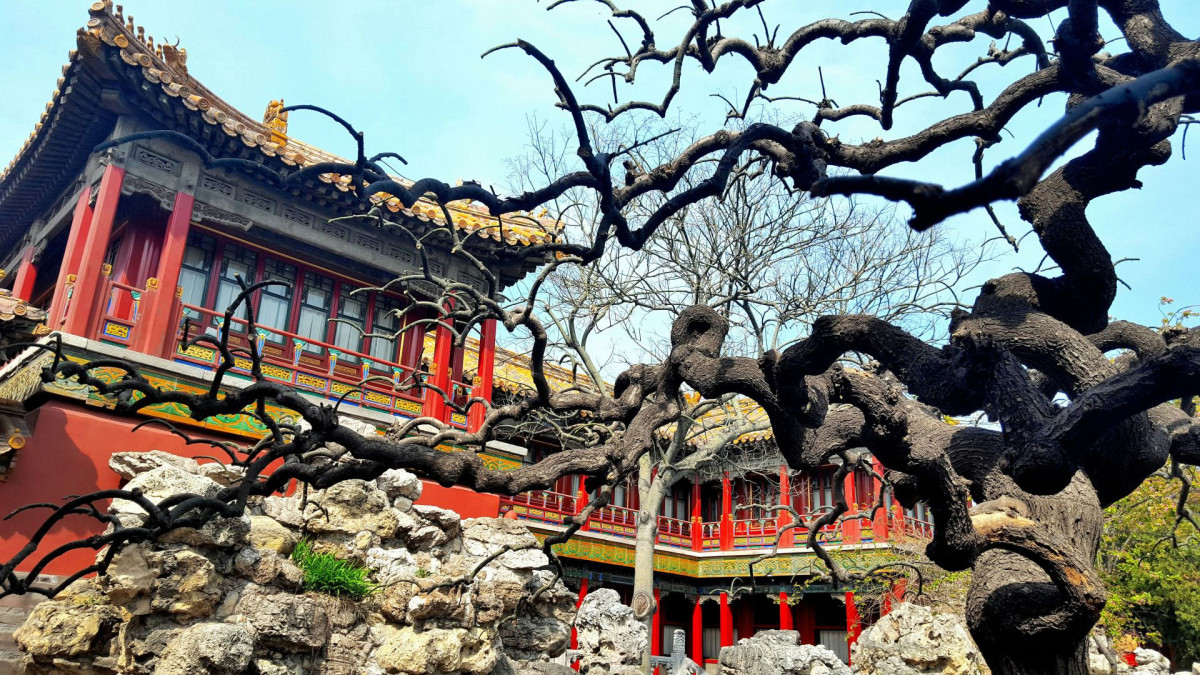
Garden / Plum Branch (Meihua) — In Chinese culture, the garden symbolizes harmony, nature, memory, and loss. It is often associated with seclusion, beauty, and the cyclical nature of time, especially when combined with blossoming plums. The plum blossom (Meihua — 梅花) is an important symbol representing resilience, purity, beauty, longevity, and rebirth. It is also associated with spring, the beginning of the new year, and hope.
Kuomintang (中国国民党 / Zhōngguó Guómíndǎng) — A conservative political party of the Republic of China. It was the sole ruling party of China from 1928 to 1949 but gradually lost control during the struggle against the Japanese Empire in the Second Sino-Japanese War and against the Communist Party of China during the Civil War. In December 1949, the Kuomintang retreated to Taiwan after being defeated by the communists.
Peking University (北京大学 / Běijīng Dàxué) — Peking University played a significant role during the Cultural Revolution. It became one of the first centers of the student movement where the Red Guards were active. Between 1966 and 1976, the university, like other educational institutions, was embroiled in political campaigns and clashes caused by the revolution.
Dazibao (大字报 / Dàzìbào) — Handwritten “big-character posters” used during the Cultural Revolution to publicly denounce “enemies of the people” and propagate Mao Zedong’s ideology. They often contained lists of enemies and slogans calling for the struggle against the “Four Olds.”
Nie Yuanzi (聂元梓) — An assistant lecturer at Peking University who, in May 1966, wrote a dazibao that became one of the first and most famous critical publications of the Cultural Revolution. Her poster, broadcast on the radio, is considered one of the signals for the start of the full-scale Cultural Revolution, calling for a fight against “monsters and demons.” Her own fate is a vivid example of the ruthlessness of that era: after the fall of her patron (Mao’s wife, Jiang Qing) in 1976, she was arrested, convicted, and spent many years in prison.
Red Guards (红卫兵 / Hóngwèibīng) — “Defenders of the revolution” — primarily students and schoolchildren organized into units at the beginning of the Cultural Revolution (1966). Their red armbands became a symbol of the chaos and violence of those years. Inspired by Mao’s calls to “Bombard the Headquarters” (criticize party leadership), they ransacked institutions, humiliated “counter-revolutionaries” and “bourgeois academics,” and burned books and artworks. Their rebellious energy, directed against the “old world,” soon became uncontrollable even for the authorities, leading to bloody clashes between factions and their subsequent disbandment and dispersal to the countryside for “re-education.”
Cultural Revolution (文化大革命 / Wénhuà Dàgémìng) — Officially the “Great Proletarian Cultural Revolution.” A campaign initiated by Mao Zedong in 1966 that lasted until his death in 1976. Formally aimed at fighting “revisionism” and “bourgeois elements” in the party and society, it actually led to large-scale purges, persecution of the intelligentsia, destruction of cultural heritage, and enormous social upheavals.
Peking Opera Costumes and Scenery (京剧 / Jīngjù) — Peking Opera is a traditional form of Chinese theater combining music, singing, dance, and acrobatics. During the Cultural Revolution, it was declared “bourgeois” and “feudal” and subjected to persecution; scenery and costumes were publicly burned as symbols of the struggle against “old culture.”
Agitation Trains, The Great Wall, and Pigsties — In the autumn of 1966, the Ministry of Transport allocated free trains for Red Guards to travel around the country to “exchange experiences.” These trips were part of a large-scale campaign to spread Mao’s ideology. In their fanatical struggle against the “old world,” Red Guards ransacked and burned temples and monasteries, and even demolished part of the Great Wall, using the bricks to build “more necessary” pigsties.
Four Olds (四旧 / Sìjiù) — An ideological concept of the Cultural Revolution calling for the destruction of old ideas, old culture, old customs, and old habits, which were considered obstacles to building a new society. This led to the destruction of cultural treasures, book burnings, and repression against the intelligentsia.
Wuhan and Guilin Incidents — An armed conflict in the Chinese city of Wuhan in July 1967 at the height of the Cultural Revolution between two opposing factions: the “Million Heroes” and the “Wuhan Workers’ General Headquarters” (mainly unskilled workers and Red Guards). After the incident, when the army openly opposed the Red Guards, their weakness became apparent. By the autumn of 1967, Mao himself used the army against the Red Guards. Sometimes the Red Guards resisted. For instance, on August 19, after a long positional war, 30,000 soldiers and peasant militia entered the city of Guilin and, over six days, exterminated almost all the Red Guards in the city.
Zhenbao Dao (珍宝岛) / Damansky Island — A small island on the Ussuri River (Wusuli Jiang), which became the site of an armed border conflict between the USSR and the PRC in March 1969. The clashes, where dozens of young soldiers from both sides died, became the crack that turned the recent “brothers forever” into enemies. The dispute was resolved by the river itself, which changed its course and joined the island to the Chinese bank.
Forbidden City (紫禁城 / Zǐjìnchéng) — The imperial palace in Beijing, the center of power in China from the 15th to the early 20th century, symbolizing the rituals and hierarchy of imperial power, a complex system of ceremonies and traditions regulating court life, including sacrifices, funeral rites, and the hierarchy of concubines.
Goryeo (高丽 / Gāolì) / Kaesong (开城) — The mention of a concubine from Kaesong, the capital of Goryeo (modern Korea), highlights the historical connection between China and neighboring states, as well as the vulnerability of foreigners at court. Yeon-ju is also a reference to the real practice of sending Korean girls to Chinese harems as “tribute.”
Re-education Camps (劳动改造 / Láodòng Gǎizào) — A system of forced labor camps in the PRC (Laogai), where people declared enemies of the people or those in need of “re-education” through labor, including former Red Guards, were sent.
Poetry Notes:
The opening lines of the poem read by Mei Lin and Chen Wang to their students:
A sleep broken by a blast…
Are a variation on lines from the poem “Requiem” by Belarusian poet Vladimir Danilyuk.
The final lines of the poem read by Mei Lin:
And what of those who stepped beyond the brink?..
Are a variation on lines from the poem “Spring Offensive” by English poet Wilfred Owen.