 такое кино
Fordow. Doomsday Clock
23 Khordad 1404 (June 13, 2025)
The night in the city was inky and dense, like the oil we so proudly pump from the depths only to burn it in the furnace of history. Silence hung over the streets not as a peaceful blanket, but as a sword of Damocles suspended by a single horsehair. In this soundlessness, there was a vibration—not acoustic, but ontological, as if the fabric of reality itself, exhausted by the tension of recent years, was preparing to come apart at the seams.
I lay in bed, staring at the ceiling, trying to classify types of insomnia. There is the insomnia of a lover—sweet, sticky, full of dopamine hallucinations. There is the insomnia of a student—caffeinated, hysterical. And there is the insomnia of a citizen of the Islamic Republic of Iran—paranoid, with the taste of metal in your mouth, when you wait not for dawn, but for a sound that will divide your life into “before” and “after.”
The clock on the wall ticked. Tick-tock. Tick-tock. Like those stupid clocks in Palestine Square in Tehran that counted down the time until the destruction of Israel. Who would have thought the timer worked both ways?
The doorbell rang not loudly, but in that cottony silence, it was like a gunshot. Short, demanding, devoid of politeness.
“For Dad,” I thought, pulling on my jeans. In recent months, this had become routine. Riots, arrests, meetings. My father was the night watchman—and the day watchman, too—of the regime in our city. He was leaving to protect us from the chaos he himself helped create.
I went out into the hallway. The light in the living room burned dimly, casting long, broken shadows.
But it wasn’t a courier from the municipality. On the doorstep stood Dr. Hassan Rezai. Mom’s boss. “Cardamom,” as I now know from the dossier. He looked as if his suit had been sewn from the same material as the night outside—dark, light-absorbing. In his hands was a briefcase he clutched as if it held the keys to paradise or the launch codes for hell.
My parents stood opposite him. Mom in a bathrobe, pale as chalk. Dad in trousers and a shirt, wearing the expression of a man who has learned his diagnosis but hasn’t yet decided how to tell his family.
They spoke in whispers, but this whisper was louder than a scream. It was the whisper of conspirators in a library they are about to set on fire.
“Good evening, Nasrin,” Dr. Rezai said, noticing me. His voice was level, mechanical.
“Not asleep?” Mom asked. Her hand nervously fingered the belt of her robe.
“Didn’t have time,” I leaned against the doorframe, trying to look like I didn’t care. “I heard the bell. What happened? Did another IAEA inspection decide to drop by in their pajamas?”
Rezai didn’t smile. It seems humor had died in our house.
“You need to leave,” he said, addressing my parents but looking at me. “Out of the city. Urgently. Somewhere far away.”
“Now?” Mom looked at the clock. “Hassan, what is going on?”
“Zahra,” he pronounced her name as if it were a formula. “Ask Nasrin to wake Zeynab. Have them pack their things. Only the essentials. Documents, money, warm clothes. No gadgets, except the simplest ones.”
Mom nodded at me.
“Nasrin, please. Wake your sister. Quickly.”
I went to Zeynab’s room. My brain, poisoned by years of reading between the lines, was already building the picture. A night visit. Emergency evacuation. This was not a drill. This was the finale.
Zeynab was asleep, clutching her pillow. She’s fourteen, but in her sleep, she looked five. I shook her shoulder.
“Hey, Sleeping Beauty. Up. We’re leaving.”
“What? Where?” She blinked, trying to focus. “Nasrin, are you stupid? I just fell asleep.”
“To the village. Pack. Mom said.”
“Which village?”
“I don’t know.”
“Why?”
“Because the adults decided to play hide-and-seek. And we’re ‘it.’”
While she stuffed random sweaters into a backpack, I went back to the hallway. I needed to hear.
They were standing by the window.
“Do you think it’s serious?” Dad asked. There was no fear in his voice, only the fatigue of a professional who knew the dam would break someday.
“Yes,” Rezai answered. “They aren’t sleeping.”
“Who are ‘they’?” Mom asked. “Israel?”
“They launched an operation. ‘People Like a Lion.’ A poetic name for a slaughter.”
“Is this war?” The word hung in the air, heavy and cold as a chunk of uranium.
“I hope not,” Rezai shook his head. “War implies two sides. This… this is surgery. They want to cut out the tumor.”
“Is the tumor us?” Mom smiled bitterly.
“The tumor is our work, Zahra. Centrifuges. Missiles. Radars. Take the children away. And you can stay with them. It might get… hot at the lab.”
“No,” Mom straightened up. In that moment, she didn’t look like a frightened woman, but like a statue of Themis, only without the blindfold. She saw everything too clearly. “I will take them to Rustam’s mother and come back. Amirkhan definitely won’t be released from work. And I… I must be there. My shift isn’t over yet.”
I returned to the room. Zeynab was already standing with her backpack, looking like a frightened sparrow.
“Nasrin, I’m scared.”
“Me too, kiddo. But that’s normal. Fear is just the body’s reaction to an excess of reality.”
We went out into the living room. Backpacks on our backs. Ready to run. Refugees in our own home.
And then it started.
First—the sound. A low, vibrating hum coming not from the sky, but from underground. A siren. The air raid alarm. It howled like a wounded animal, rising higher and higher, drilling into the brain.
Zeynab flinched and pressed against me. I hugged her shoulders, feeling her tremble. My little sister, who knows the lyrics to every BTS song but doesn’t know what death sounds like. Now she will learn.
Father walked to the window but didn’t open the curtains.
“It has begun,” he said.
He looked at me. His gaze fell on my hand. I was gripping my phone so hard the screen could have cracked.
“Did you call Adil?”
“Yes.”
“Did he answer?”
“No. I texted him.”
Mom came over, stroked my head. Her hand was icy.
“Don’t worry, darling. He’ll be fine. Their house has a basement.”
“Of course,” I thought venomously. “A basement. The best place for a first date with the apocalypse.”
“They won’t strike civilian targets,” Rezai said, checking his watch. “Their goal is infrastructure. The military. Us.”
“What’s the difference?” I asked, looking him straight in the eye. “When bombs fall, they don’t ask for a passport.”
“Smart bombs do,” he replied. “They call it ‘precision-guided munitions.’”
Right. Humanitarianism, caliber 500 pounds, I thought.
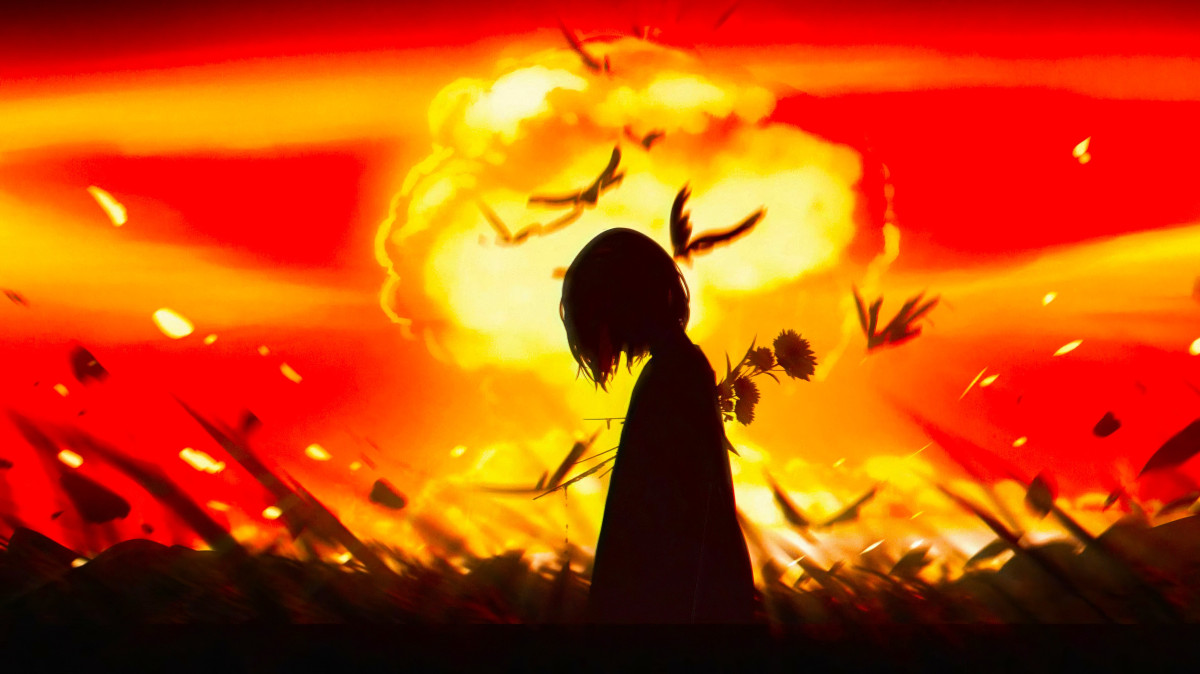
Somewhere in the distance, from the direction of Natanz, the sky lit up with a flash. Soundless. As if someone had switched the sun on and off.
“Time to go,” Dad said. “The car is at the gate.”
We walked out into a night that had ceased to be dark. The sky over Isfahan bloomed with anti-aircraft fire. Tracers drew lines in the sky, trying to cancel the inevitable. It was beautiful and terrifying. Abstract expressionism of war. Kandinsky painting with fire on a black canvas.
We ran. We were rats abandoning the ship we had built ourselves. And I thought: I wonder what they’ll write in the history books—were we victims or accomplices?
Or will there be no more textbooks?